

Fixed Honorarium Below Minimum Wages For Teachers Appointed Under Samagra Shiksha Scheme Amounts To Forced Labour & Violates Article 23: Supreme Court
The Supreme Court held that continuing part-time contractual instructors on stagnant honoraria that fall below minimum wage standards amounts to forced labour prohibited under Article 23 of the Constitution.
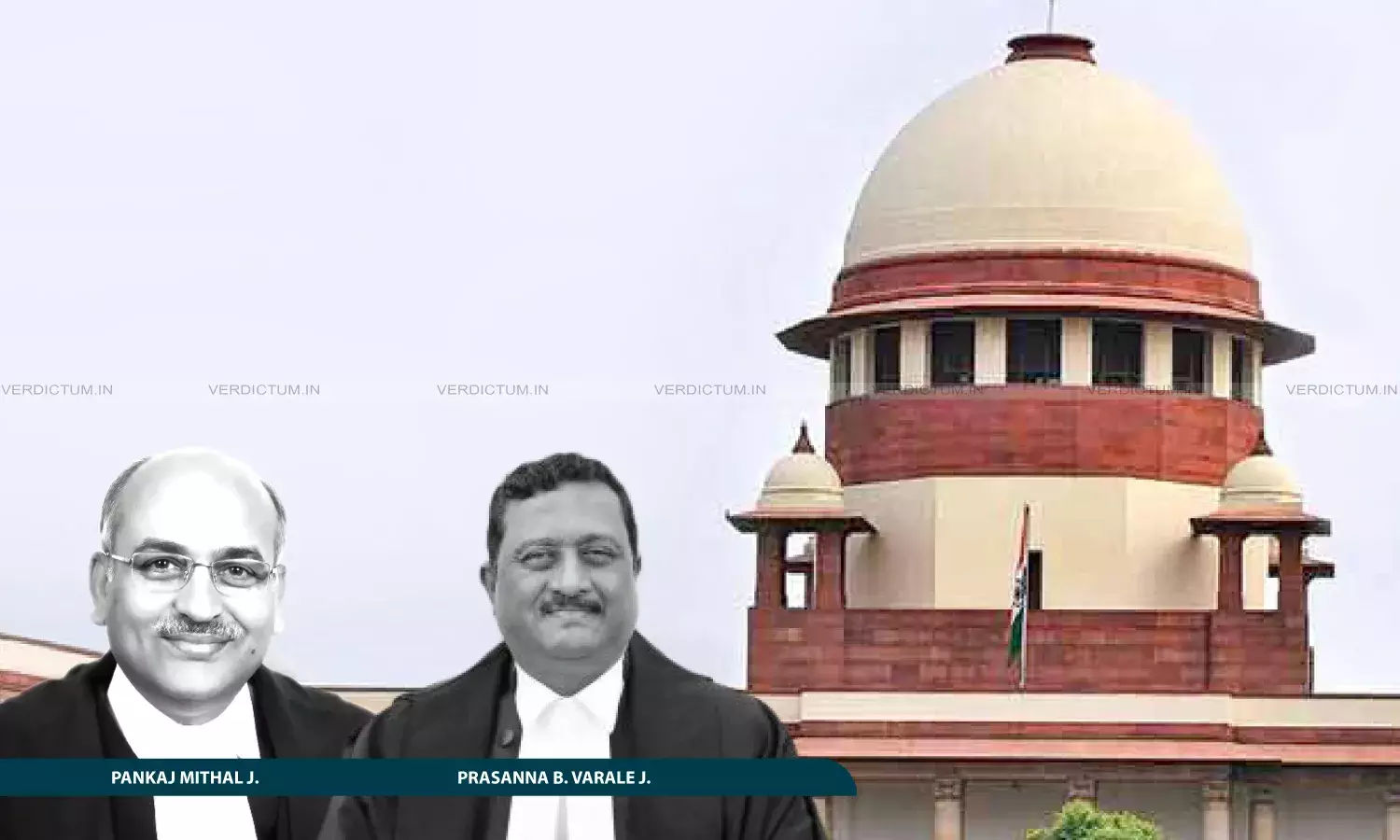
Justice Pankaj Mithal, Justice Prasanna B. Varale, Supreme Court
The Supreme Court held that fixing and maintaining honorarium for Upper Primary School instructors at artificially depressed levels constitutes economic coercion inconsistent with Article 23 of the Constitution.
The Court ruled that honorarium cannot remain stagnant and must be periodically revised, particularly where instructors are effectively prevented from seeking alternate employment and are compelled to continue service at meagre wages.
The Court was hearing a batch of civil appeals arising from disputes concerning honorarium payable to instructors appointed under the Samagra Shiksha Scheme in Uttar Pradesh.
A Bench of Justice Pankaj Mithal and Justice Prasanna B. Varale examined whether instructors appointed on contractual terms could be compelled to work indefinitely on a fixed honorarium without revision and held that “…any unfair practice fixing remuneration of these instructors/teachers permanently as Rs. 7,000/- per month or Rs. Rs. 8,470/- per month for all times is a kind of forced labour amounting to ‘Begar’ which is strictly prohibited under Article 23 of the Constitution”.
Background
The instructors were appointed under the Samagra Shiksha Scheme to strengthen primary education pursuant to the Right of Children to Free and Compulsory Education Act. Appointments were initially contractual for eleven months with a fixed honorarium of ₹7,000 per month and a clause barring engagement in any other employment.
Despite renewal of engagement over several years, honorarium largely remained stagnant, even when proposals for enhancement were approved by the Project Approval Board (PAB). Subsequent administrative actions resulted in inconsistent revisions and, at times, a reduction of honorarium.
Litigation followed, with the High Court partially granting relief. Appeals were then filed by instructors and the State challenging the scope and implementation of the honorarium revision.
Court’s Observation
The Supreme Court, at the outset, rejected the State’s preliminary objection regarding alternative remedies, holding that writ jurisdiction is not barred where issues concern constitutional and statutory rights. It reiterated that the availability of an alternate remedy is a rule of prudence, not compulsion.
The Bench then examined the contractual structure and actual service conditions. It was observed that instructors continued for years without fresh contracts and were prohibited from other employment. Their duties, the Court noted, mirrored those of regular teachers, both in qualification and workload.
The Court held that describing them as “part-time contractual” was misleading. Continuous engagement and the nature of duties indicated de facto full-time status and substantive appointment against posts deemed to exist, the Court observed.
While acknowledging that honorarium fixation is ordinarily a policy matter, the Court held that such a policy cannot operate arbitrarily or reduce instructors to conditions resembling forced labour. Honorarium must be rational, reasonable, and aligned with dignity and economic realities.
Referring to People’s Union for Democratic Rights v. Union of India, the Court reiterated that forced labour includes economic compulsion compelling acceptance of wages below minimum standards. It held that fixing honorarium at ₹7,000 or ₹8,470 for extended periods, combined with a prohibition on alternate employment, amounted to coercion.
The Court concluded that the unilateral reduction of honorarium placed instructors in economic vulnerability, inconsistent with constitutional safeguards. Such action was characterised as a form of “Begar” prohibited under Article 23.
“The State’s action of withdrawing a legitimately enhanced wage and then allowing honorarium to remain artificially depressed would, in substance, be inconsistent with the spirit of Article 23 of the Constitution which prohibits all forms of forced labour, …the State, under the guise of contractual management or financial constraint, cannot compel labours/teachers to such coercive circumstances”, the Court further remarked.
The Court also analysed the Samagra Shiksha framework and held that financial authority rests exclusively with the Project Approval Board. Decisions of the PAB regarding honorarium bind State authorities and cannot be overridden administratively.
Once the honorarium was approved at ₹17,000 per month for 2017–18, the Court held that the subsequent reduction lacked justification, while further emphasising that the honorarium must be periodically revised, at least once every three years.
Interpreting Section 7 of the Act, the Court held that the primary responsibility to pay honorarium lies with the State Government, which may recover the Union’s share later, stressing that instructors cannot be denied payment due to inter-governmental funding disputes.
"In view of the above discussion, one thing is very clear that the honorarium fixed for these instructors/teachers under the contract cannot remain stagnant and is revisable suitably on a periodical basis and that if once revised and increased cannot be reduced for subsequent periods", the Apex Court concluded.
Conclusion
The Supreme Court held that instructors are entitled to periodic revision of honorarium and that maintaining artificially low remuneration amounts to forced labour under Article 23.
The Court directed payment of honorarium at ₹17,000 per month from the relevant period and mandated periodic revision by the competent authority. Appeals by the instructors were allowed, while those by the State were dismissed.
Cause Title: U.P. Junior High School Council Instructor Welfare Association v. State of Uttar Pradesh & Ors.
Appearances
Petitioners: Senior Advocate P.S. Patwalia, with Advocates R.K. Singh, Neeraj Singh, Tom Joseph, AOR, Kumar Gaurav and Others
Respondents: Aishwarya Bhati, A.S.G., Advocates R.K.Singh, Neeraj Singh, Kumar Gaurav, Richa Tripathi, Aman Rastogi, Sanjay Rastogi, AOR and Others
