

Right To Receive Disability Pension Is A Valuable Right; Benefit Has To Be Given From The Date It Became Due: Supreme Court Grants Relief To Ex-Servicemen
The disability pension is not a matter of largesse, but a recognition of sacrifice made in service of the nation

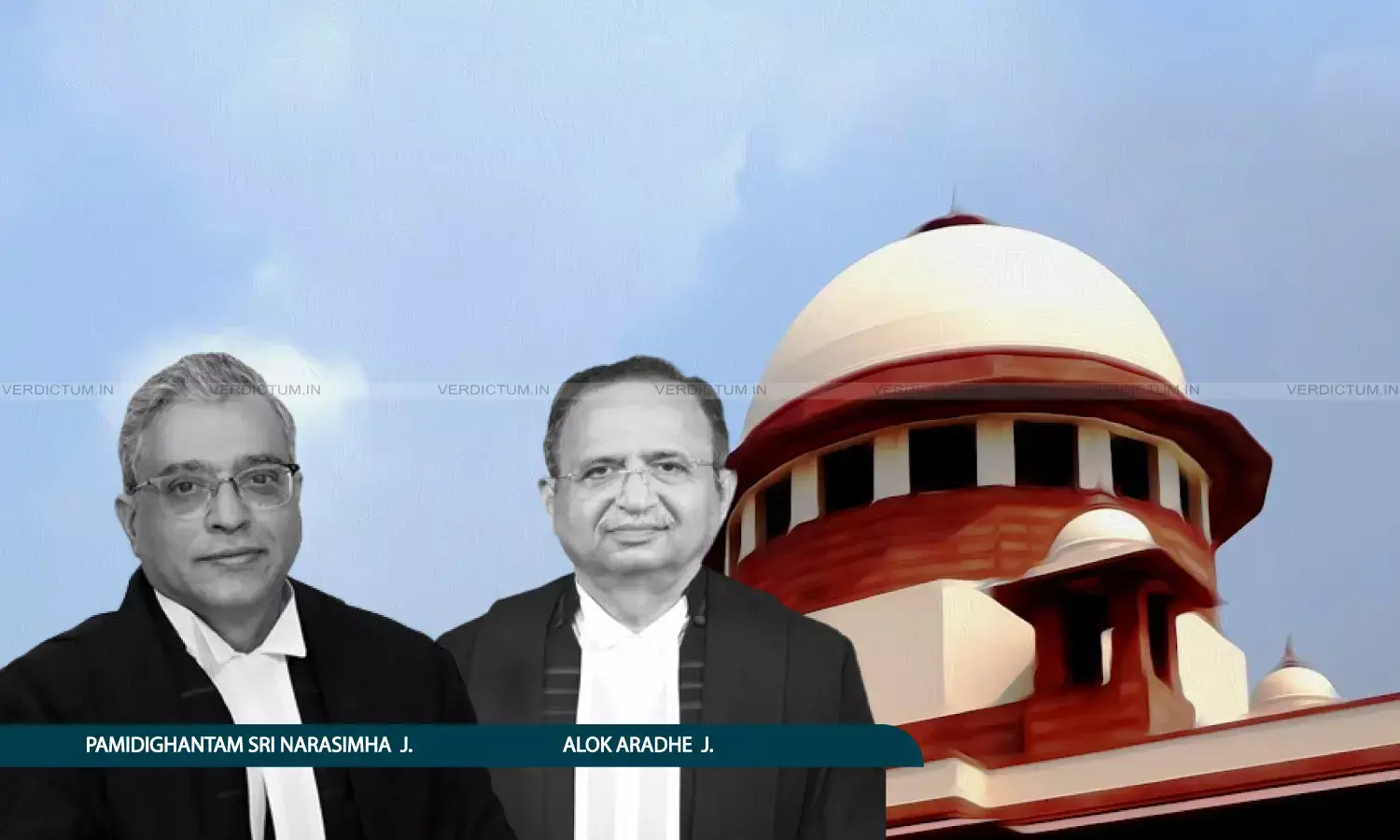
Justice Pamidighantam Sri Narasimha and Justice Alok Aradhe, Supreme Court
The Supreme Court in a significant judgment concerning disability pension jurisprudence, has held that arrears arising from grant of broad banding of disability pension cannot be restricted to three years prior to filing of applications before the Armed Forces Tribunal (AFT). The Court ruled that such arrears constitute vested property protected under Article 300A of the Constitution of India, and cannot be curtailed by invoking limitation, delay or laches.
Furthermore, the Court while relying on settled principles, emphasised that pension is not a bounty but a vested right. Disability pension is a recognition of service-related impairment and sacrifice, and once found due, cannot be diluted by technical pleas, the court also noted.
A bench of Justice Pamidighantam Sri Narasimha and Justice Alok Aradhe observed, “This Court has, in a consistent line of decisions, recognised that right to receive disability pension is a valuable right and once found due, the benefit of the same has to be given from the date it became due. The same cannot be curtailed by restricting the benefit to a period of three years preceding the filing of the original application. In the absence of any compelling reason to take a different view, we find no justification to depart from the view consistently taken by this Court”.
“…Pensionary entitlements, therefore, partake the character of property, and cannot be withheld, reduced, or extinguished except by authority of law. This principle applies with full vigour to disability pension, which is grounded not merely in length of service, but in the impairment suffered by a member of the Armed Forces in the course of, or attributable to, the service rendered to the nation. The disability pension is not a matter of largesse, but a recognition of sacrifice made in service of the nation”, the bench further observed.
R. Venkataramani, Attorney General for India, Archana Pathak Dave, ASG, Senior Advocate Dr. Harshvir Pratap Sharma appeared for the appellant and Advocate Vijay Kumar Padwal appeared for the respondent.
In the matter, the central issue before the Court was whether, after the three-Judge Bench decision in Union of India v. Ram Avtar 2014 SCC Online SC 1761, which extended the benefit of broad banding to Armed Forces personnel retiring on completion of tenure with disability attributable to or aggravated by service, the Union of India could confine arrears to three years prior to filing of original applications by relying upon the Limitation Act, 1963 or Section 22 of the Armed Forces Tribunal Act, 2007.
The Court answering the issue in the negative, observed that the legal position attained finality only on 10-12-2014 with the pronouncement in Ram Avtar, which it characterised as a judgment in rem. Therefore, the right of ex-servicemen to seek re-computation crystallised only thereafter.
Considering the statutory framework, the Bench referred to the Pension Regulations for the Army, 1961, the Pension Regulations for the Army, 2008, and the Government of India instructions dated 31-01-2001 that introduced broad banding of disability element (reckoning disabilities below 50% as 50%, between 50–75% as 75%, and between 75–100% as 100%).
Although these benefits were initially confined to personnel “invalided out”, the Supreme Court in Ram Avtar held that the benefit of broad banding also applies to those who superannuate with disability attributable to or aggravated by military service.
Rejecting the Union of India’s reliance on the Limitation Act and Section 22(1)(c) of the AFT Act, the Court held that the present cases involved re-computation of an already sanctioned disability pension, and not stale or belated claims.
The Bench further noted that the Union of India itself had taken a conscious policy decision, reflected in communications dated 15-09-2014 and 18-04-2016, to grant arrears from 01-01-1996 or 01-01-2006, as applicable. Having acknowledged entitlement in principle, the State could not subsequently confine arrears to a three-year window.
“The Union of India, as a model employer, is expected to act with fairness, consistency and even-handedness in the administration of benefits conferred upon those who have served the nation. When a benefit is recognised by a policy and affirmed by judicial pronouncement, its application cannot be selective or uneven…”, it thus noted in the judgment.
Therefore, the Court dismissed the batch of appeals filed by the Union of India under Section 30 of the Armed Forces Tribunal Act, 2007, and allowed appeals filed by ex-servicemen where arrears had been restricted by the Tribunal.
Cause Title: Union Of India Through Its Secretary & Ors. v. SGT Girish Kumar And Ors. Etc. [Neutral Citation: 2026 INSC 149]
Appearances:
Appellant: R. Venkataramani, Attorney General for India, Archana Pathak Dave, ASG, Mukesh Kumar Maroria, AOR, Chitvan Singhal, Abhishek Kumar Pandey, Raman Yadav, Kartikay Aggarwal, Ameyavikrama Thanvi, Jagdish Chandra, Madhav Sinhal, Naresh Kumar, AOR, Simarpal Singh Sawhney, Siddhant Juyal, Prateek K. Chadha, AOR, Rakesh Dahiya, AOR, J.P. Sharma, Aditya Dahiya, R.N. Mahlawat, Anuj Rathee, Pankaj Kumar, AOR, Dr. Harshvir Pratap Sharma, Senior Advocate, Tejas Patel, AOR, Akul Krishnan, A.K. Srivastava, Aayush Aman, Sakshi Apurva, Petitioner-in-person, A. Radhakrishnan, AOR, Sujeet Ranjan, Vaishnavi, Shiv Kumar, Advocates.
Respondents: Caveator-in-person, AOR, Arvind Kumar Tewari, AOR, Vijay Kumar Padwal, Rahul Burman, Jaspal Singh, Namrah Nasir, Shivansh Bharatkumar Pandya, AOR, Dhruv Jaiswal, Aldanish Rein, AOR, N. Visakamurthy, AOR, Harshvir Pratap Sharma, Tejas Patel, AOR, Aditya Kumar Singh, Akul Krishnan, A. K. Srivastava, Abhijeet Sharma, Praveen, Ganesh Chand Sharma, Dhananjay Singh, K. R. Faridi, Udhav Shanker Maurya, Sudhakar Singh Maurya, J. S. Rawat, Ajit Kakkar, Alpana Yadav, Tejas B., Arvind A., Santosh Kumar Pandey, Himanshu Gupta, Manoj C. Mishra, AOR, Dharam Pal Choudhary, Indra Sen Singh, Abhishek Singh, Rakesh Kumar Singh, AOR, Amrendra Kumar Singh, Harshita Gupta, Os Punia, Ashish Punia, Mihira Parashar, Manish Kumar Singh, Bipin Bihari, Tatsat Shukla, Raj Kumar, Dipti Rai, Nishanth Patil, AOR, G. Sivabalamurugan, AOR, Selvaraj Mahendran, Hari Krishnan P. V., Dhass Prathap Singh V. M., Heena, Ratna Priya Pradhan, V. Elanchezhiyan, AOR, Pardeep Gupta, Parinav Gupta, Mansi Gupta, Rakshit Rathi, Shadab Khan, Vipin Gupta, AOR, Krishna Kumar, Nandani Gupta, Balraj Rathee, Dinesh Verma, Goldy Goyal, AOR, Anuj Kapoor, AOR, Sudhanshu S. Pandey, Gaichangpou Gangmei, AOR, Roshan Kumar, Maitreya Mahaley, Yimyanger Longkumer, J. Prasad, Kamei Bestman Kabui, Mukesh Kumar Maroria, AOR, Jagrati Singh, AOR, Anjani Aiyagari, AOR, G. Jayendra Balaji, Jayanta Kumar Biswas, K. Sriram, Advocates.