

May Adversely Impact Operational Efficacy: Supreme Court Upholds Dismissal Of CISF Constable For His Second Marriage During Subsistence Of First Marriage
The Supreme Court was considering an appeal filed by the Union of India.

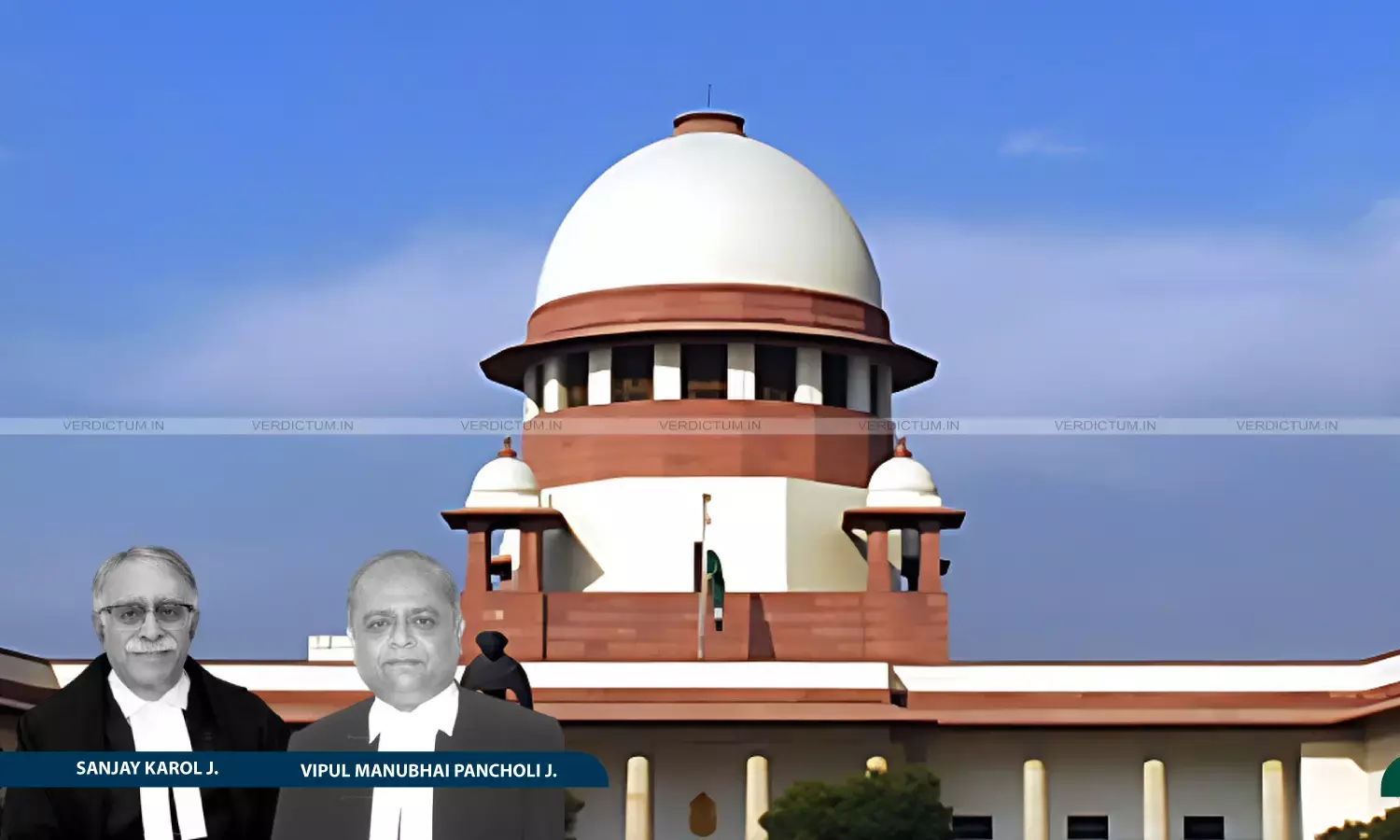
While observing that the possibility of domestic discord, financial vulnerability or divided responsibilities has the potential to adversely impact operational efficacy, the Supreme Court has restored the order of the disciplinary authority dismissing a CISF Constable for contracting a second marriage during the subsistence of the first one.
The Apex Court was considering an appeal filed by the Union of India.
Referring to the CISF Rules, 2001, the Division Bench of Justice Sanjay Karol and Justice Vipul M. Pancholi noted, “It is important to observe that such Rules are premised on an institutional requirement for all members of the force(s) to maintain the highest standards of discipline, public confidence and integrity. It is generally understood that acts, whether in personal or professional life, if they involve the possibility of domestic discord, financial vulnerability or divided responsibilities, they have the potential to adversely impact operational efficacy given mental/psychological stability is key. It is also to be noted that these rules are not a moral censure, but simply a service condition, which, it need not be stated, an employer is perfectly within their rights to prescribe, so long as such conditions are not arbitrary, disproportionate or violative of constitutional protections, which in any event stand taken before us.”
Factual Background
The Respondent was employed with the Central Industrial Security Force as a Constable on July 22, 2006. He had been dismissed from service in terms of an order dated July 1, 2017, passed by the Senior Commandant, CISF, consequent to disciplinary proceedings drawn against him, for marrying once more in the subsistence of his first marriage. The dismissal was confirmed by the Appellate and Revisional Authorities. The Single Judge and the Division Bench were of the view that dismissal from service was a harsh penalty, and the Courts directed the Disciplinary Authority to pass orders imposing a lesser penalty on him. Aggrieved thereby, the Appellant- Union of India approached the Apex Court.
Reasoning
The Bench reaffirmed that under Article 226 jurisdiction, the court is not akin to an appellate Court and its powers are limited to the extent of judicial review. They cannot set aside punishment or impose a different punishment unless they find that there is substantial non-compliance with the rules.
The Bench explained that clause 18-B is a close prescribing penal consequences for an action and it is trite in law that any provision of law or rule framed under a statute prescribing penal consequences, has to be strictly construed for the conditions that can trigger such a clause must flow from the words employed therein.
“It is also settled that when such a rule presents any ambiguity, the interpretation which favours the person sought to be penalised, is to be preferred. In the instant case, it cannot be said that there is any ambiguity. The words of the clause are clear. There is no averment as to the proper procedure not been followed in the disciplinary proceedings. The maxim “dura lex sed lex” which means “the law is hard, but it is the law” is attracted in this case. Inconvenience or unpleasant consequences of violation of law cannot detract from the prescription of the law", it added.
Allowing the appeal, the Bench restored the findings of the disciplinary authority, as confirmed by the Appellate and Revisional authorities.
Cause Title: Union of India v. Pranab Kumar Nath (Neutral Citation: 2025 INSC 1479)