

Supreme Court: Reserved Category Candidates Availing Any Relaxation At Any Stage Of Exam Aren’t Eligible To Be Adjusted Against Unreserved Vacancies
The Supreme Court clarified that a reserved category candidate cannot subsequently claim to have been selected on "General Standard" merely because his performance in the subsequent stages surpassed the general standard.
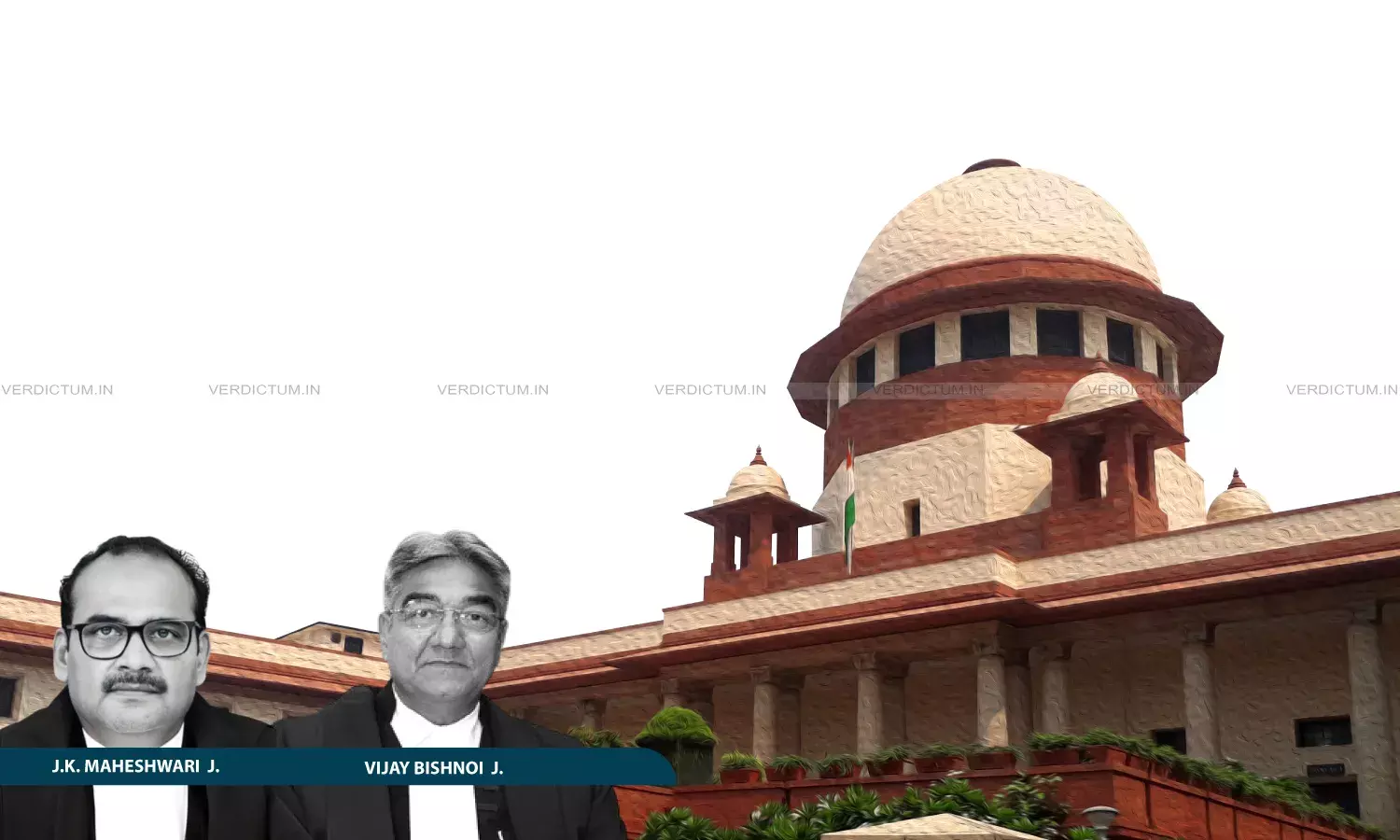
Justice J K Maheshwari, Justice Vijay Bishnoi, Supreme Court
The Supreme Court held that the reserved category candidates who have availed of any relaxation or concession at any stage of the examination are not eligible to be adjusted against unreserved vacancies.
The Court held thus in Civil Appeals challenging the Judgment of the Karnataka High Court passed in a Writ Petition.
The two-Judge Bench of Justice J.K. Maheshwari and Justice Vijay Bishnoi observed, “… if the candidates belonging to the reserved category score better than a general merit candidate in the tier two examination, such candidate cannot be denied cadre allocation in open category insider cadre vacancy. … those reserved category candidates who have availed of any relaxation or concession at ‘any stage of the examination’ are not eligible to be adjusted against unreserved vacancies.”
The Bench clarified that a reserved category candidate cannot subsequently claim to have been selected on "General Standard" merely because his performance in the subsequent stages surpassed the general standard.
Additional Solicitor General of India (ASGI) K.M. Nataraj and AOR Vardhman Kaushik appeared on behalf of the Appellant, while Senior Advocates Jayanth Muth Raj and Nikhil Goel appeared on behalf of the Respondents.
Case Background
The dispute in this case was regarding the claim of a reserved category candidate i.e., Respondent who availed relaxation in the Preliminary Examination but was placed higher in merit than the unreserved candidate in the final merit list based on total marks awarded in Main Examination (Written) and Personality Test, to be treated as a General merit candidate for the purpose of cadre allocation against a General Insider vacancy for State of Karnataka in the Indian Forest Service (IFS). Being aggrieved by the notification issued by the Ministry of Environment, Forests and Climate Change (MoEFCC) allocating Tamil Nadu Cadre to Respondent instead of Karnataka, the Respondent preferred an Original Application (OA) before the Central Administrative Tribunal (CAT).
The CAT vide Order allowed the OA and held that a meritorious Scheduled Caste (SC) candidate cannot be denied allocation against a General vacancy solely on the ground of availing relaxation in the SC cut-off marks at the stage of Preliminary Examination. It directed to allocate the General Insider vacancy in the State of Karnataka to Respondent. Being aggrieved by such Order, a Writ Petition was filed by the unreserved candidate. Another Writ Petition was filed by the Union of India-Appellant. The same was dismissed and the CAT’s Order was affirmed. Challenging this, the Appellant approached the Apex Court.
Reasoning
The Supreme Court in view of the facts and circumstances of the case, said, “The consequence of availing the ‘Relaxed Standard’ is stipulated in the proviso to Rule 14(ii), whereby it is clear that if a candidate has found place in the merit list without availing ‘Relaxed Standards’ i.e., without resorting to ‘any’ ‘relaxations’ or ‘concessions’ in eligibility or selection criteria ‘at any stage of examination’, they shall not be adjusted against the vacancies reserved for SC, ST and OBC.”
The Court noted that any relaxation or concession in eligibility or in selection criteria, if taken at any stage of examination by such candidate of SC, ST and OBC, they may not get any benefit to claim the vacancy of unreserved category, in particular, in the context of Rule 17(1) of the Exam Rules, 2013 seeking allocation of General Insider vacancy in home State cadre as it would be contrary to paragraph 9 of the Policy.
“… it is clear that the relaxations in TET marks were not considered to be a concession. … if a candidate who has resorted a relaxation at any stage of examination, would not fall within the purview of the proviso to Rule 14(ii) of the Exam Rules, 2013 and in that situation, for the purpose of the applicable Policy for cadre allocation, he would not fall within the list of candidates selected on ‘General Standard’ claiming General Insider vacancy of home state cadre as insider candidate”, it added.
The Court further observed that the ‘General Insider’ vacancy in Karnataka was rightfully allocated to the unreserved candidate who qualified the Preliminary Examination, Main Examination, and Interview on general standard.
“It is needless to say, Respondent No. 1, having qualified the Preliminary Examination availing ‘relaxed standard’, becoming eligible for the Main Examination must be considered against the reserved vacancies only and cannot be considered on general/unreserved vacancies for the purpose of cadre allocation”, it also remarked.
Conclusion
The Court was of the view that the High Court while affirming the Judgment of the Tribunal has glossed over Rule 1, intent of Rule 13 and intent of proviso to Rule 13 as well as the real meaning of Rule 14 and proviso thereto along with paragraph 9 of Policy and therefore, the Judgments of the Tribunal and the High Court deserve to be set aside
“… we hold that the Tribunal and the High Court were not correct in interpreting the relevant provisions of Exam Rules, 2013 and Paragraph 9 of the Policy and committed mistake in granting the relief to Respondent No. 1. We hold that Respondent No. 1, having availed the benefit of “Relaxed Standard” in the Preliminary Examination, cannot be treated as a candidate selected on "General Standard". Consequently, he is not entitled to be allocated against the "General Insider" vacancy in the Karnataka Cadre in place of Respondent No.3”, it concluded.
Accordingly, the Apex Court allowed the Appeals, set aside the impugned Judgment, and upheld the notification.
Cause Title- Union of India v. G. Kiran & Ors. (Neutral Citation: 2026 INSC 15)
