

Supreme Court Grants Relief To Ultratech Cement; Holds Construction Equipment Vehicles Used Within Closed Premises Not Liable To Road Tax
The Apex Court held that construction equipment vehicles used exclusively within industrial or enclosed premises are off-road vehicles, excluded from the definition of “motor vehicle” under the Motor Vehicles Act, 1988, and are therefore not eligible to road tax under the Gujarat Motor Vehicles Tax Act, 1958, unless found to be used on public roads.
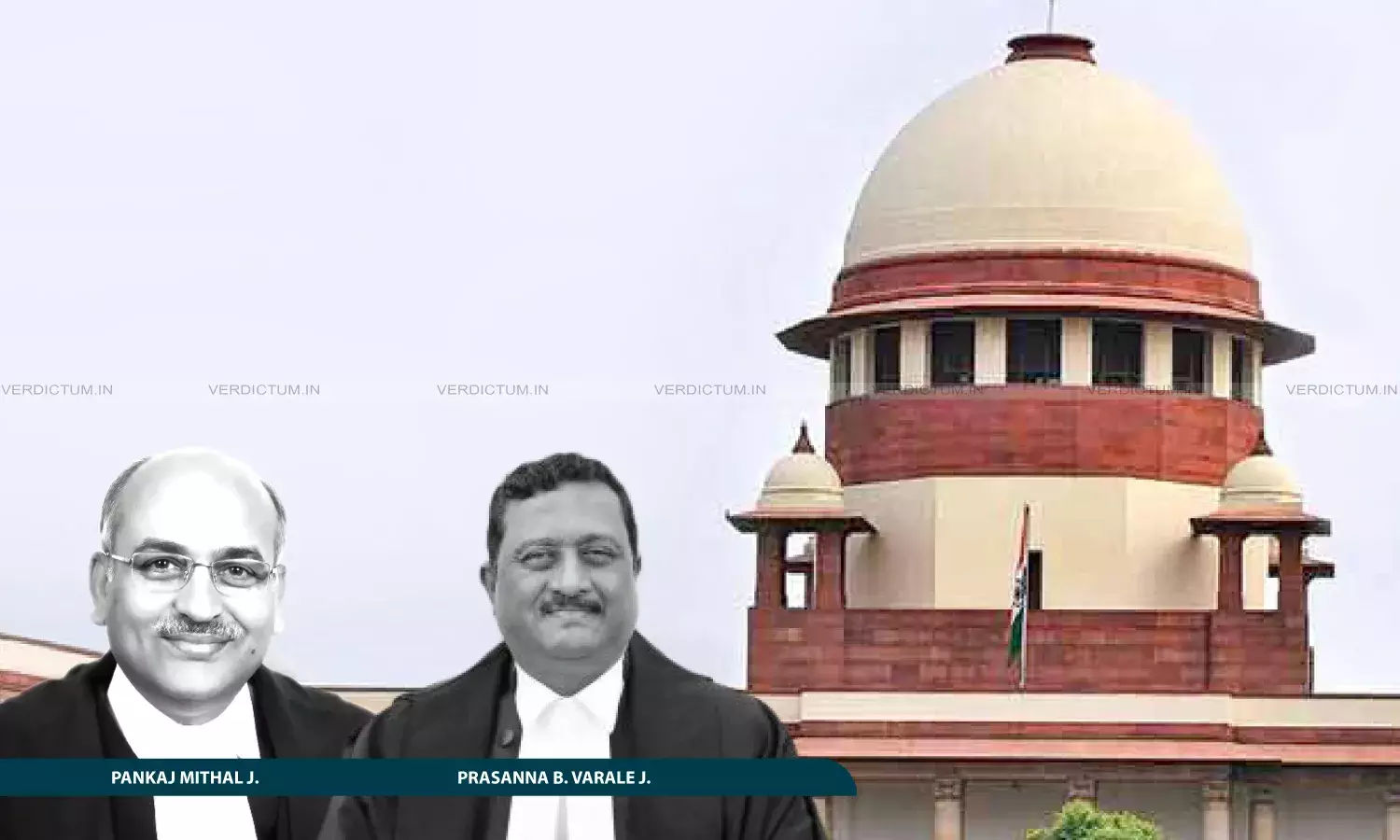
Justice Pankaj Mithal, Justice Prasanna B. Varale, Supreme Court
The Supreme Court held that construction equipment vehicles such as dumpers, loaders, excavators, surface miners, dozers, drills and rock breakers, when used exclusively within factory premises or defined enclosed areas, are vehicles of a special type not meant for use on public roads and are consequently not liable to road tax.
The Court was hearing a batch of civil appeals filed by Ultratech Cement Limited challenging judgments of the Gujarat High Court, which had upheld demands raised by the State authorities for registration of such vehicles as “motor vehicles” and levy of road tax under the Gujarat Motor Vehicles Tax Act, 1958.
A Bench comprising Justice Pankaj Mithal and Justice Prasanna B. Varale observed that “vehicles of the kind used by the appellants are construction equipment vehicles meant for off-road use within industrial or enclosed premises and stand excluded from the definition of “motor vehicle” under Section 2(28) of the Motor Vehicles Act, 1988, as well as from taxation under Entry 57 of List II of the Seventh Schedule to the Constitution”.
The appellants were represented by Senior Advocates P. Chidambaram and Nakul Dewan, while the respondents were represented by Senior Advocate K. Parameshwar.
Background
Ultratech Cement Limited operates cement manufacturing plants in Gujarat and, in connection with its mining and industrial operations, uses various heavy earth-moving and construction equipment vehicles. These vehicles were transported to the factory premises in dismantled form on trailers and were confined for use within enclosed industrial areas, without plying on public roads.
Initially, the Regional Transport Officer had acknowledged that such vehicles did not require registration under the Motor Vehicles Act, 1988. Subsequently, however, the Transport Commissioner issued directions requiring registration of special service vehicles and payment of road tax under the Gujarat Motor Vehicles Tax Act, 1958. Show cause notices were later issued demanding registration fees, tax, interest and penalty, leading the appellants to deposit substantial sums under protest.
The appellants approached the Gujarat High Court seeking the quashing of the demands and refund of the amounts paid. The High Court dismissed the petitions, holding that the vehicles fell within the definition of “motor vehicle” and were liable to tax. Aggrieved, the appellants approached the Supreme Court.
Court’s Observation
The Supreme Court examined the scope of Entry 57 of List II of the Seventh Schedule to the Constitution, which authorises taxation only of vehicles suitable for use on roads, read with Article 265 of the Constitution, which mandates that no tax can be levied or collected except by authority of law.
The Court noted that while Section 3 of the Gujarat Motor Vehicles Tax Act, 1958, provides for the levy of tax on all motor vehicles used or kept for use in the State, the charging provision cannot travel beyond the constitutional limitation under Entry 57. Consequently, vehicles not suitable for use on roads cannot be subjected to tax.
Turning to the definition of “motor vehicle” under Section 2(28) of the Motor Vehicles Act, 1988, the Court observed that while the definition is inclusive in its first part, it expressly excludes vehicles of a special type adapted for use only in a factory or in any other enclosed premises. The vehicles used by the appellants, the Court found, clearly fell within this exclusion.
The Bench placed reliance on uncontroverted certificates issued by manufacturers and expert bodies, including the Automotive Research Association of India, which established that the vehicles in question were designed for off-road industrial use and were not issued road-worthiness certificates. It was also noted that the vehicles were not driven on roads, even for transportation and were carried on trailers.
The Court further examined Schedule I to the Gujarat Motor Vehicles Tax Act, 1958, and noted that although construction equipment vehicles were referred to, no rate of tax was prescribed for such vehicles. This, according to the Court, reinforced the conclusion that the statute itself did not contemplate the levy of road tax on such equipment.
Relying on earlier precedent, including Bolani Ores Ltd. v. State of Orissa, the Court reiterated that the expression “adapted for use upon roads” must be understood as “suitable for use on roads” and that vehicles not actually used on public roads cannot be subjected to road tax. The Court distinguished contrary decisions relied upon by the State, holding that they did not consider the specific exclusion contained in Section 2(28) of the Motor Vehicles Act, 1988.
The Bench clarified, however, that if any such construction equipment vehicles are found to be used on public roads, they would attract the rigours of Section 2(28) of the Motor Vehicles Act, 1988 and Section 3 of the Gujarat Motor Vehicles Tax Act, 1958, and could be subjected to seizure and penalty in accordance with law.
Conclusion
The Supreme Court held that the construction equipment vehicles used by Ultratech Cement Limited within factory premises or enclosed industrial areas are off-road vehicles excluded from the definition of “motor vehicle” and are not liable to road tax. Accordingly, the Court set aside the judgments of the Gujarat High Court and allowed the appeals.
Cause Title: Ultratech Cement Limited v. The State of Gujarat And Others (Neutral Citation: 2026 INSC 43)
Appearances
Appellant: Senior Advocates P. Chidambaram and Nakul Dewan with Advocates Mahesh Agarwal, Ankur Saigal, Rohan Talwar, Himanshu Saraswat, Uday Aditya Jetley Pocha, Naman Agarwal, Adya Joshi, Satyender Saharan, Rohan Andrew Naik, Ishika Garg, Sathvik Chandrashekar and E. C. Agrawala AOR
Respondents: Senior Advocate K. Parameshwar with Advocates Prasad Hegde, Veda Singh, Priyal Sheth and Deepanwita Priyanka AOR
