

Voluntary Retirement Notice Effective By Operation Of Law If Not Refused Within Stipulated Period: Supreme Court
Subsequent disciplinary action and dismissal held legally untenable following automatic severance of master-servant relationship.

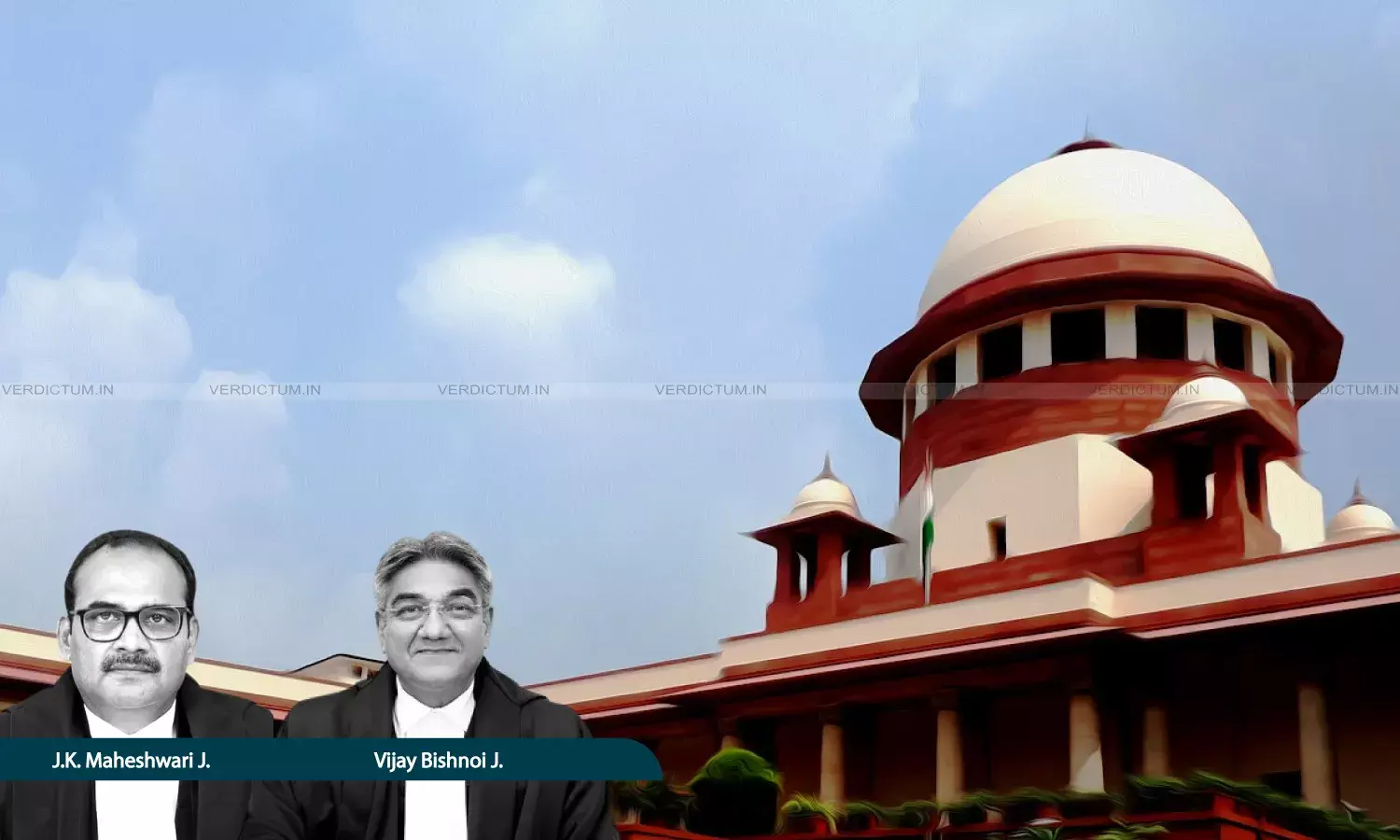
Justice J.K. Maheshwari, Justice Vijay Bishnoi, Supreme Court
The Supreme Court has affirmed that a notice for voluntary retirement becomes effective by operation of law upon the expiry of the notice period unless the appointing authority expressly refuses permission within that timeframe. On the legal fiction of "deemed acceptance", the Court held that once an employee's service is legally severed, subsequent administrative actions, including the issuance of a chargesheet or an order of dismissal, lack legal sanctity.
The Court clarified that a mere show-cause notice does not constitute the institution of disciplinary proceedings sufficient to stall the automatic effectiveness of a voluntary retirement request. The Bench further noted that internal administrative delays or contemplated proceedings cannot retrospectively undo the statutory effect of a completed notice period.
Justice J.K. Maheshwari and Justice Vijay Bishnoi noting the show cause notice issued by the UCO Bank on November 11, 2010, observed, “…it would not indicate the intention to institute disciplinary proceedings in terms of Regulation 20(3)(ii) of the Service Regulation. Nonetheless, the existence of such a show cause notice itself is not sufficient without refusal by competent authority to stop the automatic operation of the notice of voluntary retirement. In absence, the notice of voluntary retirement would take its course...”.
Brijesh Kumar Tamber, AOR appeared for the appellant and respondent appeared-in-person, Senior Advocate Gaurav Agrawal appeared as Amicus Curiae.
For the facts, the Respondent, SK Shrivastava, joined UCO Bank in 1983 and was serving as a Manager when suspicious transactions involving certain accounts surfaced in July 2010. On October 4, 2010, the Respondent submitted a notice for voluntary retirement.
While the Bank issued a show-cause notice on November 11, 2010, and internal communications suggested his retirement request was not being considered, no formal refusal was communicated to the Respondent before the three-month notice period expired.
Consequently, the Respondent stopped attending service from May 16, 2011. Nearly eight months later, on March 5, 2012, the Bank issued a chargesheet and subsequently dismissed him from service.
The Respondent challenged the non-acceptance of his retirement and the subsequent dismissal before the High Court of Chhattisgarh. A Single Judge Bench held that the Respondent stood voluntarily retired after the notice period, rendering the post-retirement disciplinary proceedings invalid.
This view was reaffirmed by a Division Bench of the High Court, which noted that the Bank failed to exercise its option of refusal within the stipulated period. The Bank then moved the Supreme Court in appeal.
The Court, thus, focused on Regulation 29 of the UCO Bank (Employees') Pension Regulations, 1995, which stipulates that voluntary retirement becomes effective if the appointing authority does not refuse permission before the notice period expires.
The Bench observed that for a refusal to be valid, it must be a "positive action" communicated to the employee within the timeframe. Relying on precedents like Dinesh Chandra Sangma v. State of Assam & Ors. (1977) 4 SCC 441 and B.J. Shelat v. State of Gujarat and Ors. (1978) 2 SCC 202, the Court clarified that a show-cause notice is merely a preliminary inquiry and does not amount to the "institution" of disciplinary proceedings required to withhold retirement benefits.
“…In our view, it is correct to hold that when an employee decides to severe master servant relationship and serves a notice indicating such intention specifying the period, by operation of law it will become effective in absence of any order of refusal. The subsequent act of issuing chargesheet and consequential order of dismissal is also not justified in law…”, the Bench noted.
“In the present case, no such order of refusal or order of withholding was passed by the competent authority within the stipulated period. The notice of voluntary retirement, therefore, became effective automatically by efflux of time upon the expiry of the three-month period on 04.01.2011. This Court, accordingly, finds no infirmity in the view taken by the High Court, which is liable to be upheld”, the Bench further noted.
Accordingly, the Court dismissed the appeals filed by UCO Bank, finding no infirmity in the High Court’s judgment. It declared that the Respondent’s retirement became effective by operation of law and the subsequent dismissal was unjustified. The Bank is directed to settle all post-retiral dues and consequential benefits within three months, along with applicable interest.
Cause Title: UCO Bank & Ors. v. SK Shrivastava [Neutral Citation: 2026 INSC 328]
Appearances:
Appellant: Brijesh Kumar Tamber, AOR, Senior Advocate Gaurav Agrawal appeared as amicus.
Respondent: Respondent-in-person.