

Police & Criminal Courts Must Be Circumspect In Filing Chargesheet & Framing Charges In Cases Where There Is Pending Civil Dispute: Supreme Court
The Supreme Court was considering an appeal filed against the judgment passed by the Calcutta High Court, whereby the revision petition filed by the Appellant-accused against the order dismissing the discharge application was dismissed.

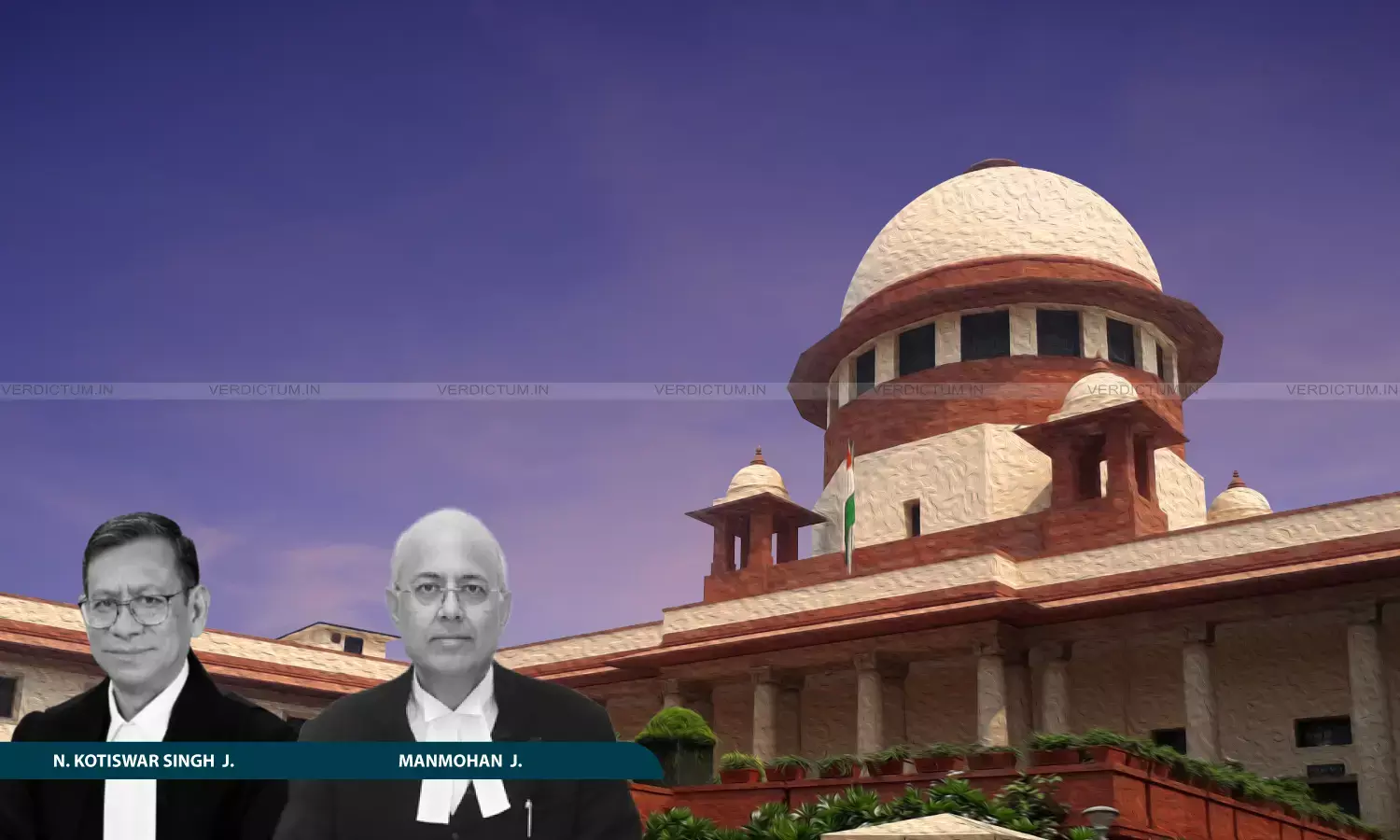
Justice Nongmeikapam Kotiswar Singh, Justice Manmohan, Supreme Court
The Supreme Court has discharged an accused in a criminal case involving a landlord-tenant dispute after noting that there was a pending civil case with regard to the property, as well as a prior subsisting injunction order. The Apex Court further held that the Police and the Criminal Courts must be circumspect in filing a chargesheet and framing charges and they must act as initial filters ensuring that only cases with a strong suspicion should proceed to the formal trial stage.
The Apex Court was considering an appeal filed against the judgment passed by the Calcutta High Court, whereby the revision petition filed by the Appellant-accused against the order dismissing the discharge application filed by the Appellant was dismissed.
The Division Bench of Justice Nongmeikapam Kotiswar Singh and Justice Manmohan observed, “The tendency of filing chargesheets in matters where no strong suspicion is made out clogs the judicial system. It forces Judges, court staff, and prosecutors to spend time on trials that are likely to result in an acquittal. This diverts limited judicial resources from handling stronger, more serious cases, contributing to massive case backlogs. Undoubtedly, there can be no analysis at the charge framing stage as to whether the case would end in conviction or acquittal, but the fundamental principle is that the State should not prosecute citizens without a reasonable prospect of conviction, as it compromises the right to a fair process.”
Advocate Somnath Ghoshal represented the Appellant, while Advocate Prashant Alai represented the Respondent.
Factual Background
The complainant, an alleged tenant of one of the co-owners, filed a complaint/FIR under Sections 341, 354C, and 506 of the Indian Penal Code (IPC). The complainant alleged that on March 18, 2020, when the complainant, along with her friend and workmen, tried to enter the property, the Appellant-accused intimidated them and restrained them from entering the property. The complainant further alleged that the Appellant-accused intimidated the complainant by clicking her pictures and making her videos on his mobile without her consent. It was further claimed that he intruded upon her privacy and outraged her modesty.
Upon completion of the investigation, a charge sheet was presented against the Appellant-accused for offences punishable under Sections 341, 354C and 506 of IPC. Thereafter, the Appellant-accused, who is the son of one of the co-owners of the property in question, filed an application seeking discharge, which was dismissed by the Trial Court. The revision petition against the same was dismissed by the Single Judge vide the impugned judgment.
Reasoning
The Bench explained that at the stage of discharge, a strong suspicion suffices. However, a strong suspicion must be found on some material which can be translated into evidence at the stage of trial. Reference was made to Section 354C of IPC, which defines voyeurism as an act of a man watching or capturing the image of a woman engaging in a ‘private act’ in circumstances where she would usually have the expectation of not being observed.
Upon a perusal of the FIR and chargesheet, the Bench was unable to conclude that the same disclosed an offence under Section 354C of the IPC since there was no allegation in the FIR and chargesheet that the complainant was watched or captured by the Appellant-accused while she was engaging in a ‘private act’. Coming to the offence of criminal intimidation, the Bench explained that to constitute an offence of criminal intimidation punishable under Section 506 of IPC, it must be shown that the person charged threatened another with injury to his person, reputation or property or to the person or reputation of anyone in whom that person is interested, with intent to cause alarm.
The Bench found that, except for the bald allegation that the Appellant-accused intimidated the complainant by clicking her photographs, the FIR and chargesheet were completely silent about the manner in which the complainant was threatened with any injury to her person or her property. “The words, if any, uttered by the complainant are not mentioned in the FIR. Additionally, as stated above, the complainant or her associates never made a statement to substantiate her allegations. Consequently, in the present case, even if the allegations in the FIR are taken at face value, the ingredients of offence of criminal intimidation are not attracted”, it added.
On the issue of wrongful restraint, the Bench noted that the material on record indicated that on the date of the alleged offence, the complainant had no right to enter the property. It was also noticed that the induction of the complainant as tenant in the property would have been in violation of the injunction passed by the Trial Court.
The Bench held, “In view of the aforesaid, this Court is of the opinion that all that the Appellant-accused did was to enforce what he bonafidely thought was his lawful right over the property in terms of the injunction order passed by the Trial Court. This Court is also of the opinion that the allegations in the FIR and the material on record at best constitute a cause of action for filing a suit for injunction and/or an application seeking modification of the interim order already in subsistence or an application for the relief of ingress and egress in the pending suit.”
The Bench further noticed, “In the present case, the Police and the Trial Court should have been cognizant that as there was a pending civil dispute with regard to the property in question as well as a prior subsisting injunction order and the complainant had refused to make any judicial statement, strong suspicion founded on legally tenable material/evidence was absent.” In light of such facts and circumstances, the Bench allowed the appeal and discharged the appellant.
Cause Title: Tuhin Kumar Biswas @ Bumba v. The State of West Bengal (Neutral Citation: 2025 INSC 1373)
Appearance
Appellant: Advocates Somnath Ghoshal, Sahid Uddin Ahmed, AOR Towseef Ahmad Dar, Anupam Bar, Zinat Sultana
Respondent: Advocate Prashant Alai, AOR Kunal Mimani