

"Predictability And Finality Central To IBC Proceedings": Supreme Court Cautions Against Expansive Judicial Scrutiny Of Resolution Plans
Reiterating the foundational structure of the Insolvency and Bankruptcy Code, 2016, the Apex Court cautioned that the Code deliberately confines review to strict statutory compliance, warning that expansive scrutiny distorts incentives, prolongs resolution, and erodes economic value.
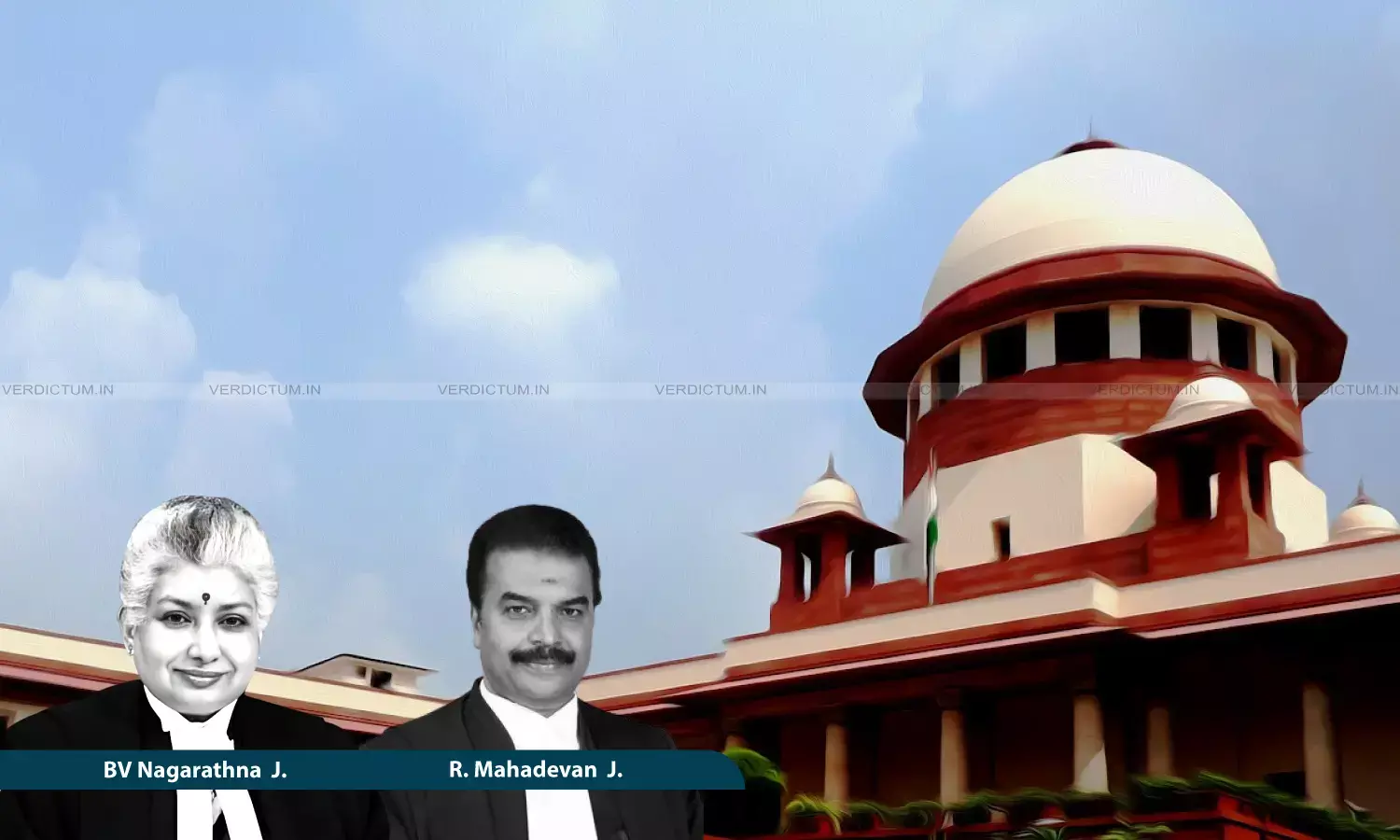
Justice B.V. Nagarathna, Justice R. Mahadevan, Supreme Court
The Supreme Court has held that judicial intervention beyond the statutory confines prescribed under the Insolvency and Bankruptcy Code, 2016, risks undermining the predictability and finality essential to a robust insolvency framework.
The Apex Court, while dismissing appeals filed under Section 62 of the IBC by unsuccessful resolution applicants seeking to reopen commercial decisions under the guise of procedural impropriety, observed that the IBC prioritises speed, certainty, and time-bound resolution and that courts must remain within the limited grounds of review expressly provided under the statute.
A Bench of Justice Justice B.V. Nagarathna and Justice R Mahadevan, upon dismissing the appeals, observed: “Predictability and finality are thus essential to maintaining a robust insolvency regime. Judicial intervention beyond the narrow statutory confines undermines both predictability and finality. Recognising this, the IBC deliberately confines judicial review to strict statutory compliance under Sections 30(2) and 61(3). Respecting these limits will preserve the economic sense of the IBC and ensure that insolvency remains a predictable, time-bound, and market-driven process”.
Background
The matter arose from appeals filed by unsuccessful resolution applicants challenging the approval of a Resolution Plan under the Insolvency and Bankruptcy Code, 2016. The Resolution Plan had been approved by the Committee of Creditors with the requisite majority and subsequently upheld by both the NCLT and the NCLAT. Aggrieved, the appellants approached the Supreme Court, alleging procedural irregularities and seeking to reopen the commercial decisions taken during the corporate insolvency resolution process.
Court’s Observations
At the outset, the Supreme Court reaffirmed the centrality of creditor-driven decision-making in insolvency resolution, stating in unequivocal terms, that the “commercial wisdom of the CoC enjoys primacy and cannot be supplanted by judicial review", and that neither the NCLT, nor the NCLAT, nor even the Supreme Court “is empowered to substitute its assessment in place of the commercial decision arrived at by a requisite majority of the CoC.”
The Court underscored that the IBC deliberately confines judicial scrutiny to limited statutory parameters. Once it is demonstrated that the Resolution Plan satisfies the requirements under Sections 30(2) and 61(3), courts cannot re-evaluate the commercial merits of the decision, the Court remarked.
Turning to the nature of the appeals before it, the Court remarked that “the appeals before us typify the growing strategic use of the judicial system by unsuccessful resolution applicants, who seek to reopen almost every commercial decision under the guise of procedural impropriety.”
It noted that such conduct converts the corporate resolution process “into a protracted adversarial contest and erodes the value of the Corporate Debtor.” The Court warned that this approach “incentivises delay, rent-seeking, and strategic obstruction and is fundamentally inconsistent with the economic logic and statutory design of the IBC.”
The Court issued a broader institutional caution regarding the scope of judicial review under the IBC. It observed that “the IBC represents a conscious legislative choice to privilege speed, certainty, and creditor-driven decision-making over exhaustive judicial scrutiny”, further emphasising that Courts “need to remain vigilant against any temptation to expand the scope of review beyond the narrow boundaries prescribed by the IBC.”
From an ex-post perspective, it explained that excessive judicial review carries “significant economic costs that run counter to the objects of IBC.” It elaborated that when commercial decisions of the CoC are subjected to expansive scrutiny, “resolution timelines lengthen, transaction costs rise, and the going-concern value of the Corporate Debtor erodes.” The result, the Court noted, is “not merely delay, but a tangible loss of economic value for all stakeholders.”
From an ex-ante perspective, the Court held that the expectation of expansive judicial review “distorts incentives for future bidders.” It cautioned that resolution applicants may either discount their offers or refrain from participation altogether, thereby weakening competition and reducing recoveries for creditors.
The Court further observed that excessive review “encourages strategic litigation,” allowing stakeholders to use litigation as a bargaining tool to delay implementation or extract concessions, thereby taking the process away from its objective of value maximisation.
Reiterating the constitutional and economic underpinnings of the Code, the Court referred to Swiss Ribbons Private Ltd. vs. Union of India (2019) and observed that the IBC prioritises time-bound reorganisation to maximise asset value and revive corporate debtors as going concerns.
From an institutional design point of view, the Court underscored that "the law must secure three interdependent economic freedoms viz. entry into the market, continuation of business operations under conditions of competitive neutrality, and exit from the market", further stressing that "where insolvency laws are tardily enforced, viable firms are driven into failure, and non-viable firms are permitted to persist".
While concluding, the Court underscored that the IBC deliberately confines judicial review to strict statutory compliance under Sections 30(2) and 61(3), and respecting these limits would preserve the economic sense of the Code and ensure that insolvency remains a predictable, time-bound, and market-driven process.
Recording the factual position in the case at hand, the Court observed that the Resolution Plan had already been approved by both the NCLT and the NCLAT and had since been implemented, “leaving absolutely no scope for intervention by this Court". Finding no merit in the appeals, the Apex Court dismissed them and affirmed the judgment under challenge.
Cause Title: Torrent Power Limited v. Ashish Arjunkumar Rathi & Ors. (Neutral Citation: 2026 INSC 206)
Appearances
Appellant: Advocates Gauri Rasgotra, Manish Kharbanda, Charu Mathur (AOR), Priyashree Sharma, Ekta Gupta, Shivansh Agarwal, Neha Maniktala, Karan Singh Duggal, S. S. Shroff (AOR), D.S.K. Legal (AOR), Samir Malik, Shahan Ulla, Jash Shah, Varun Kalra, Pranav Khanna & Others.
Respondents: N. Venkatraman (ASG), Senior Advocates Gopal Jain and Neeraj Kishan Kaul, with Advocates Madhav Kanoria, Srideepa Bhattacharyya, Neha Shivhare, Vikash Kumar Jha, Ramakant Rai, Cyril Amarchand Mangaldas (AOR), Trilegal Advocates On Record (AOR) and Others.
