

High Court Cannot Usurp Discretionary Powers Of Governor Even Before It Is Exercised In Awarding Extraordinary Pension: Supreme Court
The court has set aside a mandamus directing Uttarakhand to pay extraordinary pension to a widow of a deceased Doctor.

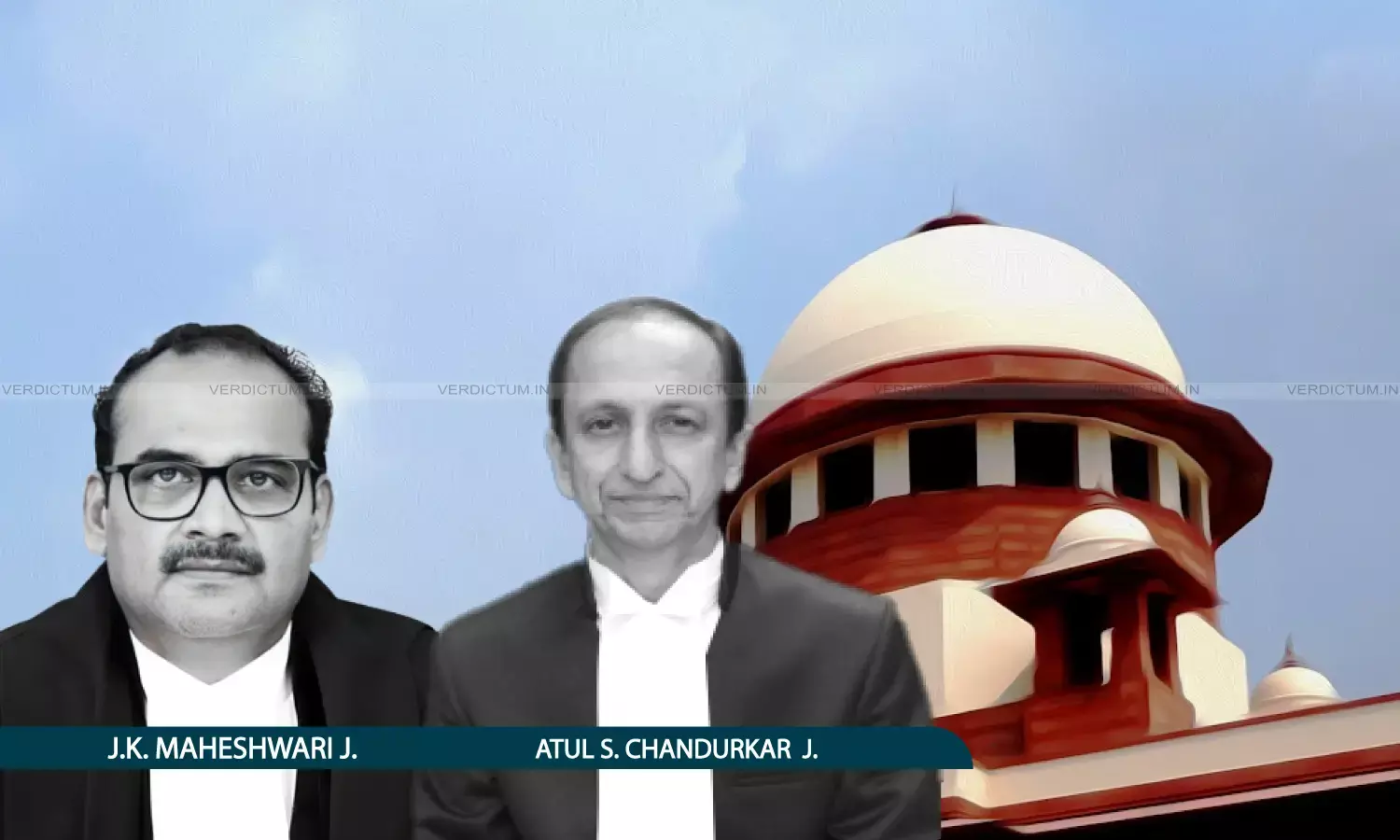
The Supreme Court has observed that the High Courts, while exercising its jurisdiction under Article 226, of the Constitution of India should not substitute their own decisions for those of statutory authorities (Governor) in matters where administrative discretion is yet to be exercised.
The Court clarified that when specific statutory rules, such as the Uttar Pradesh Civil Services (Extraordinary Pension) Rules, 1981, mandate the prior sanction of the Governor for an award, the judiciary cannot issue a writ of mandamus to bypass this procedural and substantive requirement.
Justice J.K. Maheshwari and Justice Atul S. Chandurkar observed, “…In such a scenario, the Court would be slow to itself take such decision especially when the authority on whom the power has been conferred to take such decision has had no occasion to examine the matter and exercise its discretion in accordance with law. It would be a different matter if such authority has either refused to take any decision for a reasonable period of time or the decision taken is found to be wholly arbitrary or suffering from non-application of mind. Even in such situations, normally, a direction to the authority concerned to take a decision afresh would follow. Ordinarily, the Court would not substitute its decision in place of the decision required to be taken by the concerned authority in exercise of its discretion”.
Senior Advocate Gaurav Bhatia appeared for the appellant and Senior Advocate Vijay Hansaria appeared for the respondent.
The matter pertained to the tragic death of Dr. Sunil Kumar Singh, a Pediatrician who was shot dead on April 20, 2016, while discharging his official duties at a Community Health Centre in Uttarakhand. Following his demise, his wife, Sarita Singh, sought extraordinary pension and compensation, asserting that his death occurred due to the "special risks" associated with his office.
While the State provided certain benefits, including a contractual compassionate appointment for her son and an initial ex-gratia payment, the respondent approached the Uttarakhand High Court seeking full implementation of the compensation proposals and the grant of extraordinary pension.
The High Court had previously directed the State to pay approximately ₹1.99 crore in compensation and granted extraordinary pension under the Rules of 1981, calculating the amounts based on the deceased's last drawn salary and future prospects. The State challenged this, arguing that a doctor's post was not a "post of risk" and that the mandatory procedure for Governor's sanction under Rule 4 had been ignored.
Upon examining the factual matrix, the Supreme Court noted that during the pendency of the litigation, the State had complied with interim orders to pay a total compensation of ₹1 crore to the respondent.
The primary legal friction remained the High Court’s direct order for extraordinary pension, therefore, on that the court observed that the Rules of 1981 constitute a self-contained code where Rule 4 explicitly states that no award shall be made without the Governor's sanction. Furthermore, Rules 14 and 15 vest the Governor with broad discretionary powers to handle exceptional cases or redistribute pensions.
“On a complete reading of the Rules of 1981, it is clear that in the matter of award of extraordinary pension, the sanction of the Hon’ble Governor is necessary. Such sanction is expected to be granted by the Hon’ble Governor after examining all relevant aspects referred to in the Rules of 1981. Thus, grant of sanction to the award of extraordinary pension is pursuant to an exercise of administrative power conferred on the Hon’ble Governor. It is, therefore, obvious that at the first instance it is for the Hon’ble Governor to consider whether a case has been made out for granting sanction to the award of extraordinary pension. It may be stated that where an authority has been conferred with discretionary powers that have to be exercised while taking an administrative decision and the considerations to be taken into account while exercising such discretion are duly enumerated, it would always be preferable that such authority itself takes such decision...”, the Bench noted.
“It is pertinent to note that the High Court has not found that the Hon’ble Governor had refused to exercise discretion in the said matter. No finding is recorded that despite the case of the first respondent being put before the Hon’ble Governor, a decision was not being taken in the matter of grant of extraordinary pension…in the fitness of things for the High Court to have first requested the Hon’ble Governor to examine the matter and consider the request for grant of extraordinary pension as sought by the first respondent. However, the High Court by the impugned judgment itself proceeded to take a decision in the matter of grant of extraordinary pension without the Hon’ble Governor having an occasion to exercise discretion and take a decision in accordance with the Rules of 1981”, the Bench further noted.
Accordingly, the Bench partially modified the impugned judgment by setting aside the direction to pay extraordinary pension. Instead, it permitted the respondent to file a fresh application under the Rules of 1981 within four weeks, which the Competent Authority must decide on its own merits within twelve weeks. Crucially, the Court protected the ₹1 crore compensation already paid to the widow, clarifying it shall not be recovered.
Cause Title: The State of Uttarakhand v. Sarita Singh and Ors. [Neutral Citation: 2026 INSC 337]
Appearances:
Appellant: Gaurav Bhatia, Sr. Adv., Sudarshan Singh Rawat, AOR, Anubha Dhulia, Neelmani Guha, Sunny Sachin Rawat, Shivam Wadhwa, Pranshu Dwivedi, Saakshi Singh Rawat, Advocates.
Respondents: Vijay Hansaria, Sr. Adv., Kavya Jhawar, Nandini Rai, Aashay Shukla, Sneha Kalita, AOR, Sarvesh Singh Baghel, AOR, Shaurya Krishna, Shivranjani Ralawata, Vikramjeet Banerjee, A.S.G. (Not Present), Shashwat Parihar, Chinmayee Chandra, Krishna Kant Dubey, Piyush Beriwal, S K Gupta, Mokshita Sharma, Raj Bahadur Yadav, AOR, Prateek Bhatia, AOR, Dhawal Mohan, Manish Kumar, AOR, Kumar Saurav, Advocates.