Public Servant Complaints Not Hit By Section 202 CrPC Enquiry Requirement: Supreme Court Denies Relief To Pharma Company In Drug Misbranding Case
Holding that the Legislature has placed public servants “on a different pedestal” when they act in discharge of official duties, the Apex Court set aside the High Court’s order quashing criminal proceedings against a pharmaceutical company and its officers, and restored the summoning order in a case alleging misbranding under the Drugs and Cosmetics Act.
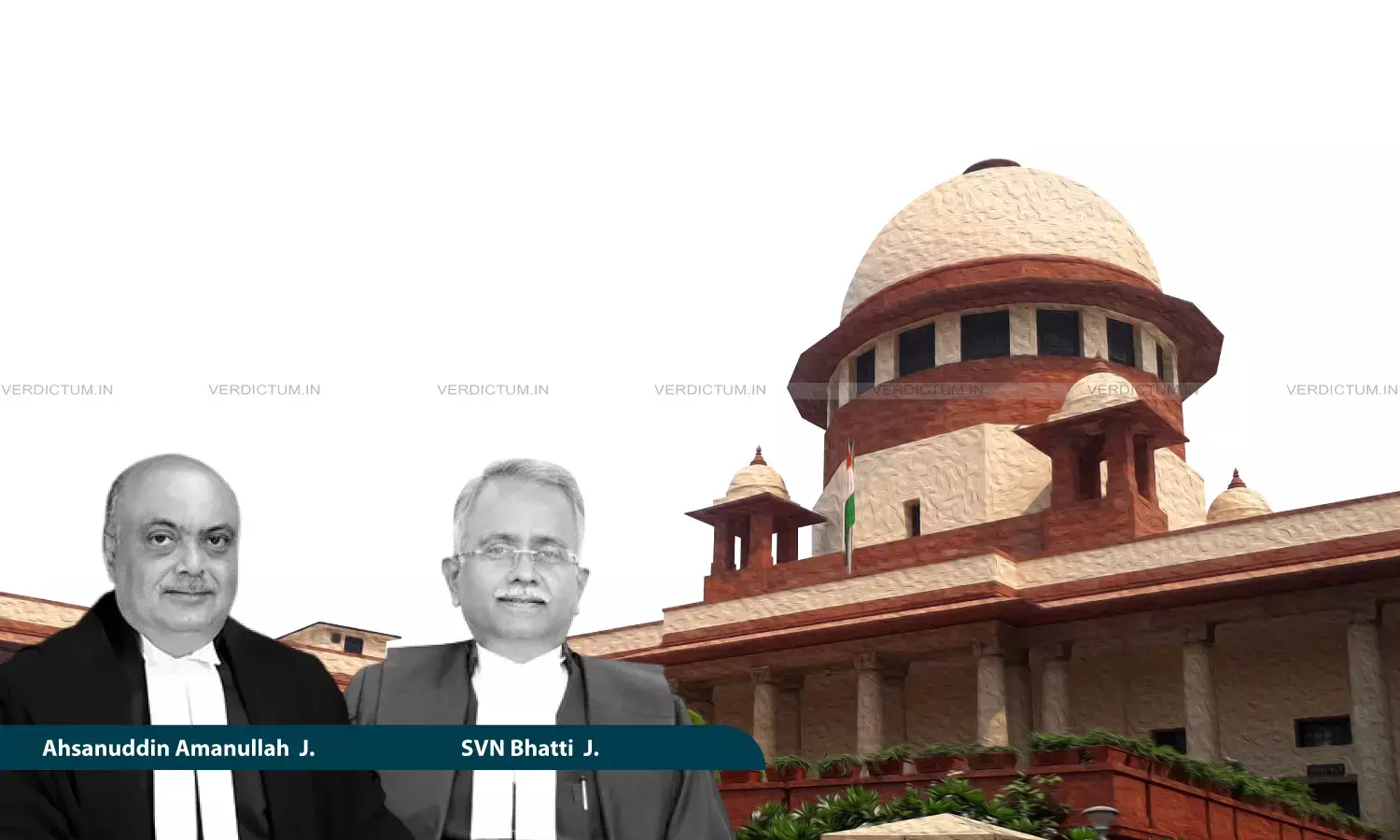
Justice Ahsanuddin Amanullah, Justice S.V.N. Bhatti, Supreme Court
The Supreme Court, while refusing to quash proceedings against a pharma company in a drug misbranding case, held that when a complaint is filed by a duly authorised Drugs Inspector in discharge of official duty, the requirement under Section 202(1) of the Code of Criminal Procedure, 1973 must be construed harmoniously with Section 200 CrPC.
The Court was hearing a batch of criminal appeals arising out of proceedings initiated under the Drugs and Cosmetics Act, 1940, including an appeal by the State challenging the High Court’s order quashing a complaint against a pharmaceutical manufacturer.
The complaint alleged discrepancies in labelling between the outer carton and the vial of a vaccine product, leading to charges of misbranding under Sections 17(b) and 17(c) read with Rule 96 of the Drugs and Cosmetics Rules, punishable under Section 27(d) of the Act
A Bench comprising Justice Ahsanuddin Amanullah and Justice S.V.N. Bhatti, while restoring the prosecution, referred to a coordinate bench decision in Cheminova India Limited v State of Punjab (2021), and reiterated that “the Legislature had accorded, to public servants discharging their duties in their official capacity(ies), a different footing qua when they were complainant(s), vis-a-vis complaints made in private capacity”.
Background
The prosecution originated from a complaint alleging that although the outer carton of the vaccine indicated it was a pentavalent formulation, the vial inside bore a different label indicating a tetravalent formulation. The complaint asserted that: the drug was not labelled in the prescribed manner as specified in Rule 96, and the carton accompanying the drug makes a false claim for the drug and is misleading. The drug is misbranded as per Section 17 (b) and 17 (c) of the Act.
Following inspection and seizure of relevant invoices and documents, the Drugs Inspector instituted a formal complaint before the Chief Judicial Magistrate, who took cognisance and issued summons.
The High Court later quashed the proceedings on the ground that the Magistrate had not conducted a mandatory enquiry under Section 202(1) CrPC, as the accused resided beyond the court’s territorial jurisdiction.
Court’s Observation
Addressing the question of limitation, at the outset, the Supreme Court examined Sections 468 and 469 of the CrPC. It held that the limitation period would commence not from the date of initial information, but from the date on which the identity of the accused became known to the competent authority under Section 469(1)(c) CrPC
The Court observed that the identity of the accused persons was established only after inspection and verification of documents. It concluded that the complaint was filed within the prescribed three-year period and that “the limitation bar does not come in the way.”
Turning to Section 202 CrPC, the Court noted: “The present case emanates from a complaint by an officer, made in writing. In terms of Section 200 of the Code, the Magistrate is not required to examine the complainant and the witnesses if a public servant is acting or purporting to act in discharge of his official duty, or a Court has made the complaint. Here, an official complaint was made on authorisation by the State Government. In this factual setting, Section 202 of the Code would necessarily have to be construed harmoniously with Section 200 of the Code when considering the postponement of the issue of process”.
Referring to and reaffirming the principle in Cheminova India Limited, the Court held that public servant-complainants stand “on a different pedestal” vis-à-vis private complainants. It rejected the attempt to distinguish the earlier precedent on factual grounds and answered the issue in favour of the prosecution
In a connected appeal involving another pharmaceutical company, the High Court had quashed proceedings against Directors for alleged non-compliance with Section 34 of the Act. The Supreme Court held that whether Directors were “in charge of” and “responsible to the company for the conduct of the business” is a question of fact best left to the Trial Court.
The Court observed that the High Court’s view on Section 34 was “premature” and restored the complaint for trial
Conclusion
Setting aside the High Court’s orders, the Supreme Court restored the summoning orders and directed the issuance of fresh summons, noting that its observations were confined to the issues raised and would not prejudice the merits at trial
Cause Title: The State of Kerala & Anr. v. M/s Panacea Biotec Ltd. & Anr. & Connected Appeals (Neutral Citation: 2026 INSC 200)
Appearances
Appellants: Advocate H. V. Hameed
Respondents: Senior Advocate Siddharth Luthra