

Supreme Court Refers Bharat Drilling Judgment To Larger Bench On Issue Of Interpretation Of Prohibitory Claim Clauses In Contracts
The appeal before the Supreme Court was filed against the judgment of the Jharkhand High Court allowing a Section 37 appeal under the Arbitration and Conciliation Act, 1996.

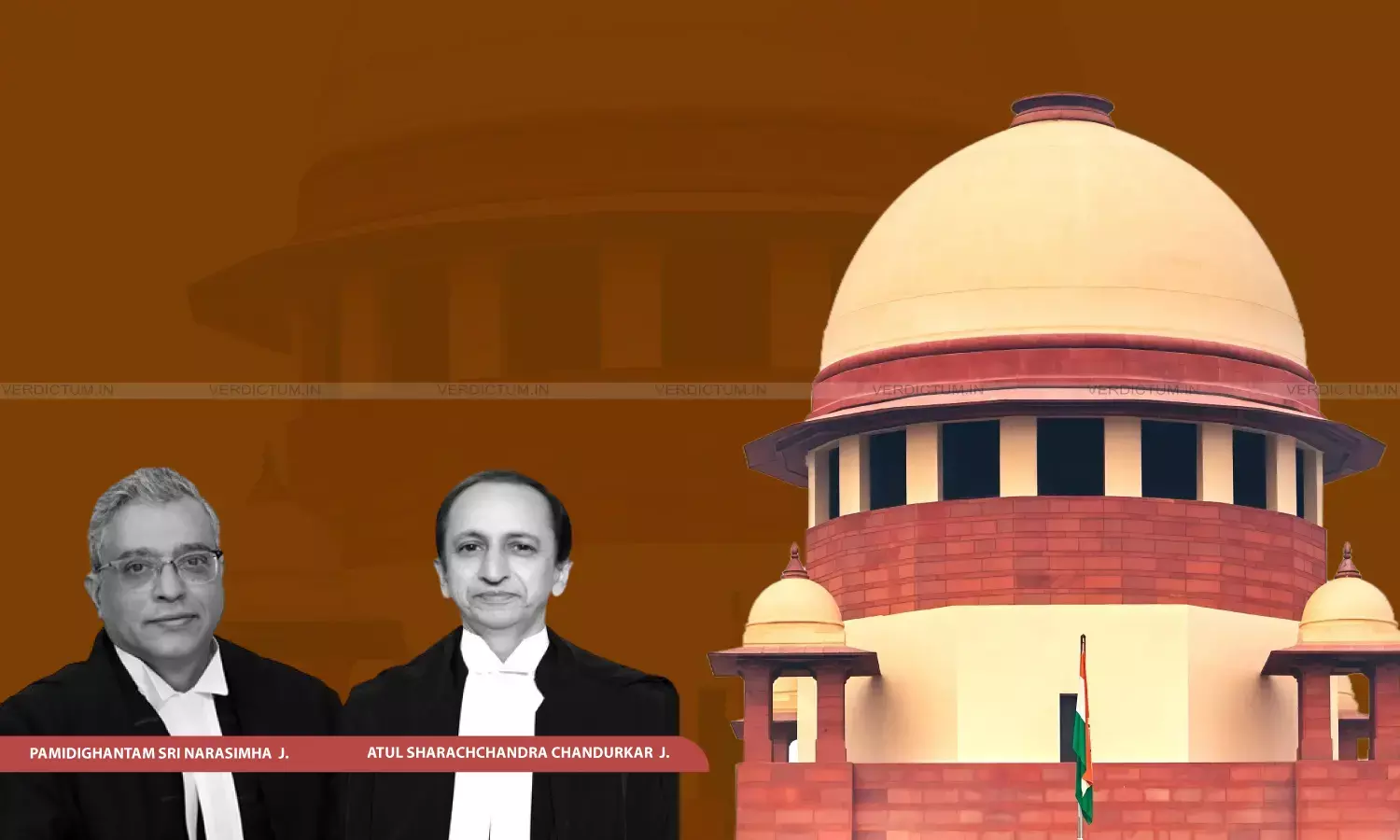
Justice Pamidighantam Sri Narasimha, Justice Atul S. Chandurkar, Supreme Court
The Supreme Court has referred its judgment in Bharat Drilling & Foundation Treatment Pvt. Ltd. v. State of Jharkhand and Ors (2009) to a larger bench for reconsideration after noting that it is not an authority for the proposition that an excepted clause or a prohibited claim in a contract applies only to the employer and not to the Arbitral Tribunal.
The appeal before the Apex Court was filed against the judgment of the Jharkhand High Court allowing a Section 37 appeal under the Arbitration and Conciliation Act, 1996. The appeal was filed by the respondent-claimant against the judgment of the Civil Court setting aside the arbitral award, allowing the objections filed by State under Section 34. By its award, the Arbitral Tribunal allowed certain claims, but the Civil Court set aside three claims on the ground that they were specifically prohibited under the contract between the parties.
The Division Bench of Justice Pamidighantam Sri Narasimha and Justice Atul S. Chandurkar held, “In view of our opinion that Bharat Drilling & Foundation Treatment Pvt. Ltd. v. State of Jharkhand and Ors is not an authority for the proposition that an excepted clause or a prohibited claim in a contract applies only to the employer and not to the Arbitral Tribunal, for the reasons to follow, in order to obviate uncertainty and for clear declaration of law, we are referring Bharat Drilling (supra) to a larger bench for reconsideration and authoritative decision.”
Arguments
It was the case of the appellant that the High Court committed a serious error in allowing the appeal on the ground that the issue arising for consideration is covered by the decision of this Court in Bharat Drilling (supra). A concern was raised that the decision in Bharat Drilling (supra) is being applied regularly and wrongly to interpret prohibitory claim clauses in all Government contracts.
The respondent supported the decision of the High Court.
Reasoning
On a perusal of the judgment of the High Court under Section 37, the Bench found that there was no discussion whatsoever as regards to the claims except for reference and reliance on the order of the Court in Bharat Drilling (supra). “Placing reliance upon Bharat Drilling (supra), without any other discussion or analysis, the High Court proceeded to restore the award as regards claim nos.3, 4 and 6”, it added.
The Bench noted that the High Court had not examined the contractual clauses and proceeded to dispose of the appeal under the impression that the issue was conclusively covered by the decision of this Court in Bharat Drilling (supra).It was noticed that in Bharat Drilling (supra), the Court had not examined the contractual clauses that fell for the Court’s decision our herein. Contractual clauses that limit claims are founded on the freedom to contract. They are agreements that crystalise informed choices of parties, it stated.
“Applicability of excepted or prohibitory clauses would primarily depend upon the agreement between the parties, which alone is the guiding principle for the Arbitral Tribunal”, it explained.
The Bench added that the jurisdiction relating to the grant of interest is sourced from Section 31(7) of the Act. The Bench observed, “As issues relating to payment of interest arising under Section 31(7) of the Act stand on a different footing from that of contractual clauses excepting or prohibiting certain claims, we are of the opinion that the judgment in Bharat Drilling (supra), relying on the judgment of this Court in Port of Calcutta (supra), dealing with the principle of grant of interest pendente lite, is not appropriate. Further, we are also of the opinion that the approach adopted in Bharat Drilling (supra) is not in tune with the principles laid down by this Court in the recent decisions of Cox and Kings Ltd. v. SAP India Private Ltd.CORE (supra) and In Re: Interplay Between Arbitration Agreements Under Arbitration and Conciliation Act, 1996 and Stamp Act, 1899”, it held.
Thus, concluding that the ratio of Bharat Drilling requires to be reconsidered, the Bench ordered, “In this view of the matter, we direct the registry to place our judgment and order before the Hon’ble Chief Justice for appropriate orders for placing the matter before a larger bench of appropriate strength.”
Cause Title: The State of Jharkhand v. The Indian Builders Jamshedpur (Neutral Citation: 2025 INSC 1388)