

There Need Not Be Specific Place To Be Declared As Police Station: Supreme Court Sets Aside Andhra Pradesh HC’s Decision Quashing FIRs Registered By ACB
The Supreme Court observed that a ‘post,’ held by a police officer, can be defined as a police station, and so also a ‘place’.
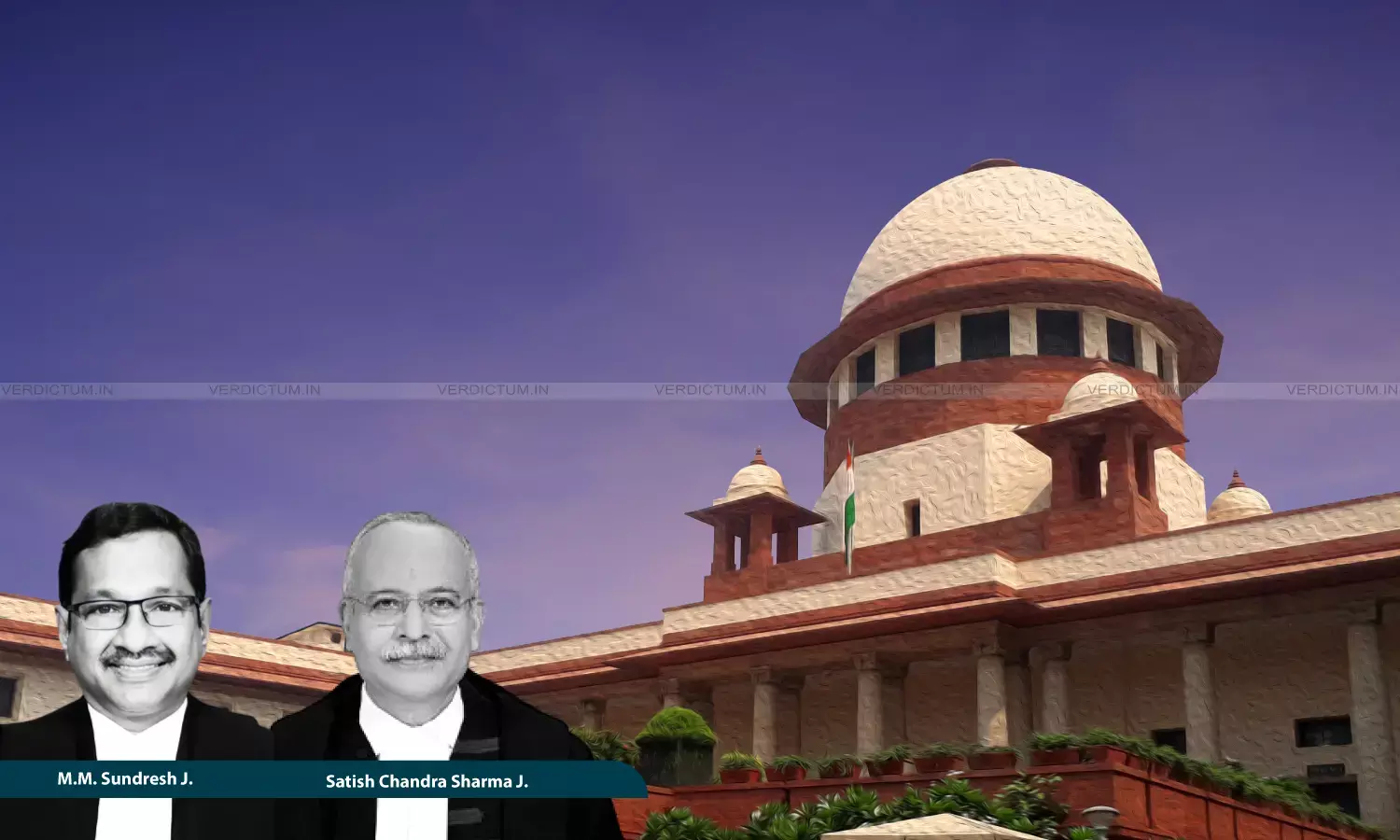
Justice M.M. Sundresh, Justice Satish Chandra Sharma, Supreme Court
The Supreme Court has set aside the Judgment of the Andhra Pradesh High Court by which a spate of FIRs (First Information Reports) registered by the Anti-Corruption Bureau (ACB) were quashed.
The Court clarified that there need not be a specific place to be declared as a police station, as even a post being held by a police officer would constitute a police station.
The two-Judge Bench comprising Justice M.M. Sundresh and Justice Satish Chandra Sharma explained, “The definition clause, under Section 2(s) of the CrPC, 1973, is both exhaustive and inclusive. It is exhaustive to mean, any post or any place, while it includes any local area specified by the State Government. The inclusion of ‘local area’ would come within the definition of place, meaning thereby, a place would include, a specified one, a town, a city, a taluk, a village, a district or even a State itself. Therefore, a local area is a species of the genus ‘place’. The declaration, that is warranted, under the definition clause, is rather formal. It can be specific, either to a place or to a post, or general, to a group of posts or places. Suffice it is to state that, under the definition, there need not be a specific place to be declared as a police station, as even a post being held by a police officer would constitute a police station.”
The Bench noted that Section 2(s) of the Criminal Procedure Code, 1973 (CrPC) defines a ‘police station’ and it concerns itself with two distinct and separate categories, namely, ‘post’ and ‘place’. It added that a ‘post,’ held by a police officer, can be defined as a police station, and so also a ‘place’.
Senior Advocates Sidharth Luthra and Siddharth Aggarwal appeared on behalf of the Appellants, while AOR Anu Gupta appeared on behalf of the Respondents.
Brief Facts
The Andhra Pradesh High Court had nullified the FIRs registered in a batch of cases pertaining to offences committed under the provisions of the Prevention of Corruption Act, 1988 (PC Act), which left the investigation(s) being nipped in the bud in some cases, while, in the others, criminal proceedings stood terminated. The Government of Andhra Pradesh had issued a notification, by way of the Government Order in 2003, declaring the offices of Anti-Corruption Bureau (ACB) as Police Stations, with their respective jurisdiction. Thereafter, the Government of India enacted the Andhra Pradesh Reorganisation Act, 2014, carving out a new State, namely, the State of Telangana, through the bifurcation of the undivided State of Andhra Pradesh.
Multiple FIRs were registered at the office of the Anti-Corruption Bureau, Central Investigation Unit, Andhra Pradesh, Vijayawada Police Station, between the years 2016 and 2020, for offences punishable under the PC Act. All these FIRs were challenged by the persons arrayed as accused i.e., the Respondents, primarily on the ground that the ACB is not notified as a police station under Section 2(s) of the CrPC, 1973 and, therefore, lacks jurisdiction to register the FIRs. By the impugned Judgment, the High Court held that in the absence of a notification under Section 2(s) of the CrPC, 1973, the police station, to which the police officers who registered the FIRs belong to, do not have any jurisdiction to register the same. It was further held that there has to be a declaration under Section 2(s) of the CrPC, 1973, published by way of a notification in the Official Gazette, declaring a police station. This was under challenge before the Apex Court.
Reasoning
The Supreme Court in view of the above facts, observed, “… there is indeed no requirement for any specific order of adoption, particularly for the State of Andhra Pradesh. In other words, the State of Andhra Pradesh continues to be the same State, as what has been done is, by merely carving out some of its territories, a new State has been created. In any case, Section 102 of the 2014 Act leaves no room for any other interpretation, especially when it contains a non-obstante clause, and facilitates the Tribunals and the Courts to follow the existing law, even in the absence of any adoption.”
The Court said that when the Courts are expected to follow the existing law, it is axiomatic that the mandate applies to the executive and every other authority.
“In our considered view, the approach of the High Court is nothing but a travesty of justice. If, on a hyper-technical ground, the FIRs are quashed, the High Court is duty-bound to lay down the law with respect to the jurisdiction that otherwise exists. We have already discussed the scope and ambit of the relevant provisions contained in the CrPC, 1973, and the 2014 Act, which was followed by a series of Government Orders and Circulars”, it remarked.
The Court was of the view that when a Government Order is issued by way of a clarification, there is no question of any retrospective application.
“In fact, the said Government Order merely quotes the various provisions of the 2014 Act in order to make the position abundantly clear. As a consequence, we are dealing with a situation where years have lapsed without further progress on the registered FIRs”, it further noted.
The Court also clarified that that the Andhra Pradesh High Court shall entertain no more challenge to the FIRs.
“We have been informed that in some cases, the charge-sheets have already been filed. Hence, we give liberty to the respondents herein, to challenge the charge sheets, which have already been filed and those which are yet to be filed, on other grounds, if so warranted. Liberty is also given to them to raise all the contentions, other than the one being decided by us, only after the conclusion of the investigation”, it ordered.
Conclusion
Moreover, the Court clarified that in those cases where the investigation is still pending, the Appellant(s) shall not take any coercive action, while the Respondents herein are expected to lend their due cooperation.
“The appellant(s) are at liberty to proceed with the investigation. … The final reports are to be filed within a period of six months from the date of receipt of a copy of this judgment. … The appellant(s) shall not take any coercive steps by way of arresting the respondents herein”, it concluded.
Accordingly, the Apex Court allowed the Appeals and set aside the impugned Judgment.
Cause Title- The Joint Director (Rayalaseema), Anti-Corruption Bureau, A.P. & Anr. Etc. v. Dayam Peda Ranga Rao Etc. (Neutral Citation: 2026 INSC 37)
Appearance:
Appellants: Senior Advocates Sidharth Luthra, Siddharth Aggarwal, AOR Guntur Pramod Kumar, Advocates Prerna Singh, Rajni Gupta, Vishwajeet Singh, Karl P Rustomkhan, and Parv Arora.
Respondents: AORs Anu Gupta, Sriram P., Bhushan Mahendra Oza, Nidhi Mittal, C. K. Sasi, Advocates Veerla Satheesh Kumar, V Elangovan, Suresh Babu, Navin Suresh, KK Geetha, and Meena K Poulose.
