

Notarised Photocopy of Power of Attorney Not Valid Evidence: Supreme Court Upholds HC’s Rejection of Alienation Claim
Court reiterates that notarised photocopies cannot prove authority to alienate property without complying with rules on secondary evidence

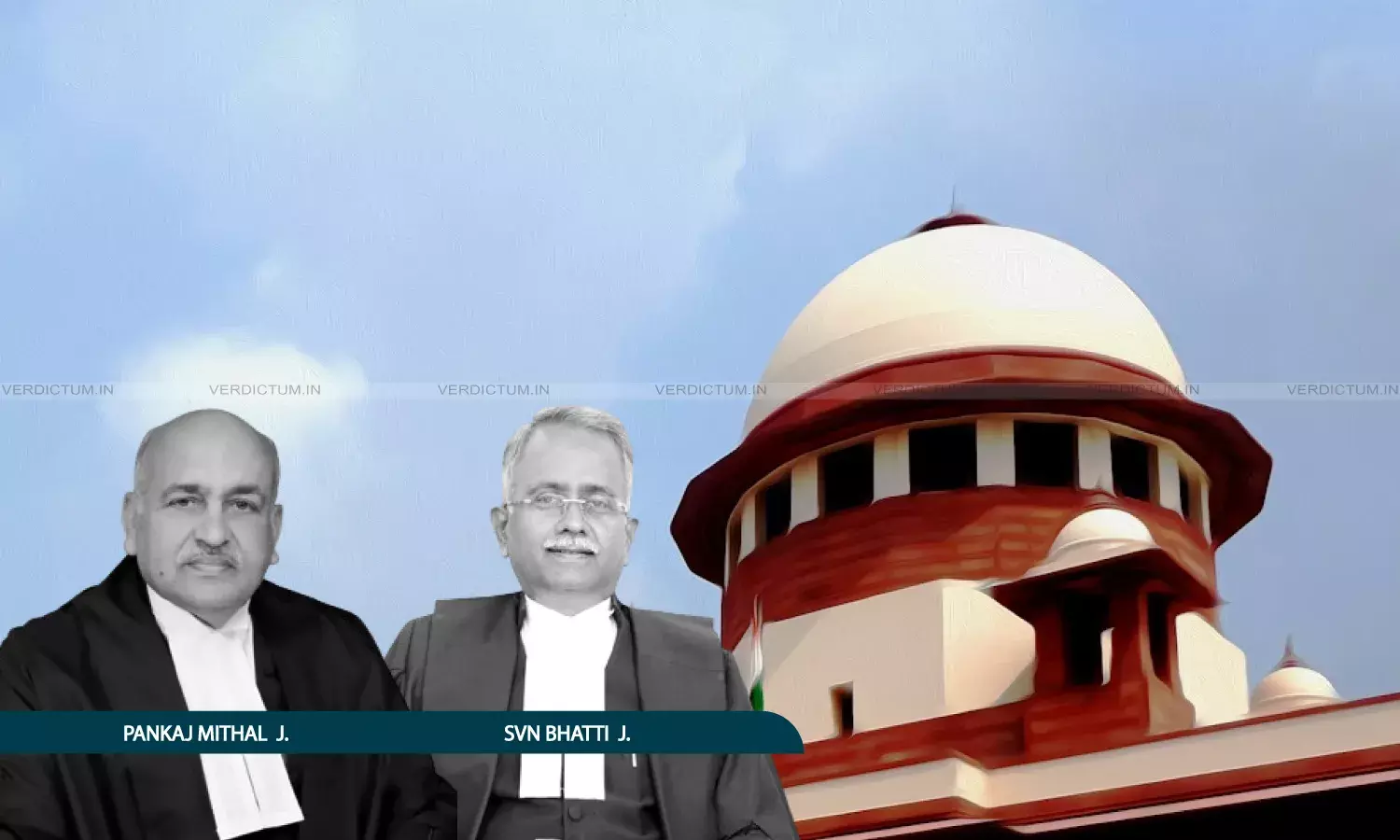
The Supreme Court in a judgment has reaffirmed that a mere photocopy of a notarised Power of Attorney or any document, cannot be relied upon to establish legal authority unless the statutory requirements for adducing secondary evidence are strictly followed.
Dismissing the challenge to the Kerala High Court’s judgment, the bench held that the alleged Power of Attorney, relied upon to justify alienation of joint family property, was inadmissible in evidence as it was only a photocopy and neither the original nor secondary evidence had been properly brought on record.
The Bench observed that courts cannot presume execution or authority under Sections 33 of the Registration Act, 1908 or 85 of the Evidence Act, 1872 unless the foundational requirement of proving the document itself is first satisfied. In the absence of proof of loss or non-availability of the original document, secondary evidence could not be admitted as a matter of course.
Justice Pankaj Mithal and Justice S.V.N. Bhatti observed, “In our considered view, neither Section 33 of the Registration Act nor Section 85 of the Evidence Act would come into application if the primary requirement of adducing secondary evidence is discharged by the party relying on the document. Section 85 of the Evidence Act falls under Chapter V, titled Documentary Evidence. In the absence of an original or at least a secondary evidence, it is impermissible to apply Section 85 of the Indian Evidence Act to conclude the execution and extent of authority given by the plaintiff to the 1st defendant. No order is brought to our notice through which secondary evidence is brought on record before the Trial Court. A photocopy of a document is no evidence unless the same is proved by following the procedure set out. Relying on Exh. B-2, the First Appellate Court acted on inadmissible evidence and accepted the existence of power to alienate. Exh. B-2/photocopy is no evidence, and the incorrect reliance on no evidence, has been rightly corrected by the High Court through the impugned judgment. The High Court has considered the misreading of evidence by the Appellate Court and, by applying the correct principles of law, allowed the second appeal”.
Senior Advocate Pijush Kanti Roy appeared for the appellants and Senior Advocate Manjula Rao appeared for the respondents.
In the present matter, the dispute arose out of a civil suit concerning alienation of Plaint A-Schedule property, which the plaintiff claimed to be joint family property. The plaintiff challenged the authority of the first defendant to deal with or alienate the property, contending that no valid Power of Attorney had ever been executed in his favour.
However, the first defendant relied upon Exhibit B-2, claiming it to be a Power of Attorney executed by the plaintiff authorising him to alienate the property. Crucially, only a notarised photocopy of the alleged Power of Attorney was produced; the original document was never placed on record, nor was any foundation laid for leading secondary evidence.
The Trial Court rejected the defendant’s claim of authority, holding that the Power of Attorney was not proved in accordance with law and could not be relied upon to justify the alienation.
To the contrary, in appeal, the First Appellate Court reversed the Trial Court’s findings, accepting Exh. B-2 as sufficient proof of authority. It proceeded to compare the disputed signatures on the photocopy with other signatures and recorded a finding against the plaintiff, thereby upholding the defendant’s power to alienate the property.
The Appellate Court also invoked presumptions under Section 85 of the Evidence Act and Section 33 of the Registration Act, despite the fact that neither the original document nor legally admissible secondary evidence had been brought on record.
Criticising the First Appellate Court’s approach, the Supreme Court noted that it had erred in comparing disputed signatures without expert assistance and without relying on admitted signatures, contrary to settled law. The Court reiterated that judges cannot undertake such comparison on their own where even the reference signatures are not admitted.
Therefore, the Bench held that the High Court was correct in setting aside the appellate finding based on “no evidence”, after noting that the alleged Power of Attorney was only a notarised photocopy and that no procedural steps had been taken to prove it in accordance with law.
Reiterating that secondary evidence is an exception and not the rule, the Supreme Court concluded that reliance on an unproved photocopy to establish power to alienate property was legally impermissible.
Upon finding no error in the High Court’s reasoning, the Court upheld the judgment and dismissed the appeal.
Cause Title: Tharammel Peethambaran & Anr. v. T. Ushakrishnan & Anr. [Neutral Citation: 2026 INSC 134]
Appearances:
Appellants: Pijush Kanti Roy, Sr. Adv., Dileep Poolakkot, Harshad V. Hameed, AOR, Ashly Harshad, Dr. Arunender Thakur, Mahabir Singh, Khushboo Sharma, Anshul Saharan, Advocates.
Respondents: Manjula Rao, Sr. Adv., Nitin Sangra, Riju Ghosh, Upmanyu Tewari, AOR, Advocates.
Click here to read/download the Judgment