

Supreme Court: Person Holding Expired Driving Licence Incompetent To Drive Vehicle From The Very Next Day After Expiry Date
The Supreme Court allowed Civil Appeals filed against the common Judgment of the High Court’s Division Bench, by which the Appeals of the Telangana State Level Police Recruitment Board (TSLPRB) were dismissed.
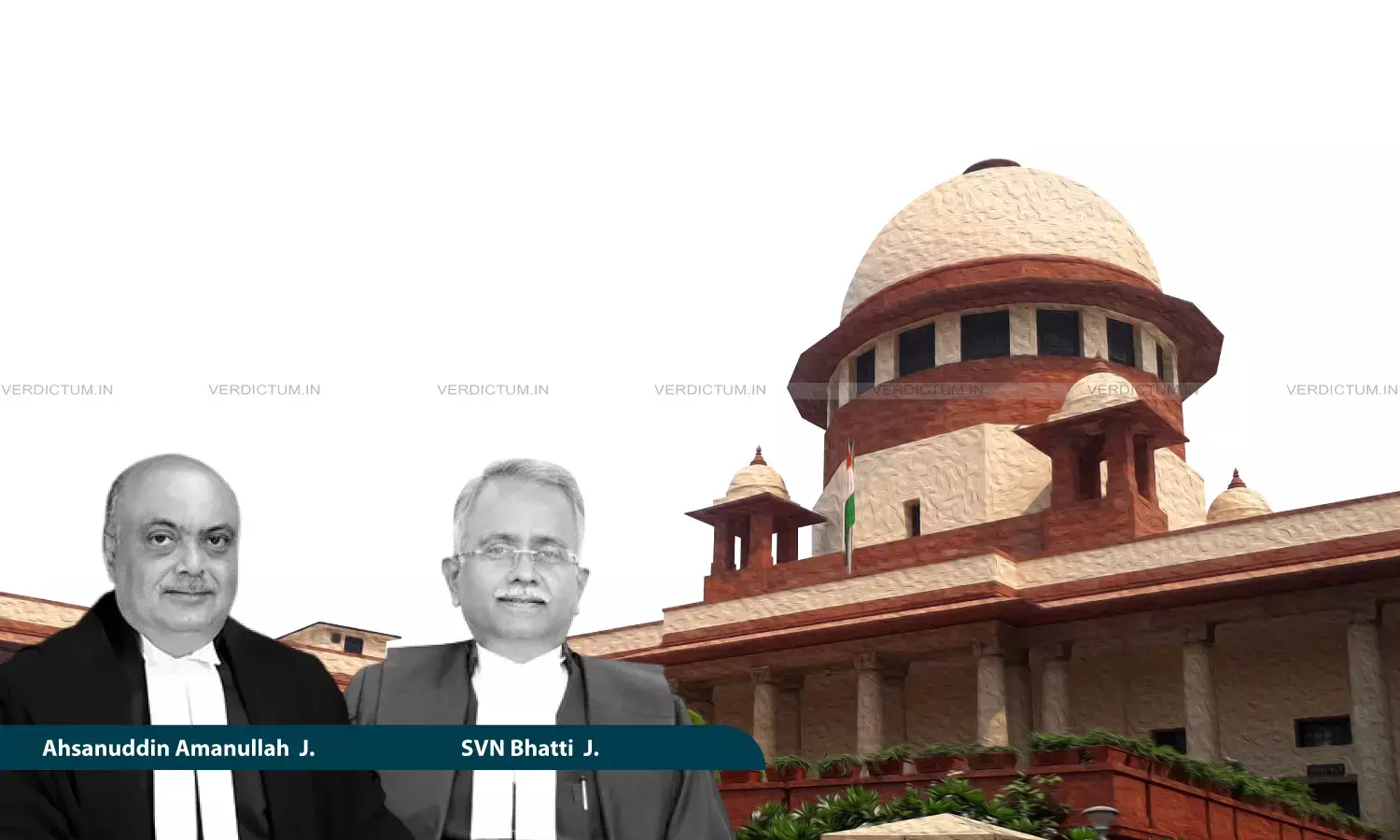
Justice Ahsanuddin Amanullah, Justice S.V.N. Bhatti, Supreme Court
The Supreme Court has clarified that after the Motor Vehicles (Amendment) Act, 2019, from the very next day after the date of expiry, without renewal, the person holding an expired driving licence is incompetent to drive the vehicles he had such licence for, meaning thereby, that there is a legal disability for driving.
The Court clarified thus in a batch of Civil Appeals filed against the common Judgment of the Telangana High Court’s Division Bench, by which the Appeals filed by the Telangana State Level Police Recruitment Board (TSLPRB) were dismissed.
The two-Judge Bench comprising Justice Ahsanuddin Amanullah and Justice S.V.N. Bhatti explained, “Hypothetically, a case may arise where a person renews his licence regularly, such that he may have a licence for many years in continuity inasmuch as the initial licence granted to him gets renewed from time to time, before the existing licence expires. This could operate in a cycle, where the said person keeps renewing the licence before expiry. Such person would come within the scope of eligibility as prescribed in the Notifications. However, after the Amendment Act, 2019, as per the 1988 Act, from the very next day after the date of expiry, without renewal, the person holding an expired licence is incompetent to drive the vehicles he had such licence for, meaning thereby, that there is a legal disability for driving. Coming back to the present case, the Notifications are for recruitment to the posts of Driver.”
The Bench said that driving is not merely a qualification on paper but also involves hands-on experience coupled with regular practice.
Senior Advocate K. Radhakrishnan represented the Appellant, while Senior Advocate Nikhil Goel represented the Respondents.
Court’s Observations
The Supreme Court in view of the facts and circumstances of the case, observed, “… Section 14 of the 1988 Act, as it stands today, does not provide for the licence to continue after its expiry even for a single day; however, before the Amendment Act, 2019, the then-existing proviso made the date extendable automatically by a further period of 30 days from the date of its expiry.”
The Court noted that Section 15 of the Motor Vehicles Act, 1988 (MV Act) only extends the period by which an expired licence would be renewed, meaning thereby, that the same licence would continue, but is silent about what happens during the interregnum i.e., after expiry but before renewal.
“The changes made in sub-sections (3) and (4) of Section 15 of the 1988 Act relate only to the fee payable for renewal, which have no bearing on the present cases. … a licence no more automatically extends beyond the period of its expiry, as was provided for in the unamended last proviso to Section 14 of the 1988 Act. This deliberate omission by the Legislature cannot be labelled cosmetic”, it said.
The Court further observed that from the date of expiry of licence, its holder is barred under law from driving and the theory that once a licence is renewed, even after a gap, the renewal would operate from a back date implying that the licence was continuing and valid even for and during the interregnum cannot be countenanced.
“We are constrained to record that the Division Bench did not engage with the issue, as after noting the rival submissions advanced at the Bar, the Impugned Judgment merely extracted the Single Judge’s Final Order/Judgment dated 30.06.2023, without assigning any reasons as to why it was ‘not inclined to interfere’ with the said Order/Judgment. As much time has elapsed, the recruitment process be completed by the Appellant expeditiously and at any rate, within three months reckoned from today”, it concluded.
Accordingly, the Apex Court allowed the Appeals and set aside the impugned Judgment.
Cause Title- Telangana State Level Police Recruitment Board v. Penjarla Vijay Kumar & Ors. Etc. (Neutral Citation: 2025 INSC 1452)
