

Supreme Court: If Interpretation Of Tender Inviting Authority Is Vitiated By Mala Fides, Constitutional Court Can't Show Deference To It
The Supreme Court reiterated that the tender inviting authority is the best judge to understand and appreciate its requirements and interpret its documents.
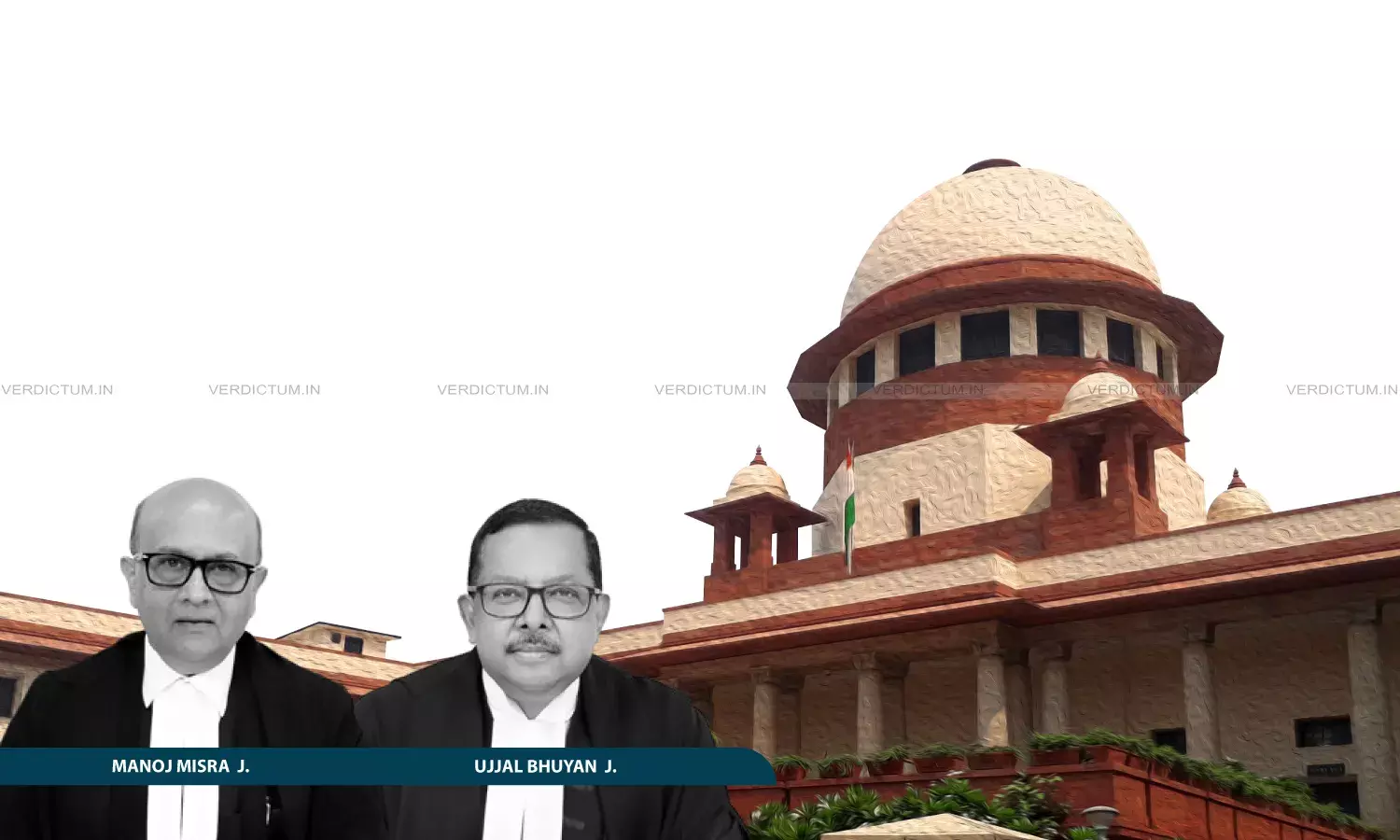
Justice Manoj Misra, Justice Ujjal Bhuyan, Supreme Court
The Supreme Court observed that if the interpretation of the tender inviting authority or its understanding of the tender conditions is vitiated by mala fides or perversity, there is no question of a Constitutional Court showing deference to such understanding.
The Court observed thus in a Civil Appeal challenging the Judgment of the Chhattisgarh High Court’s Division Bench in a Writ Petition filed by a company.
The two-Judge Bench of Justice Manoj Misra and Justice Ujjal Bhuyan explained, “If the interpretation of the tender inviting authority or its understanding of the tender conditions is vitiated by mala fides or perversity, there is no question of a constitutional court showing deference to such understanding. Likewise, if the interpretation of the tender inviting authority of a particular condition of tender, such as, an eligibility criteria as in the present case is irrational or absurd leading to arbitrary consequences, it would be the duty of a constitutional court to interdict such a decision making process. To hold otherwise would render the very object of judicial review otiose.”
The Bench reiterated that the tender inviting authority is the best judge to understand and appreciate its requirements and interpret its documents.
Senior Advocate Pooja Mehra Saigal appeared on behalf of the Appellant, while Additional Advocate General (AAG) Bishwajit Dubey appeared on behalf of the Respondents.
Facts of the Case
The Respondent had issued a notice inviting tender for construction of a road pursuant to which the Appellant-Company had submitted its tender. After exchanging correspondences, the Respondent vide letter disqualified the Appellant at the stage of technical evaluation on the ground that one experience certificate of the Appellant was of lesser value than 50 percent of the contract value while the other experience certificate was that of joint venture of which Appellant was a partner; thus Appellant failed to meet the eligibility criterion.
Appellant challenged rejection of its tender on the aforesaid ground before the High Court by filing a Petition under Article 226 of the Constitution of India. By the impugned Judgment and Order, the High Court did not find any merit in the Writ Petition and accordingly dismissed the same. Being aggrieved, the Appellant approached the Apex Court.
Reasoning
The Supreme Court after hearing the arguments from both sides, noted, “From a perusal of the NIT or the conditions in the pre-qualification document, we do not find any criteria or condition therein stating that past experience as member of a joint venture would not be considered. There is, thus, no specific or explicit exclusion of the work experience gained by a contractor in a joint venture or partnership.”
The Court was of the view that an eligibility criteria should be clear and unambiguous, otherwise, it may lead to arbitrary exercise of power by the State disqualifying a tenderer who would otherwise meet the eligibility criteria.
“… it is the responsibility of the tendering authority to issue clear and unambiguous instructions in a NIT. As pointed out by this Court in Patel Engineering (supra), when there is vagueness or subjectivity in the norms, it may result in an unequal and discriminatory treatment and provide room for manipulation to suit the whims of the State agencies in picking and choosing a bidder for awarding contracts”, it added.
The Court said that there was no justification at all on the part of the Respondents in not considering the proportionate experience certificate of the Appellant as a member of the joint venture.
“Such decision of the respondents is arbitrary and unreasonable rendering the decision making process in breach of the mandate of Article 14 of the Constitution of India. … we hold that the decision making process of the respondents in disqualifying the appellant from the tender by not taking into account its past proportionate experience in the joint venture is vitiated by irrationality leading to the arbitrary decision of declaring the appellant as disqualified”, it concluded.
Accordingly, the Apex Court allowed the Appeal, set aside the impugned Judgment, and directed the Respondents to reconsider the Appellant’s case by accepting its experience certificate as member of the joint venture.
Cause Title- M/s. Surguja Bricks Industries Company v. State of Chhattisgarh & Ors. (Neutral Citation: 2025 INSC 1456)
Appearance:
Appellant: Senior Advocate Pooja Mehra Saigal and AOR Mohit Negi.
Respondents: AAG Bishwajit Dubey, Standing Counsel Vinayak Sharma, AOR Ravinder Kumar Yadav, Advocates Karan Khetani, Kshitiz Agarwal, Kritika Yadav, and Yashvardhan Shah.
