

Fact That Multiple Cheques Arise From One Transaction Won’t Merge Them Into Single Cause Of Action: Supreme Court
The Supreme Court said that even though the powers under Section 482 of the CrPC are very wide, its conferment requires the High Court to be more cautious and diligent.
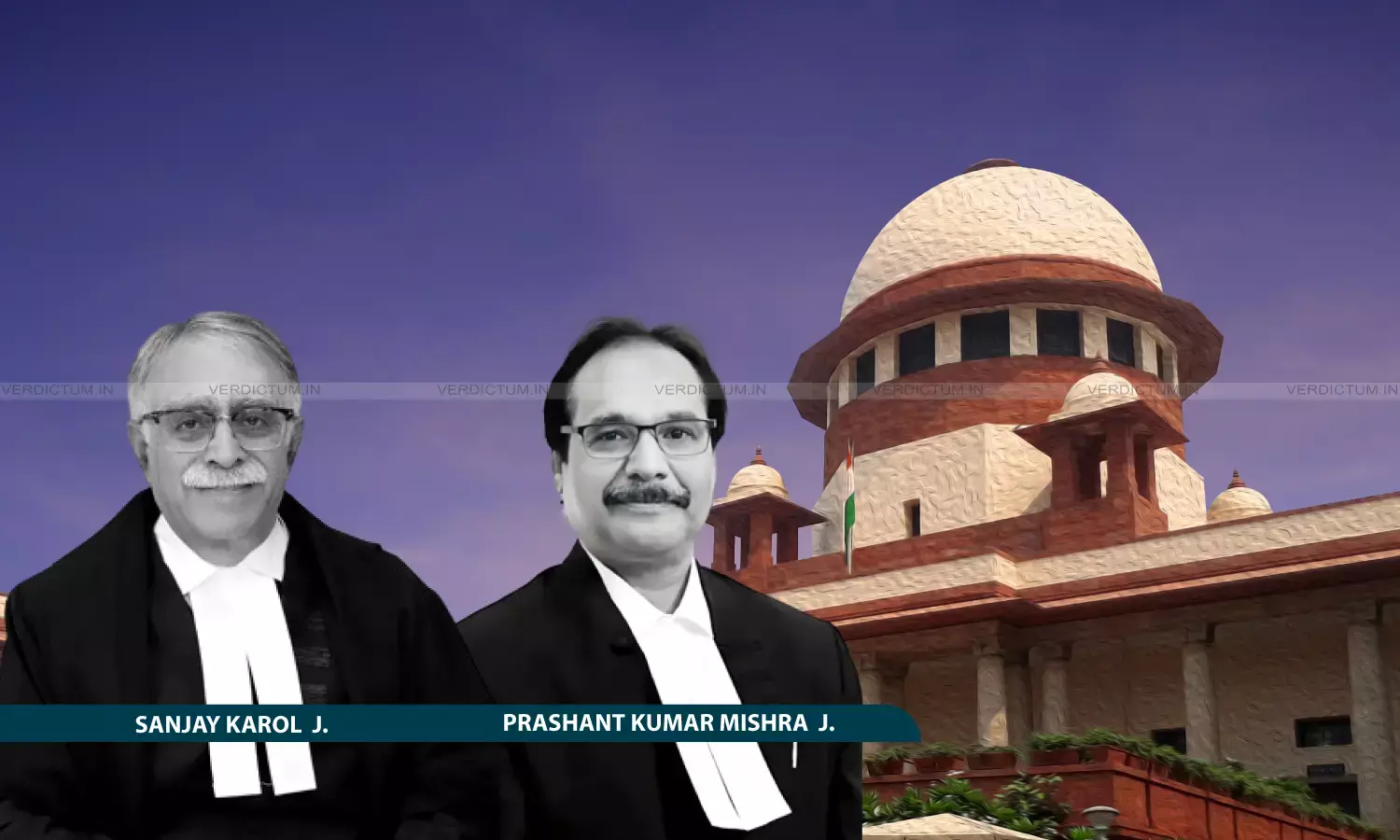
Justice Sanjay Karol, Justice Prashant Kumar Mishra, Supreme Court
The Supreme Court has observed that the fact that multiple cheques arise from one transaction will not merge them into a single cause of action.
The Court observed thus in a batch of Criminal Appeals arising out of two separate Judgments of the Delhi High Court in Petitions seeking quashing of a set of four complaints instituted under Section 138 read with Sections 141 and 142 of the Negotiable Instruments Act, 1881 (NI Act).
The two-Judge Bench comprising Justice Sanjay Karol and Justice Prashant Kumar Mishra emphasised, “It is well settled that under Section 138 of the NI Act, a separate cause of action arises upon each dishonour of a cheque provided the statutory sequence of presentation, dishonour, notice, and failure to pay is complete. The fact that multiple cheques arise from one transaction will not merge them into a single cause of action. In the present case, the cheques forming the subject of the two complaints (Complaint Case No. 2823 of 2019 and Complaint Case No. 3298 of 2019) were distinct instruments drawn on different accounts, presented on different dates, dishonoured separately, and followed by independent statutory notices. The scheme of Section 138 of the NI Act does not bar prosecution in such circumstances.”
The Bench said that even though the powers under Section 482 of the Criminal Procedure Code, 1973 (CrPC) are very wide, its conferment requires the High Court to be more cautious and diligent.
Factual Background
The parties had entered into an Agreement to Sell in 2016 in respect of three commercial units situated in a commercial project named “MGI Mansion”, at Ghaziabad, Uttar Pradesh. The total sale consideration agreed between the parties was Rs. 1,72,21,200/-, which was admittedly paid by the Complainant (Appellant) to the proprietorship firm. Under the terms of the Agreement, the vendor was obliged to execute and register the Sale Deed(s) in favour of the Complainant on or before 30.09.2018, and in the event of failure to do so, the entire amount received was to be refunded to the Complainant together with an appreciation amount by way of compensation. In July 2018, the Respondent No.2 executed a personal guarantee undertaking to ensure refund of the amount together with the appreciation amount in case the sale deeds were not executed to the Complainant within the stipulated period.
To secure the said liability, he also undertook to issue personal cheques corresponding to the firm’s cheques, to provide an alternative mechanism for repayment. Upon the failure of Respondent Nos. 1 and 2 to execute the Sale Deed(s) by 30.09.2018, Respondent No. 1 issued two cheques of that date. In addition, in terms of his personal guarantee, Respondent No. 2 issued two personal cheques. These cheques were handed over to the Complainant with an understanding that the personal cheques could be presented earlier, while the firm’s cheques would be available for presentation later. Acting on such understanding, the Complainant presented the personal cheques for encashment, however, both the cheques were returned dishonoured with the bank’s remark “Exceeds Arrangement”. Subsequently, the Complainant presented the firm’s cheques, which too were returned unpaid with the remark “Funds Insufficient”.
The statutory notice was served to the accused persons, but no payment was made. Hence, complaints were instituted under Section 138 of NI Act. Aggrieved by the institution and continuation of the criminal complaints and the Summoning Orders passed thereafter, the Respondents preferred Petitions before the High Court. The High Court held that the Complainant could not simultaneously maintain two separate complaints in respect of the same debt or liability, merely because separate sets of cheques i.e., one issued in the name of the firm and another personally by its proprietor, had been presented and dishonoured. It was, thus, concluded that continuation of both complaints would amount to parallel prosecution for the same cause of action. This was under challenge before the Apex Court.
Reasoning
The Supreme Court in view of the facts and circumstances of the case, noted, “This Court in catena of judgments has emphasised that the High Court must avoid usurping the function of a Trial Court or conducting a mini trial when disputed factual questions attend the maintainability of a complaint.”
The Court reiterated that the power to quash criminal proceedings must be exercised sparingly, and only where the complaint, even if accepted in full, discloses no offence or continuation would amount to abuse of process of law.
“While examining any complaint or FIR, the High Court exercising its power under this provision cannot go embarking upon the genuineness of the allegations made. The Court must only consider whether there exists any sufficient material to proceed against the accused or not”, it said.
The Court was of the view that the High Court exceeded its jurisdiction and was not justified in quashing Complaint Case and the Summoning Order.
“The complaint on its face discloses the ingredients of offence under Section 138 of the NI Act and must proceed to trial. … On a careful reading of the ingredients required for commission of offence under Section 138 of the NI Act, we find that the record before us clearly indicates that the cheques, as provided above, were dishonoured, statutory notices were served, cheques were returned, and the summons were thereafter issued. On such material, we are of the view that the complaint prima facie stands”, it added.
The Court further said that disputed question of fact qua the offence under Section 138 of the NI Act or any defence that Respondent No. 2 wants to raise against the offence alleged must be done during the trial.
“… we are of the view that the burden of proving whether there exists any debt or liability is something which must be discharged in trial. A bare perusal of Section 139 of the NI Act would indicate that once a cheque is issued in discharge of liability and dishonoured, a presumption of liability in favour of the complainant arises. The accused person is then required to rebut the presumption by raising facts that either there was no debt or liability when the cheque was drawn, or the cheque was not drawn in discharge of liability, or notice was not served in time”, it also observed.
Conclusion
Furthermore, the Court remarked that the statutory presumption attached to the issuance of a cheque, being one made in discharge of a legally enforceable debt or liability, is required to be accorded due weight and therefore, in circumstances where the accused approaches the Court seeking quashing of proceedings even before the commencement of trial, the Court must exercise circumspection and refrain from prematurely stifling the prosecution at the threshold, particularly by overlooking the legal presumption that operates in favour of the Complainant.
“For these reasons, we are of the view that the High Court was justified in not quashing Complaint Case No. 2823 of 2019, Complaint Case No.13508 of 2019 and Complaint Case No. 743 of 2020 registered against Respondent No. 2 herein. The foregoing complaints prima facie discloses the ingredients of offence under Section 138 of the NI Act and must proceed to trial”, it concluded.
Accordingly, the Apex Court allowed the Complainant’s Appeal and set aside the impugned Judgment.
Cause Title- Sumit Bansal v. M/s MGI Developers and Promoters and Another (Neutral Citation: 2026 INSC 40)
Appearance:
Senior Advocate Harshvir Pratap Sharma, AORs Namit Suri, Tejas Patel, Advocates Sameer Rohatgi, Rameezudin Raja, Pepakayala Geetanjali, Anish Singh, Akul Krishnan, Sakshi Apurva, Akul Krishnan, and Sakshi Apurva.
