

Protecting Disability Rights A Facet Of Corporate Social Responsibility: Supreme Court Directs Creation Of Supernumerary Post In Coal India Limited For Visually Disabled Candidate
The Apex Court held that the rights of persons with disabilities must be viewed through the prism of Corporate Social Responsibility, observing that true equality at the workplace can be achieved only when disability rights are treated as an essential component of such responsibility.
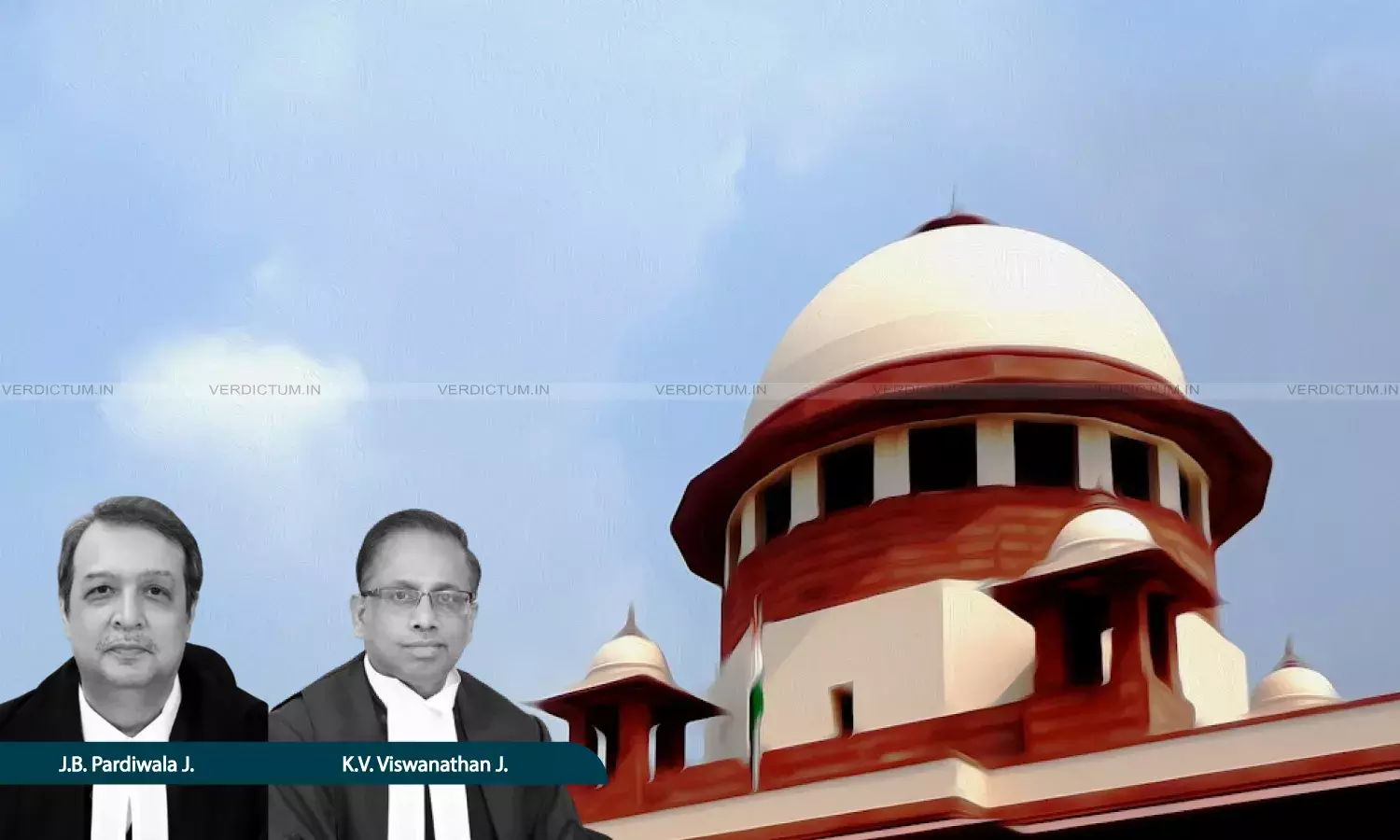
Justice J.B. Pardiwala, Justice K.V. Viswanathan, Supreme Court
The Supreme Court, while directing the creation of a supernumerary post in Coal India Limited for a visually disabled candidate, held that the rights of persons with disabilities have to be viewed as a facet of Corporate Social Responsibility, and that substantive equality at the workplace can be achieved only when appropriate impetus is given to disability rights within institutional and corporate frameworks.
The Court was hearing a civil appeal arising from a judgment of the Calcutta High Court, which had set aside the relief granted by a Single Judge to a candidate with visual disability who was denied appointment as a Management Trainee by Coal India Limited.
A Bench comprising Justice J.B. Pardiwala and Justice K.V. Viswanathan, while allowing the appeal, observed: “rights of persons with disabilities have to be viewed from the prism of Corporate Social Responsibility in order to protect and further such rights. True equality at the workplace can be achieved only with the right impetus given to disability rights as a facet of Corporate Social Responsibility.”
The appellant was represented by Advocate Prashant Srikant Kinjale, while Coal India Limited was represented by Advocate Vivek Narayan Sharma.
Background
Coal India Limited issued an advertisement in 2019 inviting applications for recruitment to the post of Management Trainee. The appellant applied under the Visually Handicapped category and was shortlisted for document verification and Initial Medical Examination.
Although the appellant produced disability certificates certifying visual impairment exceeding the benchmark prescribed under the Rights of Persons with Disabilities Act, 2016, she was declared medically unfit on the ground that she also suffered from residual partial hemiparesis.
Aggrieved, the appellant approached the Calcutta High Court. A Single Judge, after examining the statutory framework, held that Coal India Limited, being a public sector undertaking, was obligated to consider candidates with multiple disabilities and quashed the medical unfitness declaration. However, considering the passage of time, the Single Judge moulded the relief by permitting the appellant to be considered in the subsequent recruitment process, while directing that one post be kept vacant.
In appeal, the Division Bench of the High Court set aside the Single Judge’s order on the ground that the recruitment panel had expired. This led to the present appeal before the Supreme Court.
Court’s Observation
The Supreme Court noted that the appellant had been denied employment pursuant to the 2019 recruitment process through no fault of her own. It was observed that the subsequent expiry of the recruitment panel could not be a valid ground to deprive her of relief, particularly when an interim order had already directed the reservation of a vacancy.
During the proceedings, the Court directed the constitution of a Medical Board at the All India Institute of Medical Sciences, New Delhi, to independently assess the appellant’s disability. Based on the Medical Board’s report, the Court recorded that the appellant suffered from 57% disability, exceeding the benchmark disability threshold prescribed under the Rights of Persons with Disabilities Act, 2016.
The Bench reiterated that the concept of “reasonable accommodation” is central to disability jurisprudence and flows from Articles 14, 21 and 41 of the Constitution of India. It observed that reasonable accommodation is not limited to the provision of assistive devices, but encompasses institutional flexibility to ensure full and effective participation of persons with disabilities in professional life.
The Court referred to its earlier decisions emphasising that denial of reasonable accommodation constitutes discrimination, and that rigid or mechanical application of recruitment norms cannot override statutory and constitutional obligations owed to persons with disabilities.
The Bench further examined the issue from the standpoint of intersectionality, noting that the appellant, as a woman with disability, faced compounded disadvantage. It held that technical objections, such as expiry of recruitment panels, cannot stand in the way of doing complete justice in such cases.
The Court also stressed that disability inclusion is not merely a statutory mandate but also a dimension of Corporate Social Responsibility. Referring to international instruments and policy frameworks, the Court held that public sector undertakings and corporations have a responsibility to respect and advance the rights of persons with disabilities as part of their social obligations.
The Court held that viewing disability rights through the lens of Corporate Social Responsibility is essential to achieve substantive equality and dignified employment for persons with disabilities, while further highlighting that “disability inclusion is a vital component of the 'Social' dimension in the Environmental, Social and Governance (ESG) framework.”
The Court also referred to Section 39 of the Directive Principles of State Policy and reiterated that, DPSPs, though not enforceable, make it incumbent that “the State shall in particular, direct its policy towards securing that the citizens, men and women equally, have the right to an adequate means of livelihood”.
Conclusion
The Supreme Court held that the appellant was wrongly denied employment despite possessing a benchmark disability and qualifying in the recruitment process. It set aside the judgment of the Division Bench of the Calcutta High Court.
Invoking its powers under Article 142 of the Constitution of India, the Court directed Coal India Limited to create a supernumerary post and appoint the appellant as a Management Trainee. It further directed that the appellant be provided a suitable desk job with appropriate accommodations consistent with the principle of universal design under the Rights of Persons with Disabilities Act, 2016, and expressed the expectation that Coal India Limited would post her in a suitable establishment.
The appeal was disposed of in these terms.
Cause Title: Sujata Bora v. Coal India Limited & Ors. (Neutral Citation: 2026 INSC 53)
Appearances
Appellant: Advocates Amol Nirmalkumar Suryawanshi, Prashant Shrikant Kenjale, B Dhananjay, Damini Vishwakarma, with M/s Juristrust Law Offices, AOR
Respondents: Advocates Vivek Narayan Sharma, AOR, Mahima Bhardwaj Kalucha, Akash Singh, Adhiraj Wadhera, Dinesh Sharma, Rajeev Kumar Jha, Shubham Awasthi
