

Stray Dogs Case| "Total Eye Wash": Supreme Court Warns Of Strictures Against States For Filing Vague And Misleading Affidavits
The Court also said that every educational institution is required to be fenced and have boundary walls.

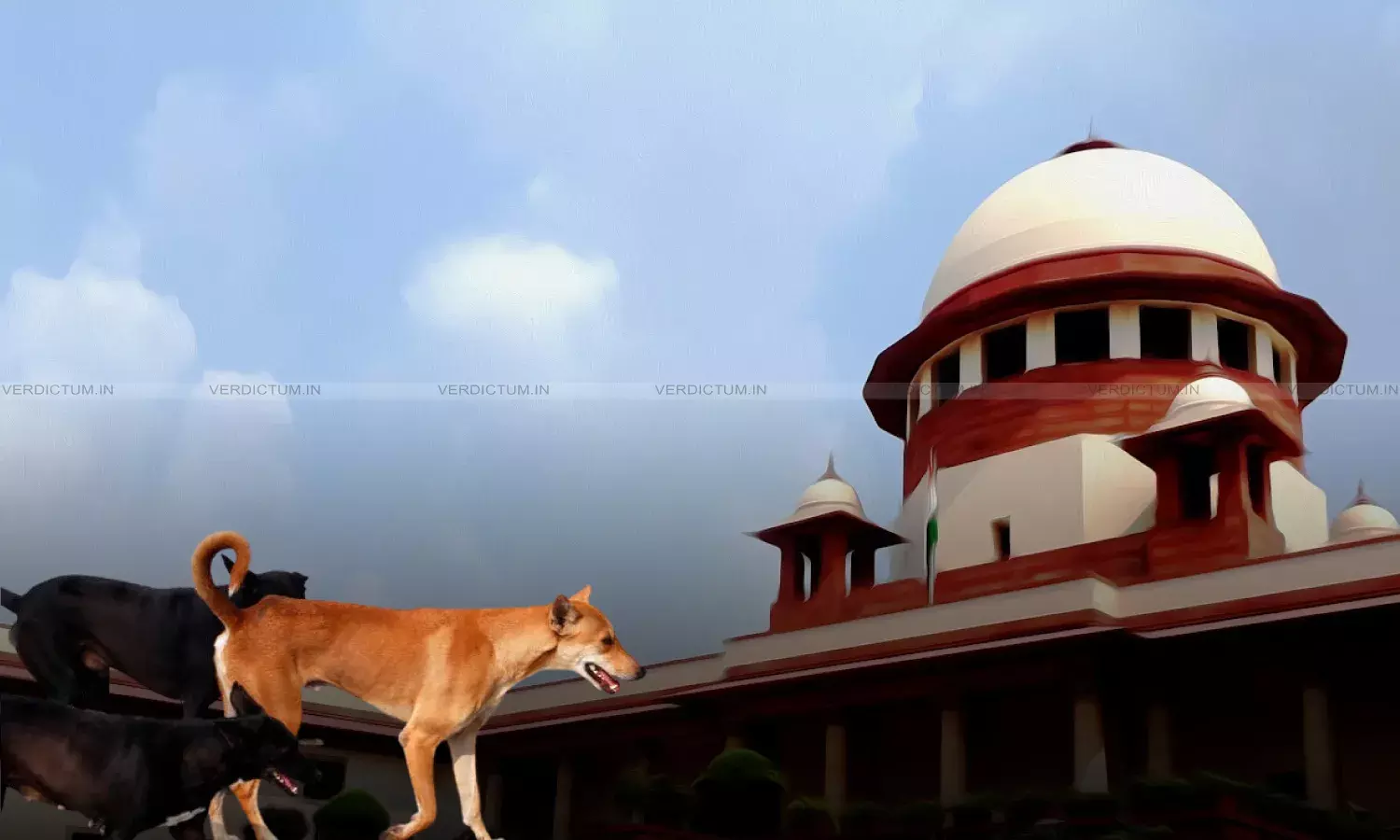
Supreme Court, Stray Dogs
The Supreme Court, today, has remarked that it will pass strong strictures against all the States that have put vague averments in their Affidavits in the matter pertaining to the issue of stray dogs in the country.
Previously, on January 20, 2026, the Court expressed displeasure over former Union minister Maneka Gandhi's remarks criticising the court orders in the stray dog matter, saying that she had committed contempt of court.
The Bench was hearing a suo motu case, initiated on July 28, over a media report on stray dog bites leading to rabies, particularly among children, in the national capital. On August 11, the Court had directed the State of NCT of Delhi, Municipal Corporation of Delhi (MCD) and the New Delhi Municipal Corporation (NDMC) to pick up all stray dogs from the localities and public places in Delhi and put them in shelter homes. Such detained dogs are not be released under any circumstances.
The Bench of Justice Vikram Nath, Justice Sandeep Mehta and Justice NV Anjaria said, "The arguments of Amicus Mr Gaurav Agarwal are continuing. List tomorrow as part-heard at 2 pm."
Amicus Curiae Gaurav Agarwal submitted a comprehensive note to the Bench, organizing his findings for each State into four critical pillars: the operational status of Animal Birth Control (ABC) centres, the establishment of dog shelters, the removal of strays from institutional premises, and the management of cattle ingress on highways.
For Jharkhand, the Court remarked, "We can’t believe this. 1.89 lakh dogs have been sterilised."
Counsel for Jharkhand replied, "Till November, there were twenty-nine thousand were sterilised. The figures have to be subtracted."
The Court remarked, "That means it is 1.6 lakh dogs in 2 months?... One caged vehicle can catch how many dogs in a day?...How do you achieve the figure of one lac figure...It is practically impractical...It is absolutely fudged-up figures."
For the State of Karnataka, the Court said, "This is the only state which has given a number, if stray dogs are in institutions. They have also mentioned an app, i.e., Rajmagra Yatra App, which is a dedicated helpline...linked with State Helpline number..."
Amicus Agarwal replied, "Yes. Although they (stray dogs) have been identified, they have not been picked up."
The Bench remarked to the Counsel for the State of Karnataka, "All these Affidavits that we find, which are incomplete and vague and without any specific information and no honest commitment, we are passing strong strictures against the Government for all the States...You can't put vague information...If you had said you don’t have information and need more time, we would understand. This is a total eye wash in the presence of the Court...We are saying that all the States that have put these vague averments in their Affidavits, total eye wash, will be getting a proper dressing down."
Regarding Andhra Pradesh, the Amicus reported that the State currently operates 39 ABC Centres with a cumulative capacity to sterilize 1,619 dogs daily. However, he emphasized the need for a rigorous audit to determine if these facilities are being utilized to their full potential and called for a strict timeline to establish additional centres. On the issue of public safety in sensitive areas, it was revealed that 14,000 institutions have been identified for dog removal, with 12,000 already having completed mandatory fencing.
The Amicus pressed for detailed explanations regarding the persistent ingress of cattle on highways. Counsel for Andhra Pradesh informed the Court that specific data and mitigation strategies have been detailed in a recent supplementary affidavit, which will be shared with the Amicus for further review.
Amicus Curiae Gaurav Agarwal highlighted a critical infrastructure deficit in Assam, noting that despite having three municipal corporations, the state’s ABC (Animal Birth Control) capacity is virtually non-existent. Currently, only Dibrugarh operates a functional centre. While the state government expressed intent to establish more facilities within six months, the Amicus pointed out that their affidavit lacked a detailed action plan or the logistics required to achieve this goal.
The Court expressed concern over the state’s lack of preparation, noting that the affidavit was entirely silent on the manpower and human resources necessary to run such centres. The Bench clarified that while physical barriers are needed for the 318 identified stadiums and other institutions, it had not strictly mandated expensive "boundary walls"—suggesting that cost-effective solutions like wire fencing or mesh would suffice to secure these areas.
The Court noted that while elevated roads have been built in some areas to protect wildlife, a broader collaboration between the National Highways Authority of India (NHAI) and the State Government is essential to manage animal movement and ensure public safety.
Amicus reported that while Bihar has established 34 ABC centres, their current output is "totally insufficient." To date, only 20,648 dogs have been sterilized out of an estimated population exceeding 6 lakh. Further, it was noted that only 91 dogs are currently housed in pounds, a negligible figure compared to the state's stray population.
Agarwal said, "There are dogs in beaches of Goa and Kerala. They cannot be released back."
The Court said, "They scavenge on leftovers. Fish carcasses, especially from shacks...It will ultimately affect their tourism. SCAORA made us have a first-hand experience..."
For Madhya Pradesh, Counsel admitted that dog catching has stalled due to a severe lack of shelter homes. While 475 dogs are currently housed, the Court noted that a remaining capacity of 300 spaces is still being underutilized. The State has committed to filing an additional affidavit to address this gap.
The State of Maharashtra created a centralized dashboard that tracks real-time data on dog bites, sterilizations, vaccinations, and veterinary centres. The Court suggested that this data-driven model should be emulated by other states to ensure transparency and accountability.
The Bench noted that Odisha has successfully picked up a significant number of dogs from institutional areas. Amicus Gaurav Agarwal recommended that the state now conduct a full audit and establish dedicated ABC centres in high-traffic tourist zones like Puri and Konark to ensure long-term population control.
For Haryana, the Amicus submitted that the Affidavit lacked proper information on steps that have been taken to remove dogs from institutional areas. "In a large number of area, there has been no implementation of ABC Rules, so on this aspect they have to tell the Court," he said.
ASG SD Sanjay appeared for Delhi and submitted, "Chief Secretary of Delhi has filed a detailed affidavit. NDMC is a small area. Rest is taken care by MCD."
The Court said, "If they are sterilising 68000 dogs in 8 months, it will be around 80000 in a year. It will not be sufficient to reduce the dog population."
Justice Sandeep Mehta remarked, "I had gone to a society a couple of days back, there was a board which said 'Iss gali me kaatne wale kutte rehte hai'. So you don't walk then? At least they were decent enough to put a board."
Background
Previously, the Court said that it will consider the imposition of heavy compensation for States for not making the requisite arrangements and the dog feeders for every dogbite and death.
On January 9, 2026, the Supreme Court said it would not go into the allegations of harassment of women dog feeders and caregivers by purported anti-feeder vigilantes since it was a law-and-order issue, and the aggrieved persons could lodge FIRs about it.
The Supreme Court proceedings on January 9, 2026, highlighted a deep divide between public safety concerns and the scientific management of stray dogs. Senior Advocate Menaka Guruswamy argued that the ABC Rules 2023 are the result of decades of parliamentary deliberation and that sterilization, not culling, remains the only effective solution. She blamed the current "catastrophe" on regulatory failure and the underutilization of funds. However, the Bench expressed frustration with the lack of progress, with Justice Nath warning that the Court might fix heavy compensation on States and dog feeders for every bite or death, emphasizing that the effects of a dog bite are lifelong.
Senior Advocate Arvind Datar strongly challenged the ABC Rules, calling them ultra vires and in conflict with over 60 laws. He raised an ecological alarm regarding 50,000 feral dogs in Ladakh threatening endangered species like the snow leopard. Datar further argued that street dogs have no right to reside in public institutions or gated communities if the majority of residents oppose them.
Justice Mehta supported this concern by citing the "terminal" threat of canine distemper virus spread by dogs to forest wildlife and comparing the situation to the invasive python crisis in Florida.
On the welfare side, Senior Advocate Pinky Anand and others argued that mass removal is counterproductive due to the "vacuum effect," where more aggressive dogs move into cleared territories. They suggested that dogs also play a vital role in urban ecosystems by controlling rodent populations. Counsel for singer Mohit Chauhan and other advocates pushed for the formal recognition of "individual feeders" as partners to authorities, suggesting that compassionate management and adoption policies for "Indie" breeds are more sustainable than relocation.
The Court also addressed massive logistical hurdles, including a severe shortage of accredited ABC centers—only 76 nationwide to manage 5.2 crore dogs. Senior Advocate Krishnan Venugopal estimated a requirement of ₹26,800 crore for infrastructure and proposed a 60:40 fund-sharing model between the Centre and States. With the Bench growing weary of the lengthy arguments, Justice Mehta remarked that the proceedings had become more of a "public platform" than a court case, noting that "no one has argued for human beings so compassionately" as they have for animals.
The Court, on January 7, 2026, had remarked against the local authorities for their failure to monitor and implement statutory rules effectively, leading to an uncontrollable surge in stray animal incidents.
The Court, on August 22, had partially modified its previous order directing the capture and shifting of dogs from the streets in Delhi NCR. The Three Judges Bench directed that the stray dogs that will be picked up shall be sterilized, vaccinated and released back to the same area from which they were picked up. However, stray-dogs inflicted with rabies or with aggressive behaviour were not to be released into the streets. The court has also proposed to expand the scope of this matter beyond the confines of New Delhi and the NCR region.
While responding to a Petitioner in the stray dogs case who objected to some Rules framed by the Delhi Municipal Corporation (DMC), saying 'inhuman' treatment was being meted out to them, the Supreme Court had said that a video will be played in the next hearing, "asking you what is humanity".
On November 7, taking note of the "alarming rise" in dog bite incidents within institutional areas like educational institutions, hospitals and railway stations, the Apex Court had directed the forthwith relocation of stray canines to designated shelters after due sterilisation and vaccination.
Previously, while hearing the Suo-Moto Writ Petition on the issue of dog-bites reported in Delhi and the areas on the outskirts, urged genuine stray dog lovers to take care and upkeep of the stray dogs responsibly at the dog shelters or pounds. The Court urged thus while directing the State of NCT of Delhi, Municipal Corporation of Delhi (MCD) and the New Delhi Municipal Corporation (NDMC) to pick up all stray dogs from the localities and public places in Delhi and put them in shelter homes.
Cause Title: In Re: City Hounded By Strays, Kids Pay Price vs. The State Of Andhra Pradesh [SMW(C) No. 5/2025 Diary No. 41706/2025]