

Admission In Govt. College Doesn’t Mean Right To Appointment Is Automatically Implied: Supreme Court Sets Aside Direction To Consider Candidates For Appointment As Ayurvedic Staff Nurse
The appeal before the Supreme Court was filed by the State challenging the judgment passed by the Division Bench of the Allahabad High Court.

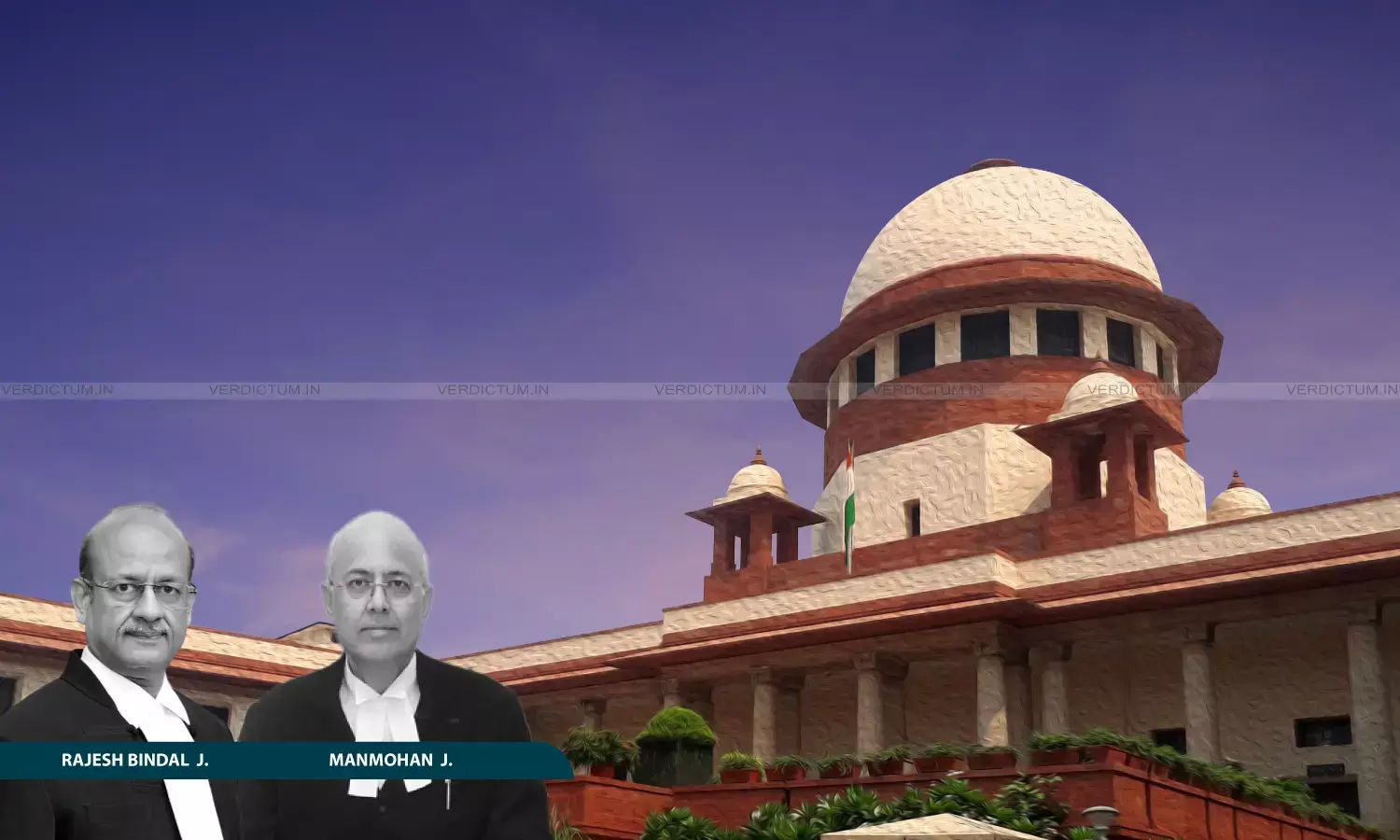
Justice Rajesh Bindal, Justice Manmohan, Supreme Court
While allowing an appeal filed by the State, the Supreme Court has set aside a direction of the Allahabad High Court mandating the State to consider the candidature of respondents for appointment as Ayurvedic Staff Nurse in a Medical College, Hospital or Dispensary under the State Government. The Bench held that while advertisements for private colleges explicitly state that admission does not grant a right to appointment, the absence of this specific disclaimer in government college advertisements does not mean a right to appointment is automatically implied.
The appeal before the Apex Court was filed by the State challenging the judgment passed by the Division Bench of the Allahabad High Court.
The Division Bench of Justice Rajesh Bindal and Justice Manmohan held, “The available vacancies with the government being less, the normal rule provides for a selection process to be followed so that the best available candidate is selected. There is no violation of Article 14 as, in the facts of this case, it cannot be opined that there was any discrimination against the respondents or that the action of the State was arbitrary. The essence of discrimination is the unequal treatment of equals; however, the State has clearly established that no appointments were made under the old system for any candidate admitted after the 2010-11 session.”
“While advertisements for private colleges explicitly state that admission does not grant a right to appointment, the absence of this specific disclaimer in government college advertisements does not mean a right to appointment is automatically implied”, the order read.
AOR Sakshi Kakkar represented the Appellant while Advocate Varun Singh represented the Respondent.
Factual Background
An advertisement was issued in 2013 inviting applications for admissions to the Ayurvedic Nursing Training Course for the year 2013-14. The notice suggested that for the aforesaid session, the admission was for 20 seats in the Government Ayurvedic College and Hospital, Lucknow. Clause 9 of the advertisement provided that after completion of training, in case the government selects any candidate for mandatory service, it shall be incumbent for the candidate to serve the State at least for a period of 5 years from the date of appointment. The candidates had to submit a bond stating that after training, in case they were appointed by the State government, they shall compulsorily serve the State for at least 5 years.
Prior to the issuance of the aforesaid advertisement, a notification was issued specifying that Ayurvedic Nursing Training Course in Ayurvedic and General Nursing (Unani Nurses) could be conducted by the institutions both in the government and non-government sectors. The respondent was notified about her selection and was required to appear and complete the formalities to be considered for admission in the Ayurvedic Nurses Training Session 2013-14. After the respondent completed her training course in the year 2017, it was claimed that she sent a representation to the competent authority seeking an appointment. When she passed out in the year 2017, there was a change in the policy. The selection to the post of Ayurvedic Staff Nurse was to be made by the UPSSSC. To expedite the decision thereon, the respondent filed a Writ Petition before the High Court, seeking a direction for her appointment, but the same wasrejected.
The aforesaid rejection order was challenged by the respondent by filing a Writ Petition before the High Court. Definite stand taken by the State before the High Court was that mere admission in the course did not give any right of appointment. The aforesaid Writ Petition was allowed by the High Court. The State preferred an intra-court appeal. The same was dismissed vide the impugned order. The opinion of the High Court was that the case of the respondent fell within the principles of legitimate expectation as the erstwhile policy, which was in accordance with the Government Order, had been followed for a number of years. The candidates who were admitted to the course were appointed immediately after the completion of their training. It was the case of the State that the condition in the advertisement regarding the five-year bond was only in case of selection for the post of Ayurvedic Nurse Staff, but that did not entitle them to appointment.
Reasoning
On a perusal of the advertisement inviting applications for the course of Ayurvedic Nursing Training, the Bench noticed that Clause 9 in the advertisement clearly stated that a candidate who is finally selected for the mandatory service-training by the State Government shall have to execute a bond in favour of the government. It stipulated that only in case the candidate is appointed after training, he/she shall compulsorily serve the government for at least 5 years. It was further noticed that the bond was meant for the candidate selected for the government service.
Considering the fact that the number of pass-outs had far outnumbered the available vacancies, the Bench stated that it was impossible to recruit all the pass outs. “Besides, appointing candidates passing out of government institutions and not offering the same to the candidates passing out of private institutions would have led to discrimination”, it added.
The Bench found that the respondent-candidates had failed to identify any specific clause in the advertisements for admission to the course that guarantees a right to appointment upon admission. The Bench noticed that the Statutory rules governing the post had not been framed earlier, and the same came to be framed in the year 2021. There was a change in the process of selection, as earlier the selection was being made by UPPSC, now it was being made by UPSSSC. Further, after the change in policy of the government permitting private institutions to impart training for the Ayurvedic Nursing Training Course, the availability of candidates was much higher compared to the earlier regime, where only 20 seats in the government institution were there.
Considering that no batchmates of the respondent, nor any other candidates passing out after the first private college batch in 2016, were given direct appointments, the Bench noted that there was no instance of a similarly situated person being treated preferentially. The respondent had failed to point out a single candidate from her own batch or subsequent batches who was directly appointed by the State, thereby rendering the plea of discrimination factually and legally unsustainable.
Thus, allowing the appeal, the Bench set aside the impugned judgment of the High Court.
Cause Title: State of Uttar Pradesh v. Bhawana Mishra (Neutral Citation: 2026 INSC 38)
Appearance
Appellant: AOR Sakshi Kakkar, Advocates Mrigank Mishra, Shakti Singh
Respondent: Advocates Varun Singh, Alankriti Dwivedi, Somesa Gupta, Shivam Sharma, AOR Mudit Gupta, AOR Talha Abdul Rahman, Advocates M Shaz Khan, Sudhanshu Tewari, Faizan Ahmed, Rafid Akhter