"Eradication Of Dowry Is A Constitutional And Social Necessity": Supreme Court Issues Nationwide Directions To Combat Dowry Practices
Emphasising that dowry is a deeply entrenched social evil incompatible with constitutional values, the Apex Court issued comprehensive directions aimed at education, enforcement, institutional accountability, and social reform, as a measure to counter persisting dowry practices.
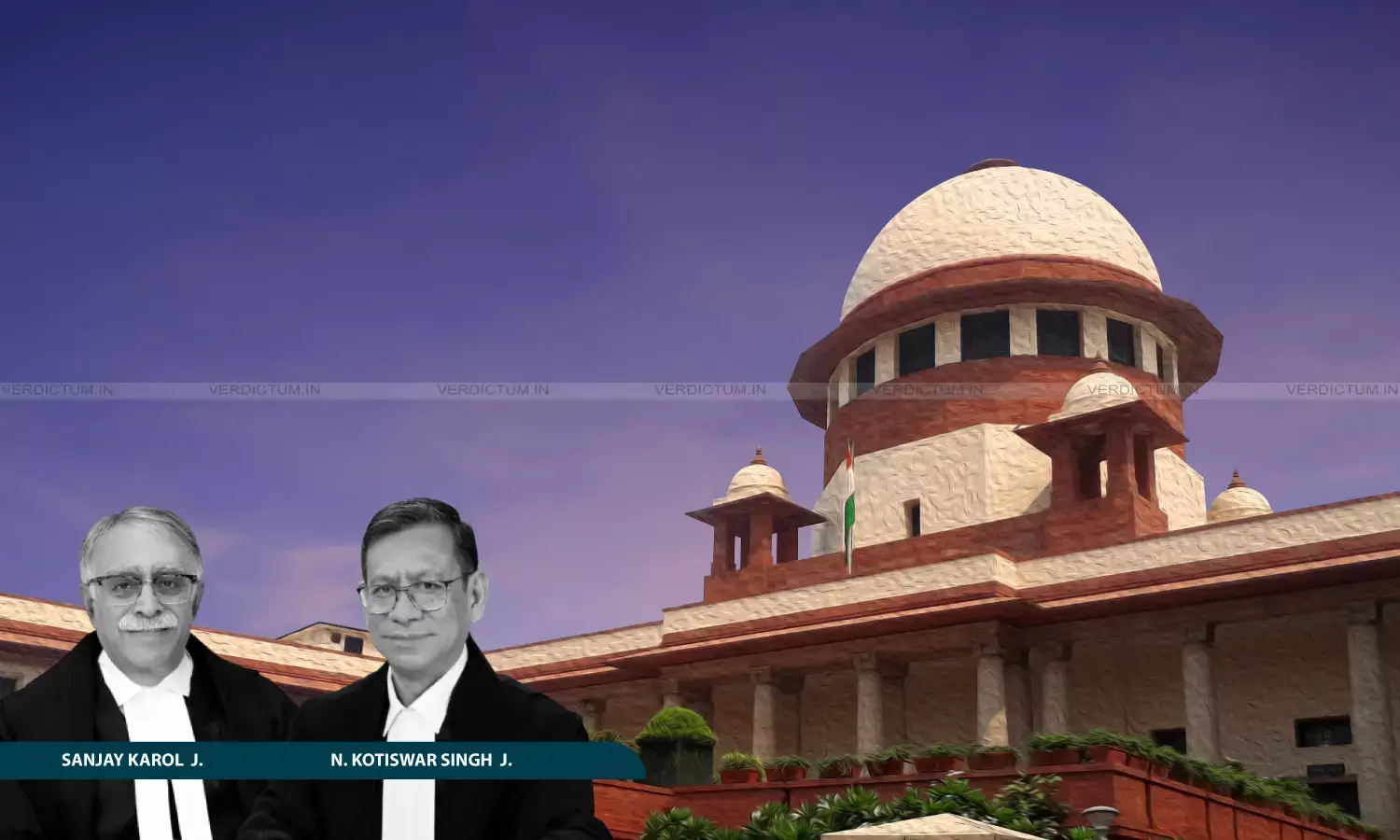
Justice Sanjay Karol, Justice Nongmeikapam Kotiswar Singh, Supreme Court
While issuing a series of nationwide directions to address the continuing prevalence of dowry-related cruelty and deaths across the country, the Supreme Court observed that the eradication of dowry is an urgent constitutional and social necessity.
The Apex Court was hearing criminal appeals filed by the State of Uttar Pradesh challenging the judgment of the Allahabad High Court, which had set aside the findings recorded by the Trial Court in a case arising out of allegations of cruelty and death of a woman in connection with dowry demands.
The appeals arose from proceedings in which the prosecution alleged persistent harassment and cruelty linked to dowry demands, leading to the unnatural death of the victim.
A Bench comprising Justice Sanjay Karol and Justice N Kotiswar Singh, while observing that “eliminating dowry is not only a matter of enforcing the DPA 1961 but a constitutional imperative to fulfil the Republic’s promise that every woman should enter marriage as an equal citizen and not as the bearer of an unjust financial burden”, issued a series of directions to ensure a concentrated effort on the part of the Legislature, Law Enforcement Agencies, Judiciary, and Civil Society Organizations in order to curb the menace.
Background
In this specific matter that reached the Supreme Court, the prosecution's case was that the deceased was subjected to repeated demands for dowry after her marriage and was harassed and assaulted on account of non-fulfilment of such demands. Evidence on record indicated that demands were reiterated shortly before her death.
The Trial Court, upon appreciation of the oral and documentary evidence, recorded findings that the essential ingredients of dowry-related offences stood established. The Allahabad High Court, however, reversed the findings, disbelieving key prosecution witnesses and holding that the alleged dowry demands were improbable.
Aggrieved by the reversal, the State approached the Supreme Court, contending that the High Court had failed to apply the statutory framework governing dowry deaths.
Court’s Observation
The Supreme Court, at the outset, undertook an extensive discussion on the historical evolution of dowry, noting that the practice predates modern legal systems and has existed in various forms across communities. In the context of Hindu society, the Court observed that dowry was historically intended as a form of voluntary gifting meant to provide financial security to women. Over time, however, this practice became distorted into a coercive demand, transforming into an instrument of determination of societal status, exploitation and control.
The Court further observed that dowry, in its current form, is not confined to any one religion or community. Referring to Muslim society, the Court noted that despite Islamic law recognising “mehr” as a mandatory obligation of the husband towards the wife, the practice of dowry has nonetheless permeated sections of Muslim society as well, operating in contradiction to religious principles. The Court emphasised that dowry has thus become a cross-cultural social evil cutting across religious, regional, and economic boundaries.
Turning to contemporary realities, the Court referred to official data placed on record reflecting the alarming number of cases registered annually under Sections 498-A and 304-B of the Indian Penal Code. The Court noted that incidents of cruelty by husband or relatives and dowry deaths continue to be reported in significant numbers, demonstrating that the menace of dowry remains widespread despite the enactment of the Dowry Prohibition Act, 1961 and penal provisions under criminal law.
The Court observed that the persistence of such figures underscores the inadequacy of legislative measures when not supported by effective enforcement, awareness, and societal change. It held that dowry-related violence strikes at the core of constitutional guarantees under Articles 14, 15, and 21, perpetuating systemic gender inequality and undermining the dignity of women.
"While on the one hand, the law suffers from ineffectiveness and so, the malpractice of dowry remains rampant, on the other hand, the provisions of this Act have also been used to ventilate ulterior motives along with Section 498-A, IPC. This oscillation between ineffectiveness and misuse creates a judicial tension which needs urgent resolution", the Court remarked. The Court, however, underscored that "when it comes to the giving and taking of dowry, this practice unfortunately has deep roots in society, hence, it not being a matter of swift change, instead needs concentrated effort on part of all the involved parties, be it Legislature, law enforcement, Judiciary, civil society organizations etc".
Against this backdrop, the Court issued a set of directions aimed at addressing dowry practice at multiple levels. The Court directed that awareness against dowry be incorporated into educational curricula to instil constitutional values from an early age, emphasising that "it is to be ensured that the future generation, youngsters of today, are informed and made aware about this evil practice and the necessity to eschew it".
The Court further emphasised the need for effective appointment, training, and monitoring of Dowry Prohibition Officers to ensure meaningful enforcement of the law, stressing that "it is to be ensured that these officers are duly deputed, aware of their responsibilities and given the necessary wherewithal to carry out the duties entrusted to them".
The Court further directed that police officers, prosecutors, and judicial officers dealing with dowry-related offences undergo periodic sensitisation and training to ensure proper appreciation of evidence and application of statutory presumptions. It also directed High Courts and State Governments to ensure expeditious disposal of dowry-related cases and to monitor the effective implementation of existing statutory frameworks.
Taking note that "the instant case began in 2001 and could only be concluded 24 years later by way of this judgment", the Apex Court directed the High Courts "to take stock of the situation, ascertain the number of cases pending dealing with Section 304-B, 498-A from the earliest to the latest for expeditious disposal."
Additionally, the Court underscored the role of Legal Services Authorities and district administrations in conducting community-level awareness programmes, engaging civil society, and addressing the social acceptance of dowry practices. The Court emphasised that the eradication of dowry requires sustained institutional commitment alongside societal transformation.
The Court further directed that a copy of the judgment be circulated electronically to the Registrars General of all High Courts for placing it before the respective Chief Justices for appropriate directions, and also to the Chief Secretaries of all States for necessary follow-up action. The States were directed to file affidavits indicating compliance with the directions issued to them, and the High Courts were similarly directed to place on record their compliance with the directions addressed to them.
Conclusion
In the case at hand, the Supreme Court held that the High Court had erred in interfering with the findings recorded by the Trial Court and had failed to properly apply the statutory presumptions governing dowry-related offences. The Court concluded that the evidence on record satisfied the legal requirements for attracting the relevant provisions.
Accordingly, the Supreme Court allowed the appeals filed by the State and restored the findings recorded by the Trial Court, subject to the modifications and considerations with regard to the sentencing.
The Court directed that the matter be listed after four weeks to monitor compliance with the directions issued and to pass any further orders if required.
Cause Title: State of Uttar Pradesh v. Ajmal Beg & Ors. (Neutral Citation: 2025 INSC 1435)
Appearances
Appellants: Advocates Abhishek Saket, Sudeep Kumar, AOR, Amruta Padhi, Chanchal Sharma, Manisha, Rupali
Respondents: Advocates Sadhna Sandhu, AOR, Shekhar Kumar, AOR, Bhanu Pratap Gupta, Shikha Sandhu, Rita Gupta, Nikhil Kumar Sharma, Shantanu Krishna, AOR (A.C.)