

Directing Time-bound Investigation Must Remain Exception Rather Than Norm: Supreme Court
The State of Uttar Pradesh filed an appeal before the Supreme Court challenging the judgment and orders of the Allahabad High Court in petitions for quashing preferred by the accused persons.

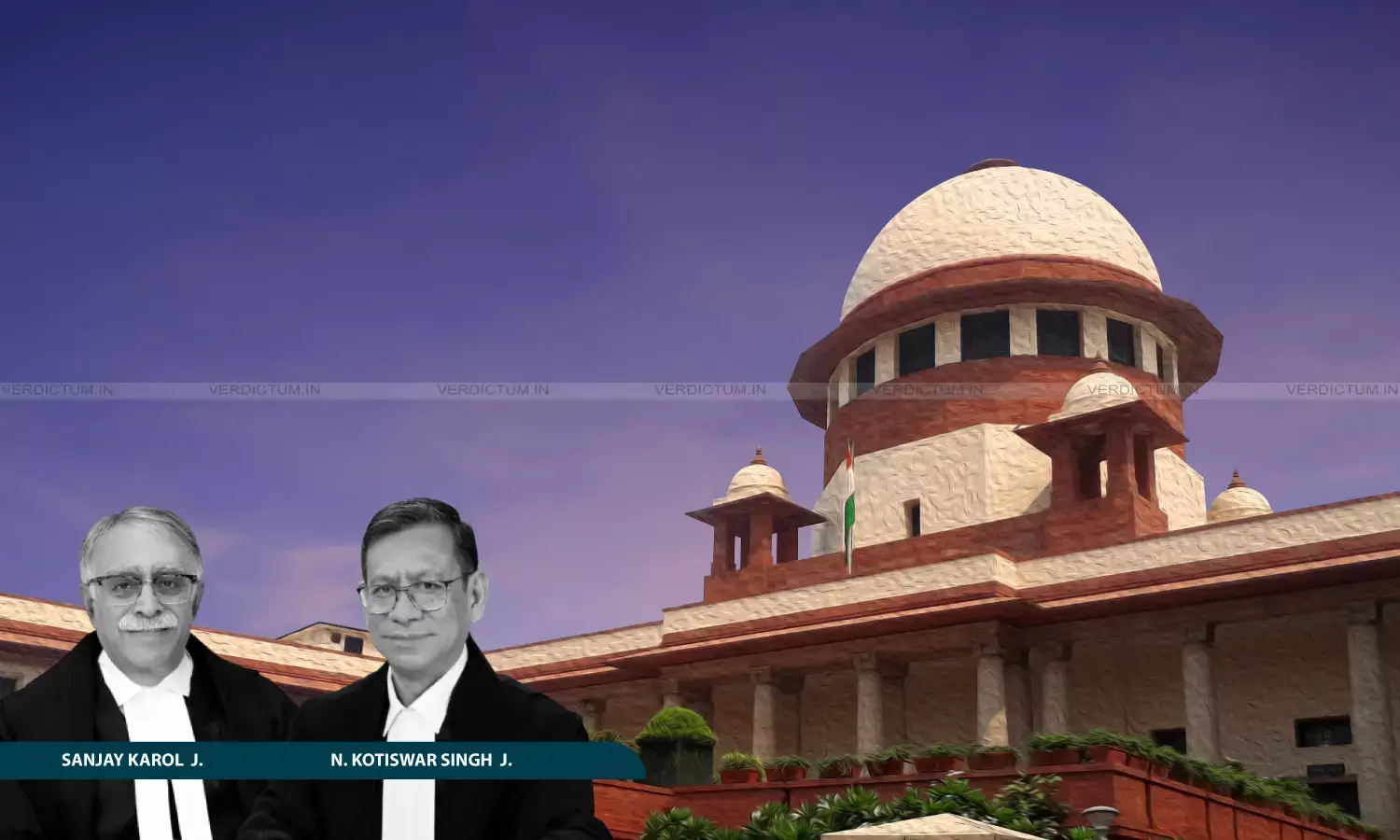
Justice Sanjay Karol, Justice Nongmeikapam Kotiswar Singh, Supreme Court
The Supreme Court has set aside a direction granting protection from arrest to the accused persons till the taking of cognisance by the concerned court. This direction of the Allahabad High Court was passed while disposing of a petition for quashing. The Apex Court also reaffirmed that directing a time-bound investigation must remain the exception rather than the norm.
The State of Uttar Pradesh filed an appeal challenging the judgment and orders of the Allahabad High Court in petitions for quashing preferred by the accused persons in a case registered under Sections 420, 467, 468, 471 of the Indian Penal Code, 1860 and Sections 3,25,30 of the Arms Act 1959.
The Division Bench of Justice Sanjay Karol and Justice Nongmeikapam Kotiswar Singh held, “The text of the order in no way provides or attempts to provide, as in Shobhit Nehra (supra), any justification for granting protection from arrest despite the position of law laid down in Neeharika (supra). Without going further into the issue, we set aside the condition.”
"Courts have consistently recognized that directing a timebound investigation must remain the exception rather than the norm. Investigation is, as can be seen from the above discussion, a product of many factors and happenings apart from the crime itself, that lend to it a sense of uncertainty and the law therefore accords investigating agencies a reasonable degree of latitude", it added.
AOR Ruchira Goel represented the Appellant while Senior Advocate Pradeep Kumar Rai represented the Respondent.
Factual Background
The case arose from an investigation directed by the Senior Superintendent of Police, STF Headquarters, Lucknow, pursuant to an anonymous petition which, during inquiry, culminated in a statutory complaint. The complaint alleged that certain persons had procured and used arms licenses by submitting forged documents and false affidavits. Acting on these directions, the STF conducted an inquiry. The investigation found serious irregularities and it was recommended that a criminal case be registered and further investigation be conducted hereinto. The FIR thus came to be registered.
All three accused - respondents filed petitions before High Court under Article 226 of the Constitution which were closed as disposed of, and not allowed. The investigating officer was directed to complete the investigation into the alleged offence within 90 days and it was further ordered that the accused would not be arrested till the concerned court took cognizance of the matters. The State thus approached the Apex Court opposing the protection from arrest, being contrary to the law laid down in Neeharika Infrastructure Pvt. Ltd. v. State of Maharashtra (2021).
Reasoning
The Bench affirmed that the writ jurisdiction of the High Courts under Article 226 of the Constitution is wide and extends to criminal matters as well. The Bench also explained that the writ jurisdiction has also been exercised in criminal matters for purposes other than quashing. Coming to the aspect of investigations and trials, the Bench stated that speedy trial, which necessarily includes timely and diligent investigation, has been recognized as an integral part of Article 21 of the Constitution and is essential to the fairness and credibility of the criminal justice system. Undue delay prejudices not only the accused, whose liberty and reputation remain under a cloud, but also the victim and society at large, for whom justice loses meaning when it is endlessly deferred.
“Courts have consistently recognized that directing a timebound investigation must remain the exception rather than the norm. Investigation is, as can be seen from the above discussion, a product of many factors and happenings apart from the crime itself, that lend to it a sense of uncertainty and the law therefore accords investigating agencies a reasonable degree of latitude. At the same time, the Constitution does not permit investigations to remain open-ended. The Supreme Court has long held that the right to a speedy trial, which necessarily includes a timely and diligent investigation, forms an essential part of Article 21, as first recognized by a Constitution Bench in Hussainara Khatoon v. State of Bihar, and later elaborated by another Constitution Bench in Abdul Rehman Antulay v. R.S. Nayak…”, the order read.
The Bench further held, “The necessary conclusion to be drawn from the above discussion is that timelines are not drawn by the Court to be followed by the investigators/the executive right from the beginning, for that would clearly amount to stepping on the toes of the latter."
"Timelines are therefore imposed at a point where not doing so would have adverse consequences i.e., there is material on record demonstrating undue delays, stagnation, or the like. In sum, timelines are imposed reactively and not prophylactically. As such, the timelines imposed by the High Court need to be interfered with and set aside. Ordered accordingly", it stated.
Dealing with the aspect of protection from arrest, the Bench referred to Neeharika (supra) where the Supreme Court has cautioned the High Courts against passing such orders of not to arrest or “no coercive steps to be taken” till the investigation is completed and the final report is filed, while not entertaining quashing petitions under Section 482CrPC or Article 226 of the Constitution of India.
Allowing the appeal, the Bench ordered that the interim protection in favour of the respondents would continue to operate for the next two weeks, after which, all actions as permissible in law would follow.
Cause Title: State of U.P. v. Mohd Arshad Khan (Neutral Citation: 2025 INSC 1480)
Appearance
Appellant: AOR Ruchira Goel
Respondent: Senior Advocate Pradeep Kumar Rai, Advocates Farhat Naim, Rajshree Rai, Vinay Kumar Rai, Modoyia Kayina, Shreyansh Singh, Paras Chauhan, Vaibhav Agarwal, Parimal Rai, AOR M/S R And R Law Associates, AOR Anil Kumar, Advocates Warisha Farasat, Abhishek Babbar, Suvarna Swain,