

State Can Withdraw Tax Exemptions In Public Interest But Must Give Reasonable Notice To Beneficiaries: Supreme Court
The Court said that policy withdrawal should not operate in a manner causing sudden fiscal shock.

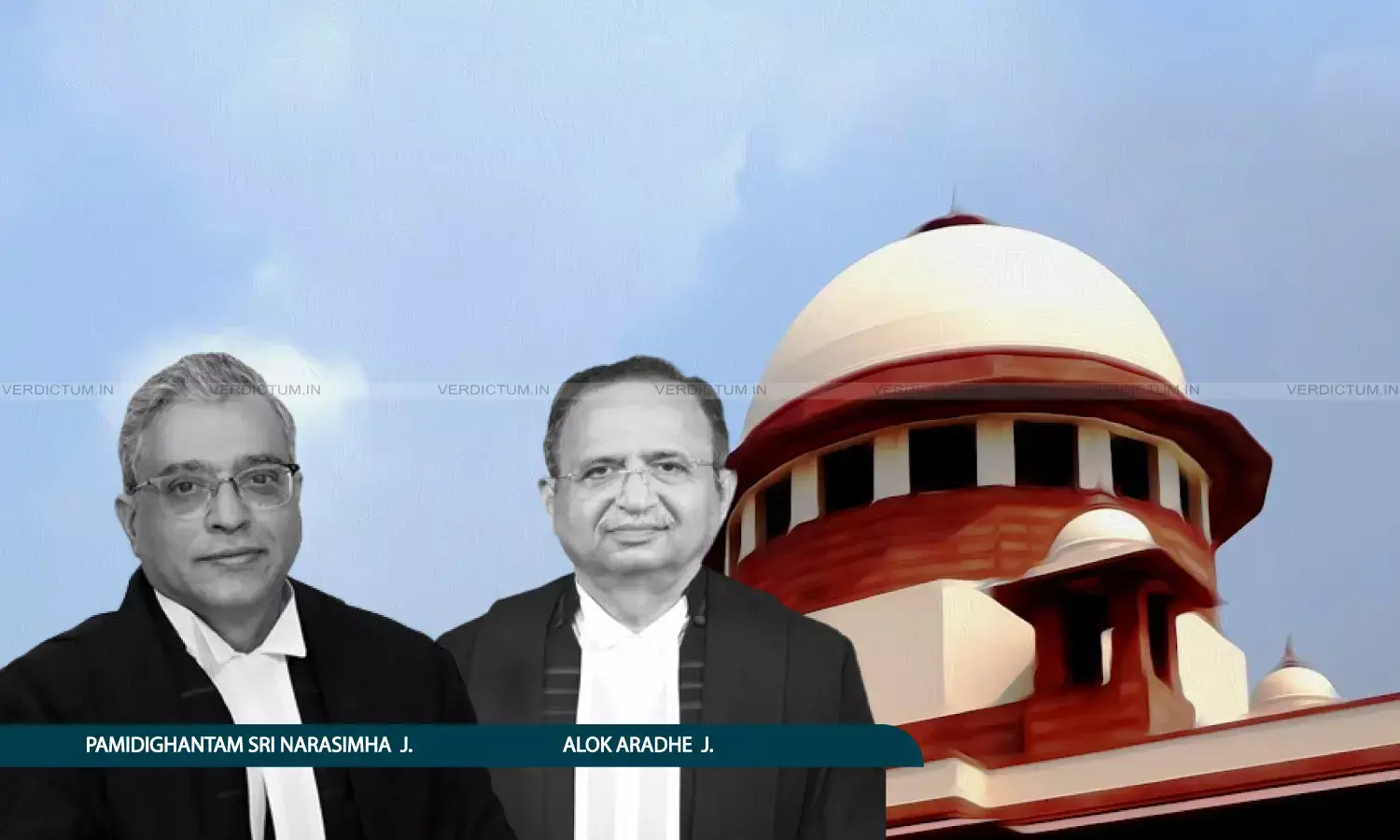
Justice Pamidighantam Sri Narasimha and Justice Alok Aradhe, Supreme Court
The Supreme Court has held that tax or duty exemptions granted by the government are in the nature of policy concessions and can be withdrawn or modified in public interest. However, at the same time, the Court clarified that such withdrawal must be implemented with a reasonable notice period to avoid undue hardship to beneficiaries who structured their commercial affairs relying on the concession.
Observing that policy withdrawal should not operate in a manner causing sudden fiscal shock, the Court held that a reasonable notice period must precede implementation of such decisions. Considering the facts of the case, the Bench held that a period of one year would constitute adequate notice enabling captive power generators to reorganise their financial and operational arrangements.
Justice Pamidighantam Sri Narasimha and Justice Alok Aradhe delivered the judgment while allowing appeals filed by the State of Maharashtra challenging Bombay High Court judgments that had quashed notifications withdrawing electricity duty exemptions granted to captive power generators. “…While the State, undoubtedly possesses the power to withdraw or modify a concession granted under a statutory provision, the manner in which such statutory power to withdraw exemption is exercised, must also satisfy the requirements of reasonableness and fairness. The principles of fair play demand that such withdrawal should not operate in a manner that causes undue hardship to those who have structured their affairs on the basis of concession earlier extended to them. This Court recognized the principle that Government may withdraw or modify a concession in exercise of statutory power. At the same time, it was held that Government ought to resile from its stand by giving reasonable notice so as to afford the beneficiary a reasonable opportunity to reorganise their affairs provided such a course is feasible. The rationale behind the principle is that the persons who have structured their commercial or industrial activities on the basis of a concession should not be subjected to abrupt policy reversals which leave them without reasonable time to adjust to the altered regulatory framework”.
“…captive power generators had been enjoying exemption from electricity duty for a considerable period from 1994. The industrial units would naturally have organised their financial and operational arrangements on the basis of the concession extended to them. The sudden withdrawal of the exemption without providing a reasonable transitional period to the industries had the effect of placing the captive power generators in a position to immediately bear an additional fiscal burden. The legitimate object of withdrawal of exemption is not such an urgent or time sensitive measure as to preclude the grant of a reasonable notice period to the affected industries”.
Senior Advocate Shyam Mehta appeared for the appellant and Senior Advocates Basava S Prabu Patil, Harish M Jagtiani, C. S. Vaidyanathan appeared for the respondent.
The dispute concerned exemptions issued under Section 5A of the Bombay Electricity Duty Act, 1958, through which industries generating electricity through captive power plants for self-consumption were exempted from electricity duty since 1994. The exemption was introduced as a policy measure aimed at encouraging industrial self-sufficiency in power generation and reducing pressure on public electricity supply systems.
In April 1, 2000 and April 4, 2001, the State Government issued fresh notifications modifying and partially withdrawing the exemption, citing fiscal considerations and the need to augment public revenue. Captive power producers challenged the decision before the Bombay High Court, which held the withdrawal to be arbitrary, discriminatory and lacking justification, and consequently struck down the notifications.
Before the Supreme Court, the State argued that exemption from taxation is merely a statutory concession and that the authority empowered to grant such exemption inherently retains the power to withdraw it. It was contended that doctrines such as promissory estoppel and legitimate expectation cannot restrict governmental policy decisions taken in public interest, particularly in fiscal matters.
Accepting this contention, the Court observed that an exemption under a fiscal statute is a privilege relieving a person from a liability otherwise payable under law. The beneficiary, the Court held, possesses no legally enforceable right to insist upon continuation of such concession indefinitely, and the right to enjoy an exemption remains defeasible and subject to change.
“The judicial review in such a policy matter is confined to examining whether decision is manifestly arbitrary, discriminatory or actuated by extraneous consideration. The courts do not undertake a detailed evaluation of the wisdom, sufficiency or effectiveness of an economic policy, for such assessment properly belongs to the domain of the Government and the experts advising it. The decision to withdraw and modify the exemption has been taken in public interest and therefore doctrines of legitimate expectation and promissory estoppel have no application to the facts and circumstances of the case. Therefore, the decision to withdraw and modify the exemption can neither be termed as arbitrary nor unreasonable”, the Court noted.
The Bench further emphasised that decisions relating to taxation and economic policy involve balancing industrial promotion with fiscal stability, an area in which courts must ordinarily defer to executive judgment.
The appeals were consequently allowed without any order as to costs.
Cause Title: State of Maharashtra & Ors. v. Reliance Industries Ltd. & Ors. [Neutral Citation: 2026 INSC 296]
Appearances:
Appellants: Shyam Mehta, Sr. Adv., Siddharth Dharmadhikari, Aaditya Aniruddha Pande, AOR, Shrirang B. Varma, Varad Kilor, Advocates.
Respondents: C. S. Vaidyanathan, Sr. Adv., K. R. Sasiprabhu, Gaurav Thakur, Mahesh Sahasranaman, Vishnu Sharma A S, Vinayak Goel, Yasharth Misra, Ronak Shankar Agarwal, Vijay Valsan, Vidhatri, Parmanand Pandey, Sandeep Sudhakar Deshmukh, Rakesh K. Sharma, Adviteeya, D. Tejaswi Reddy, Sanjeev K. Kapoor, Divya Chaturvedi, Srishti Rai, Jai Dhanani, Khaitan & Co., Parekh & Co., Sumit Goel, Ishan Nagar, Swati Bhardwaj, Apurba Pattanayak, Akhil Shresth, Suvasita Chopra, Harish M Jagtiani, Sr. Adv., Bhargava V. Desai, Jahnavi Vohra, Yash Jain, Shivam Sharma, Karanjawala & Co., Ruby Singh Ahuja, Megha Dugar, Jappanpreet Hora, Basava S Prabu Patil, Sr. Adv., Praveena Gautam, Brijendra Chahar, K K Gupta, Pawan Shukla, Tissy Annie Thomas, Rohan Bansla, Arijit, Pranaya Goyal, Omm Mitra, Advocates.
Click here to read/download the Judgment