

Vacancy Caused By Non-Joining Of Selected Candidate Does Not Automatically Travel Down Merit List In Absence Of Statutory Provision: Supreme Court
The Court held that in a recruitment governed by statutory rules, vacancies arising due to non-joining cannot be filled by moving down the select list unless the rules expressly permit such substitution.
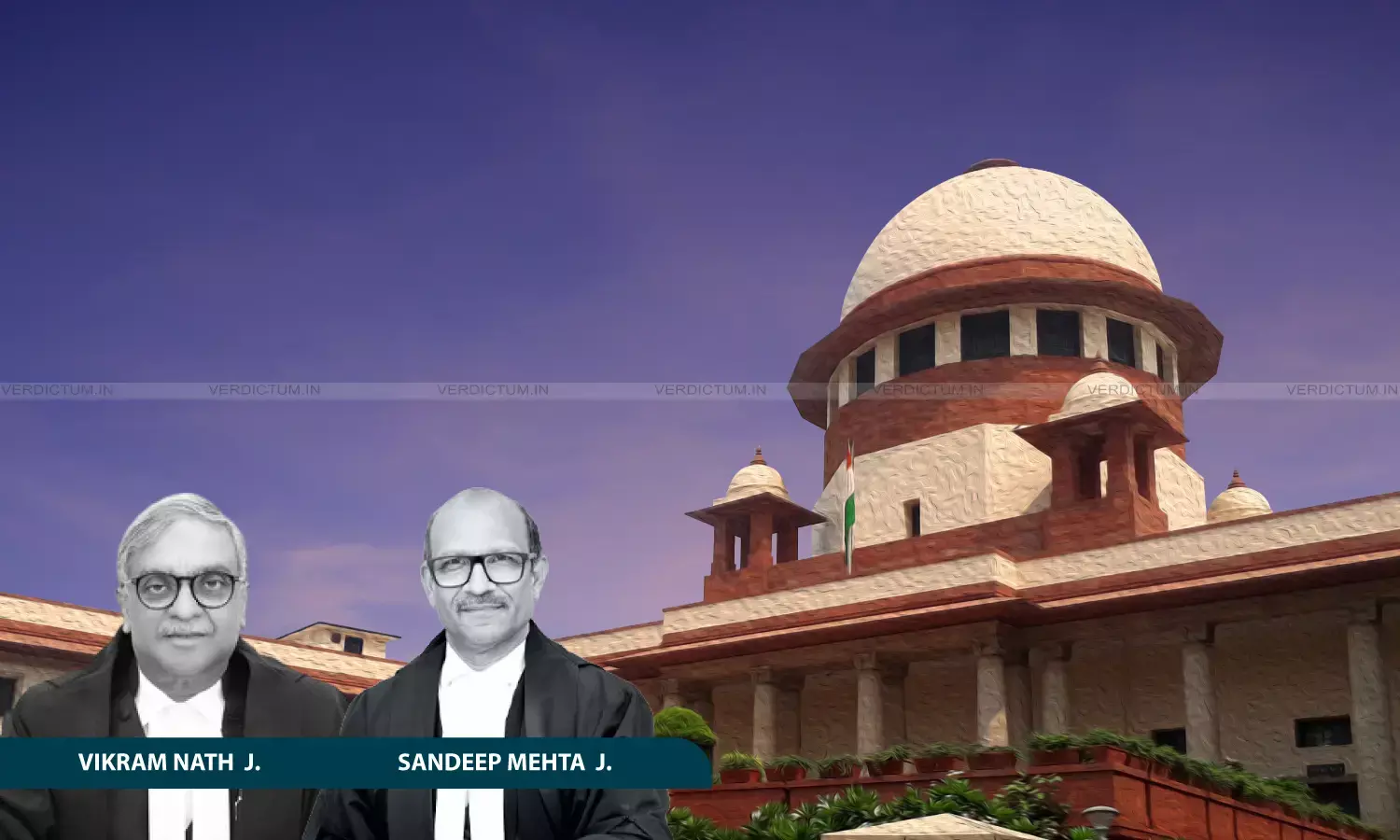
Justice Vikram Nath, Justice Sandeep Mehta, Supreme Court
The Supreme Court has held that a vacancy arising due to non-joining of a selected candidate does not automatically travel down the merit list, and that any right to claim appointment on such vacant posts must arise strictly from the governing statutory rules.
The Court was hearing a civil appeal challenging the judgment of the Karnataka High Court, which had directed consideration of a candidate for appointment against a vacancy arising from non-joining of a selected candidate.
A Division Bench of Justice Vikram Nath and Justice Sandeep Mehta observed: “The decision of the Government to fill the notified vacancies cannot be equated with the creation of a right in favour of every candidate below the selected candidate to claim automatic substitution in the event of non-joining. The right, if any, must arise from the Rules themselves".
With regard to the matter under consideration, the court further held that "in the absence of any provision in the 1997 Rules enabling such substitution, the respondent could not claim appointment merely because one selected candidate did not complete the pre-appointment process”.
Nishanth Patil, Additional Advocate General, appeared for the appellants, while Advocate Shloka Narayanan appeared for the respondent.
Background
The dispute arose from a recruitment process conducted by the Karnataka Public Service Commission for appointment to Group A and Group B posts under the Karnataka Recruitment of Gazetted Probationers Rules, 1997.
The respondent participated in the selection process and was appointed to one of the posts. However, he later claimed appointment to another post because the candidate selected for that post had neither completed the mandatory pre-appointment formalities nor joined service.
The respondent contended that, being placed immediately below the selected candidate and having indicated a preference for the post, he was entitled to be considered against the vacancy.
The State rejected the claim, stating that the governing rules did not provide for any waiting list or mechanism to fill vacancies arising due to non-joining by reverting to the same select list. It was contended that such vacancies must be treated as fresh vacancies to be filled through a subsequent recruitment process.
The Tribunal upheld the State’s position. However, the High Court allowed the writ petition and directed consideration of the respondent for appointment, leading to the present appeal.
Court’s Observation
The Court undertook a detailed analysis of the statutory scheme under the 1997 Rules and emphasised that the recruitment process was structured around service-wise selection against notified vacancies, and not as a general merit-based reservoir of candidates.
It noted that Rule 11 mandates preparation of lists equal to the number of notified vacancies, and that such lists are finite in nature. The Court observed that “the list is not an open-ended reservoir of candidates, but a service-wise list prepared equal to the number of available vacancies…”
The Court further held that the Rules do not contemplate any waiting list, reserve list, or additional list, nor do they permit the select list to be operated beyond the notified vacancies.
Reaffirming settled principles, the Court referred to Shankarsan Dash v. Union of India (1991), Rakhi Ray v. High Court of Delhi (2010), and State of Orissa v. Rajkishore Nanda (2010), holding that inclusion in a select list does not confer an indefeasible right to appointment.
The Court rejected the contention that non-joining of a selected candidate entitles the next candidate in the merit list to claim appointment. It held that such a proposition would be valid only if expressly provided for under the Rules. “In the absence of such a provision, the mere fact that a selected candidate did not join cannot, by itself, create an enforceable right in favour of the respondent”, the Bench remarked.
The Court also took note of the Karnataka Civil Services (Validation of Selection and Appointment of 2011 Batch Gazetted Probationers) Act, 2022, which accorded finality to the selection process, and held that “a direction which, in effect, reopens that concluded process and compels recourse to a mode of appointment not contemplated by the 1997 Rules would be plainly inconsistent with such legislative finality”.
The Court further noted that the respondent had already been selected and appointed to another post under the same recruitment process, and that his claim was not based on exclusion from selection but on a subsequent vacancy. It also observed that the respondent’s claim was not free from difficulty even on facts, as other candidates above him in the merit list were not before the Court.
Upon a cumulative assessment, the Court held that the High Court erred in directing consideration of the respondent and in treating the vacancy as one capable of being filled from the same select list, while concluding that “once the Rules themselves define the contours of the list and do not provide for any reserve or additional list, the absence of a selected candidate from the field cannot enlarge the statutory operation of the list”.
Conclusion
The Court allowed the appeal, set aside the judgment of the High Court, and upheld the order of the Tribunal rejecting the respondent’s claim for appointment.
Cause Title: State of Karnataka & Ors. v. Santhosh Kumar C (Neutral Citation: 2026 INSC 276)
Appearances
Appellants: Nishanth Patil, Additional Advocate General, with Sanchit Garga, Kunal Rana, Bhanu Pratap Singh, Diksha Arora, Shashwat Jaiswal, Arijit Dey, Bhumi Agrawal, Abhishek Gupta and Awanish Gupta, Advocates
Respondent: Shloka Narayanan, Advocate with Shubhani D. Krishan, Advocate
