

Dying Declarations Need Not Follow Rigid Form; Hyper-Technical Objections Cannot Justify Rejection: Supreme Court
The Apex Court reaffirmed that the evidentiary value of a dying declaration does not depend on adherence to any rigid or technical format, and that such a declaration can form the sole basis of conviction if the Court is satisfied as to its voluntariness, truthfulness, and reliability.
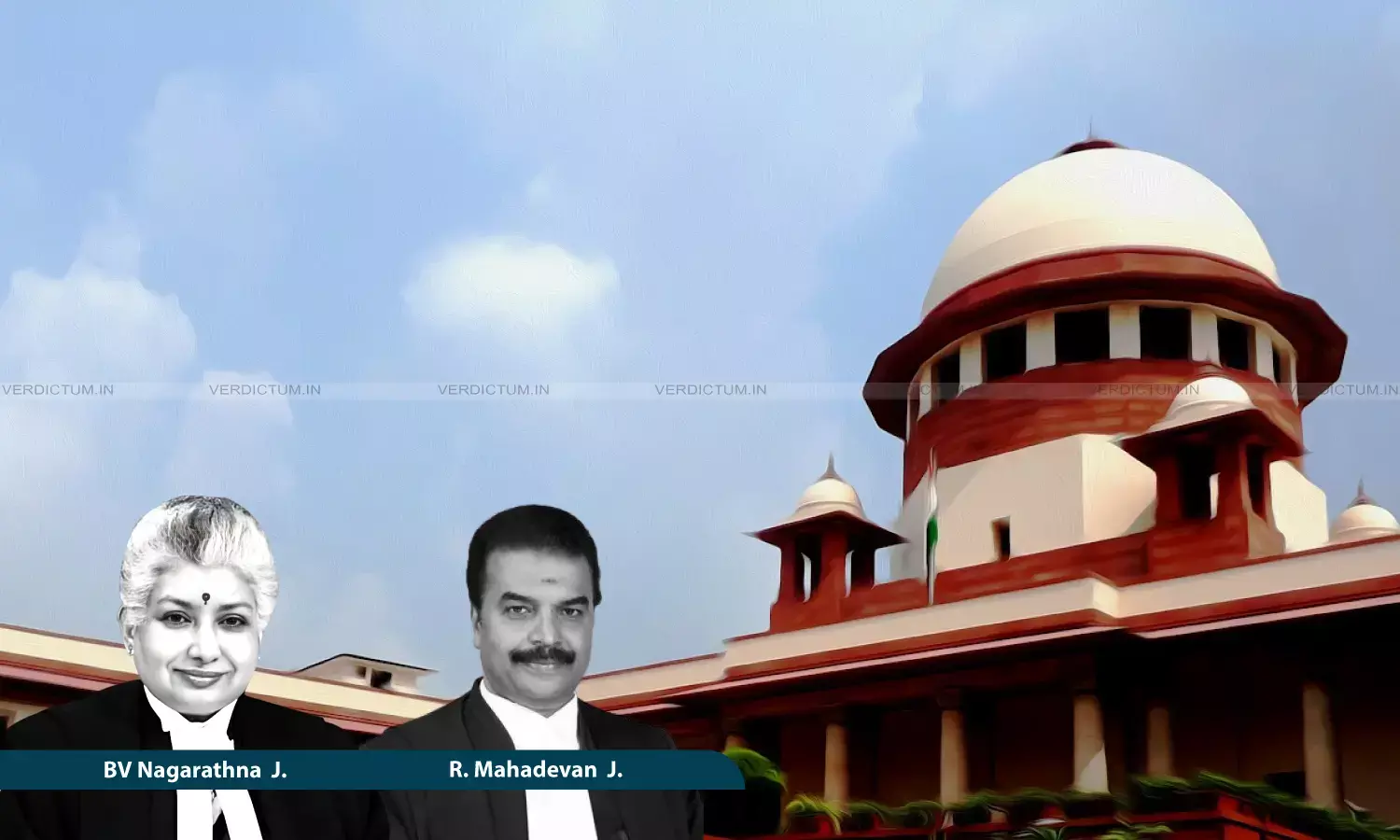
Justice B.V. Nagarathna, Justice R. Mahadevan, Supreme Court
The Supreme Court held that dying declarations need not follow any rigid form and that once the Court is satisfied that a dying declaration is voluntary and reliable, hyper-technical objections cannot justify its rejection.
The Court emphasised that minor discrepancies or procedural doubts cannot outweigh the substantive truth emerging from a credible dying declaration.
The Court was hearing a criminal appeal filed by the State of Himachal Pradesh challenging the judgment of the Himachal Pradesh High Court, which had set aside the conviction and life sentence imposed on the accused for the offence of murder under Section 302 of the Indian Penal Code, 1860.
A Bench comprising Justice B.V. Nagarathna and Justice R. Mahadevan allowed the appeal, restoring the conviction and sentence imposed by the Trial Court, while holding that “the law does not prescribe any rigid form for recording a dying declaration, …so long as the Court is satisfied that the declaration is voluntary, truthful and reliable, hyper-technical objections cannot form the basis for its rejection”.
The appellant-State was represented by Advocate Vivek Kumar, while the respondent was represented by Advocate Anvita Aprajita.
Background
The prosecution's case was that the respondent had poured kerosene on his wife at their residence and set her on fire following matrimonial discord. The victim sustained extensive burn injuries and was initially taken to the District Hospital, Chamba, and thereafter to a medical college hospital for further treatment. She ultimately succumbed to her injuries after several weeks.
During her treatment, the statement of the victim was recorded by a Tehsildar-cum-Executive Magistrate after obtaining a medical opinion regarding her fitness to make a statement. The statement was treated as a dying declaration.
Upon completion of the investigation, a charge sheet was filed for the offence of murder. The Trial Court convicted the accused and sentenced him to imprisonment for life. However, the High Court reversed the conviction, extending the benefit of doubt primarily by disbelieving the dying declaration. Aggrieved thereby, the State approached the Supreme Court.
Court’s Observation
The Supreme Court noted the principles governing dying declarations under Section 32(1) of the Indian Evidence Act, 1872. It reiterated that a dying declaration need not be made in expectation of immediate death, and that a conviction under Section 302 of the Indian Penal Code, 1860 can rest solely on a dying declaration if it is voluntary, truthful and reliable; corroboration, it said, is not a rule of law but a rule of prudence.
Referring to Khushal Rao v. State of Bombay (1958), the Court noted that there is no absolute rule that a dying declaration cannot be the sole basis of conviction without corroboration, and that each case must be decided on its own facts, keeping in view the circumstances in which the declaration was made.
Turning to the facts, the Court recorded that the deceased’s statement was taken in the hospital by the Tehsildar-cum-Executive Magistrate after obtaining medical opinion regarding her fitness, and it was recorded in the presence of the Deputy Superintendent of Police. The prosecution relied upon this statement as the dying declaration.
The Court noted the sequence reflected in the evidence regarding the medical opinion on fitness. It recorded that the doctor (who was later declared hostile) admitted issuing a written opinion declaring the patient unfit to make a statement on the first occasion. It further noted that, as recorded in the evidence, no question was put to him regarding the subsequent medical opinion declaring the patient fit to make a statement, pursuant to which the Tehsildar recorded her statement.
The Supreme Court held that the law does not prescribe any rigid format for recording a dying declaration, and that hyper-technical objections cannot justify rejection if the Court is otherwise satisfied about the declaration being voluntary, truthful and reliable.
It further held that the credibility of a dying declaration must be tested on its own merits, and that it cannot be rejected on “speculative and hyper-technical grounds” by placing “undue reliance on the testimonies of hostile and defence witnesses”. On an overall appraisal, it concluded that the dying declaration in the present case was voluntary, truthful and reliable, and that the prosecution had proved the charge beyond a reasonable doubt.
On motive, the Court reiterated that motive assumes significance primarily in cases based on circumstantial evidence, and that where there is direct evidence in the form of a credible and trustworthy dying declaration, absence of strong proof of motive is not fatal.
Conclusion
The Supreme Court concluded that “the High Court fell into manifest error in reversing the well-reasoned judgment of conviction recorded by the trial Court by re-appreciating the evidence in a manner contrary to the settled principles governing appellate interference”.
Accordingly, the appeal filed by the State was allowed. The judgment of acquittal passed by the High Court was set aside, and the conviction and sentence imposed by the Trial Court were restored. The accused was directed to surrender forthwith to undergo the remaining sentence.
Cause Title: State of Himachal Pradesh v. Chaman Lal (Neutral Citation: 2026 INSC 57)
Appearances
Appellant: Vivek Kumar, Advocate; Abhishek Gautam, AOR
Respondent: Anvita Aprajita, Advocate; Krishna Pal Singh, AOR; Mohan Singh Bais, Advocate; Seemab Qayyum, Advocate
