

Banks Must Furnish Full Forensic Audit Report But Need Not Grant Personal Hearings For Fraud Classification Of Account: Supreme Court
Banks must ensure robust procedural fairness by furnishing complete audit reports while the right to an oral hearing remains at the regulator's discretion, the Court said

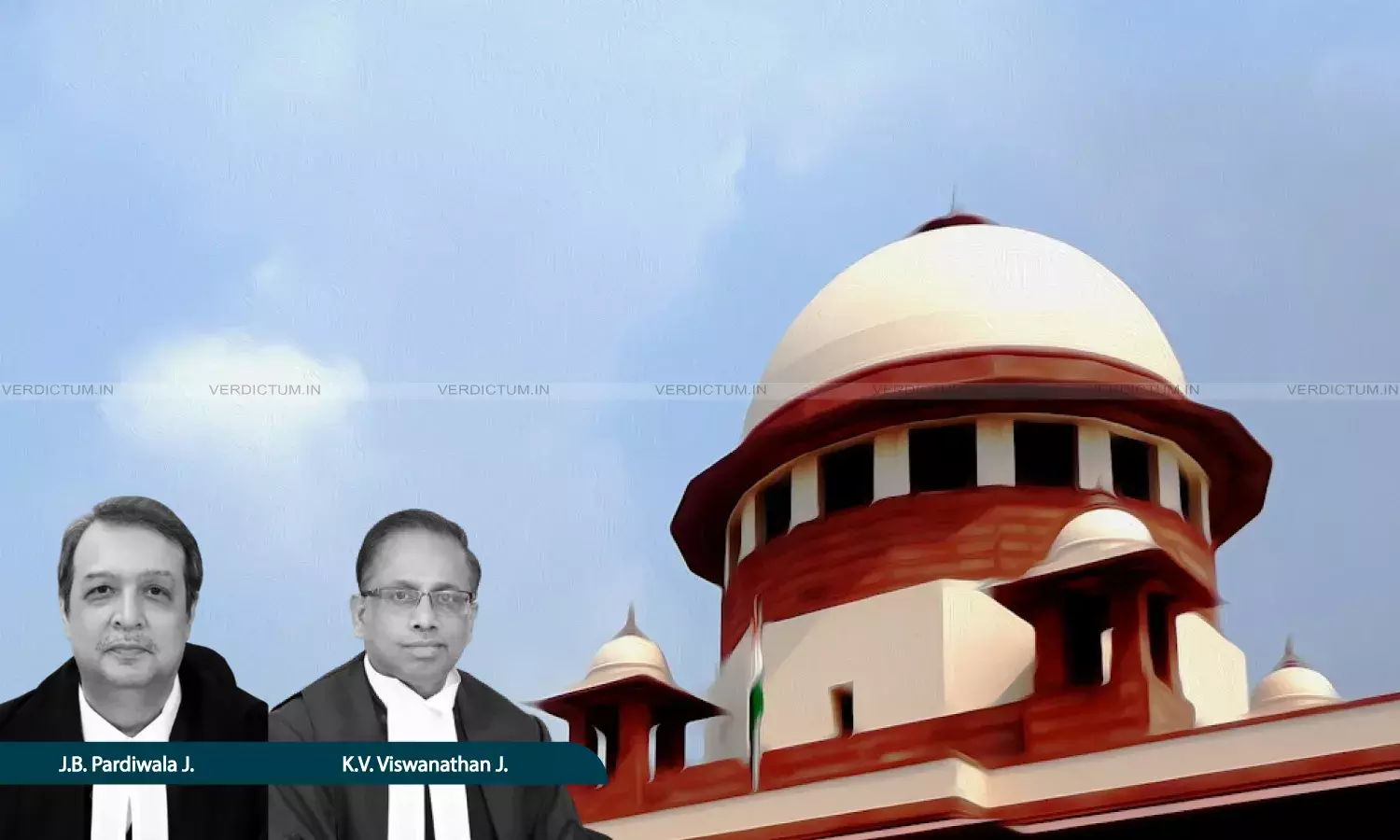
Justice J.B. Pardiwala, Justice K.V. Viswanathan, Supreme Court
The Supreme Court has clarified that the principles of natural justice in the context of classifying a loan account as 'fraud' do not inherently include a right to a personal or oral hearing. The Court further held that the requirement of audi alteram partem is sufficiently met through a detailed show cause notice, the opportunity to file a written representation, and the passing of a reasoned order.
Simultaneously, the Court reinforced the transparency of the process by making the disclosure of the entire Forensic Audit Report (FAR) as the rule, rather than the exception. Rejecting the contention that providing mere conclusions or extracts was enough, the Bench noted that the underlying reasons for such findings are contained within the body of the report. Borrowers are entitled to the full material to effectively represent their case, with limited exceptions only for information involving third-party interests or strategic confidentiality.
Justice J.B. Pardiwala and Justice K.V. Viswanathan observed, “The only justification given for denial of disclosure of the full report, is that the entire audit report would become a subject matter of criminal investigation. We find no merit in this submission. Once the criminal proceedings are launched, Investigating Authority will independently investigate and file a charge sheet/complaint of which the forensic audit report may be a part. Hence, we direct that as held in Rajesh Agarwal (supra) the forensic audit reports ought to be disclosed if they are to be considered relevant by the banks in classifying the account as fraud”.
Solicitor General Tushar Mehta appeared for the Appellant and Senior Advocates Venkatesh Dhond, Parag P. Tripathi and K. Parameshwar for the respondents.
The dispute pertained to two separate cases involving the State Bank of India and Bank of India, where the accounts of Amit Iron Private Limited and Liliput Kidswear Limited were classified as fraud based on forensic audit findings. The borrowers challenged these orders primarily on the grounds that they were denied a personal hearing and were not provided with the complete forensic audit reports, which led to severe civil consequences, including being debarred from institutional finance.
The procedural history involved the High Courts of Calcutta and Delhi, both of which had interpreted the Supreme Court’s 2023 decision in State Bank of India and Others v. Rajesh Agarwal and Others (2023) 6 SCC 1 as mandating a personal hearing. The High Courts had quashed the fraud classification orders for failing to grant such hearings and for not furnishing the full audit reports. The Banks subsequently appealed these findings to the Supreme Court.
The Court observed that since fraud classification is based on objective documentary evidence, often already within the borrower's knowledge, a written response is adequate for fairness. The Bench accepted the Reserve Bank of India’s (RBI) concern that mandatory oral hearings would cause "chaotic conditions", leading to dilatory tactics, and impede the timely detection of systemic risks.
However, on the issue of disclosure, the Court applied the "duty to disclose" principle, ruling that a borrower cannot defend themselves against an accusation of fraud without seeing the full investigative material relied upon by the bank.
The Bench, thus, observed, “It has been rightly contended that contrasted with the categories of fraud as set out in Clause 6.1 of the 2024 Master Directions read with Clause 2.2 of the 2016 Master Directions (see Para 16 hereinabove), it will be clear that in the case of fraud, there is an element of criminality. In the case of a wilful default, though it may involve financial default, there is not as yet an element of criminality. This, in any event, is the perception of the regulator. If the regulator, keeping in mind the various factors decides to give personal hearing before classifying an account as a wilful default account and decides not to grant a hearing as of right in the case of a ‘fraud accounts’ and instead grants an opportunity to file a representation after issuance of a show cause notice and the supply of evidentiary material and further mandates the passing of a reasoned order, courts cannot second guess the regulator. A ‘wilful default account’ and a ‘fraud account’ are not on par and no discrimination can be complained of on that score”.
“The procedure set out in Rajesh Agarwal (supra) which has been incorporated in the reincarnated master direction 2024, strike a fair balance between promptitude and fairness. We find that the procedure is intended to imbue in the process an element of fairness and attempts to thwart miscarriage of justice...”, it further noted.
Accordingly, the Court upheld the RBI’s Master Directions-2024 as correctly embodying the principles of natural justice. It set aside the High Court orders insofar as they mandated a personal hearing but upheld the directions to furnish the full forensic audit reports. The Banks were directed to provide the reports, allow a fresh representation from the borrowers, and pass new reasoned orders thereafter.
Cause Title: State Bank of India v. Amit Iron Private Limited & Ors. [Neutral Citation: 2026 INSC 323]
Appearances:
Appellant: Tushar Mehta, Solicitor General, Chandrashekhar A. Chakalabbi, AOR, S.k. Pandey, Awanish Kumar, Anshul Rai, Jatin Kumar, Rahul Singh Latwal, Sanjay Kapur, AOR, Surya Prakash, Shubhra Kapur, Abhishek Tiwari, Anuraj Mishra, Aman Mehta, Advocates.
Respondents: Parag P. Tripathi, Sr. Adv., Nakul Mohta, Misha Rohatgi, AOR, Ayush Kashyap, Amulya Upadhyay, Aparajito Sen, Rini Mehra, Rajat Nair, AOR K. Parmeshwar, Sr. Adv. Suryaksh Manot, Randeep Sachdeva, Shivang Gupta, Dhruv Pande, Akshaja Singh, Alok Dubey, Veda Singh, Adv. Mr. Prasad Hegde, N Sai Kaushal, Pallav Pal, Venkatesh Dhond, Sr. Adv. Ramesh Babu M. R., AOR Nisha Sharma, Prasad Shenoy, Rohan Kelkar, Advocates.
Intervenor: Purti Gupta, AOR, Henna George, Sunidhi Sah, Pooja, Khushi Sharma, Advocates.
Click here to read/download the Judgment