

Dominant Nature Of Duties Determines ‘Workman’ Status Under Industrial Disputes Act, Not Designation: Supreme Court
The Apex Court clarified that the determination of whether an employee qualifies as a “workman” under the Industrial Disputes Act depends on the dominant and principal nature of duties actually performed, emphasising that Incidental supervisory functions or inflated designations cannot exclude an employee from statutory protection when the substantive work remains clerical or manual.
The Supreme Court has held that the status of an employee as a “workman” under Section 2(s) of the Industrial Disputes Act, 1947, must be decided by applying the dominant nature test, which focuses on the principal duties performed and not on the designation assigned by the employer.
The Court was hearing an appeal challenging the judgment of the Orissa High Court, which had set aside an award of the Labour Court reinstating the appellant with back wages after holding his termination to be illegal under the Industrial Disputes Act.
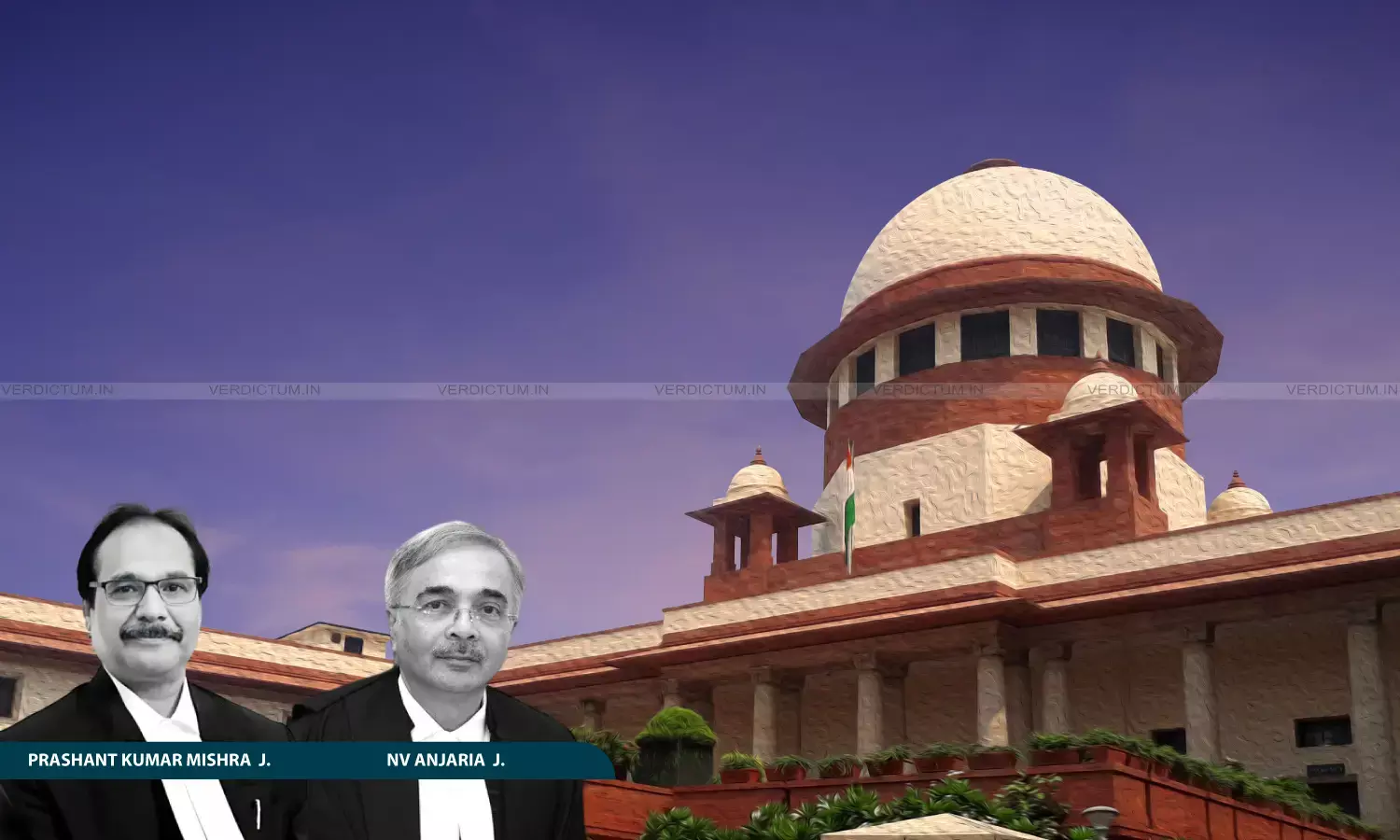
A Bench comprising Justice Prashant Kumar Mishra and Justice N. V. Anjaria, upon examining the criteria to be taken into consideration while determining whether an employee can be classified as a workman, observed that “it is the dominant nature of work or the main employment to which the employee is engaged, that would make or unmake the status as a ‘workman’ for such employee”,
The Bench further clarified that “an employee, notwithstanding the designation given to him, would be a ‘workman’ for the reason that the substantial and essential nature of duties assigned to him and performed by him, are manual and non-supervisory”.
Advocate Awanish Sinha, AOR, represented the appellant, while Advocate Kedar Nath Tripathy, AOR, represented the respondents.
Background
The appellant was employed with a hotel establishment and was initially appointed as a cashier. Over the years, he continued in service and claimed to have worked continuously for more than 240 days in a year.
Following the cessation of salary and subsequent termination, the appellant raised an industrial dispute. The Labour Court held that the hotel was an industry, that the appellant was a workman under Section 2(s) of the Industrial Disputes Act, and that his termination violated Section 25-F of the Act.
The High Court, however, interfered with the award and held that the appellant was not a workman, relying on the employer’s assertion that he was discharging supervisory functions. This led to the present appeal before the Supreme Court.
Court’s Observation
The Supreme Court examined the definition of “workman” under Section 2(s) of the Industrial Disputes Act and analysed its exclusions, particularly in relation to employees engaged in managerial, administrative, or supervisory capacities. It reiterated that the statute excludes only those employees whose primary and dominant duties are supervisory or managerial in nature.
Surveying a long line of precedents, the Court reaffirmed that designation or nomenclature is not decisive. What matters is the real, substantive nature of duties performed by the employee. Inflated titles or high-sounding designations assigned by management, the Court held, cannot override the actual work undertaken.
The Bench relied upon decisions including Lloyds Bank Ltd. v. Panna Lal Gupta, National Engineering Industries Ltd. v. Shri Kishan Bhageria, Anand Bazar Patrika (P) Ltd. v. The Workmen, and Ved Prakash Gupta v. Delton Cable India (P) Ltd. to reiterate that supervisory functions must involve effective control, decision-making authority, and independent command over subordinates.
The Court explained that supervisory work implies authority to direct work to its logical end, exercise disciplinary control, or bind the employer through decisions. Mere checking, reporting, allocation of minor tasks, or incidental oversight does not amount to supervisory or managerial authority.
Applying the dominant nature test, the Court found that the appellant’s primary duties were clerical and operational. The evidence showed that he had no independent authority to sanction leave, initiate disciplinary action, or exercise control over staff. His alleged supervisory role was unsupported by cogent material.
“Merely because the management named the post of the appellant as manager in the front office, it would not ipso facto take him out of the purview of workman, for he was not entrusted with any independent supervisory authority or work, except incidental to manual work”, the Bench remarked.
The Court further observed that even where an employee performs some supervisory or clerical tasks incidentally, such incidental functions cannot override the essential and substantial nature of employment. The law requires a realistic and practical assessment of duties, not a theoretical one.
Conclusion
The Supreme Court concluded that the High Court had committed a manifest error in overturning the Labour Court’s findings. It held that the appellant clearly fell within the definition of “workman” under Section 2(s) of the Industrial Disputes Act.
Accordingly, the Court set aside the impugned judgment of the High Court and restored the award of the Labour Court directing reinstatement with back wages. The appeal was allowed, and the respondent-employer was directed to comply with the award within the stipulated time.
Cause Title: Srinibas Goradia v. Arvind Kumar Sahu & Ors. (Neutral Citation: 2025 INSC 1467)
Appearances
Appellant: Awanish Sinha, AOR
Respondents: Kedar Nath Tripathy, AOR; Aditya Narayan Tripathy, Advocate; P. K. Chand, Advocate; Dhananjaya Mishra, AOR
