

Adjudicating Authority Cannot Override Competent Authority’s Findings U/S 37A FEMA During Pendency Of Appeal: Supreme Court
The Court held that seizure under Section 37A FEMA is predicated on the existence of “reason to believe,” and where the Competent Authority refuses to confirm seizure for lack of such material, the foundation of further proceedings is seriously undermined.
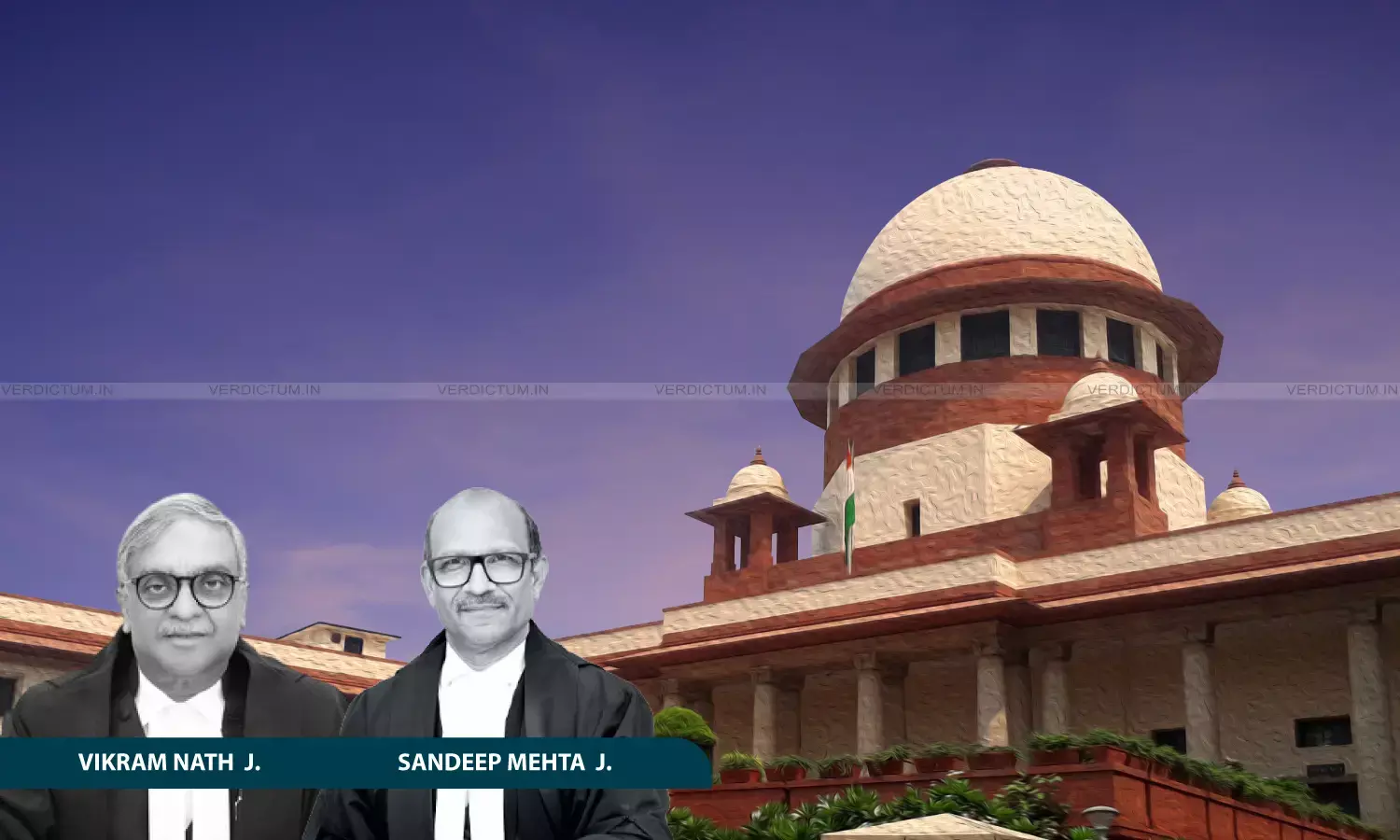
Justice Vikram Nath, Justice Sandeep Mehta, Supreme Court
The Supreme Court has held that the power of seizure under Section 37A of the Foreign Exchange Management Act, 1999 (FEMA) is contingent upon the existence of a valid “reason to believe,” and where the Competent Authority refuses to confirm such seizure on merits, the Adjudicating Authority cannot undo such an order while an appeal against it remains pending.
The Court was hearing appeals challenging the dismissal of writ petitions against a show cause notice issued under FEMA, where the appellants contended that the very basis of the proceedings stood negated by an earlier order refusing to confirm the seizure of their assets.
A Bench of Justice Vikram Nath and Justice Sandeep Mehta observed: “… the Competent Authority declined to confirm the seizure by a well-reasoned order, thereby indicating that the material did not meet even this preliminary threshold, … the refusal to confirm the seizure, therefore, reflects a considered finding that the foundational requirement of a ‘reason to believe’ was not satisfied on the material available.
“The Adjudicating Authority has undone the order of the Competent Authority even while the appeal against the said order is pending, … such a course of action, in the opinion of this Court, tantamounts to abdicating the powers of the Appellate Authority, even when the order of the Competent Authority was still under challenge in appeal at the instance of the department”, the Bench added.
Advocate E. Sudarsanan appeared for the appellants, while Additional Solicitor General Anil Kaushik appeared for the respondents.
Background
The proceedings arose from allegations that the appellants had acquired and held shares of a foreign entity without requisite approval, in violation of Section 4 of FEMA and allied regulations. Acting on this premise, the Authorised Officer passed an order of seizure under Section 37A(1), attaching equivalent assets within India.
In accordance with the statutory scheme, the matter was placed before the Competent Authority under Section 37A(2) for confirmation of seizure. Upon evaluation, the Competent Authority refused to confirm the seizure, holding that there was no material to establish that the appellants had held foreign securities of any value or had contravened FEMA.
Despite this finding, the department issued a show-cause notice under Section 16 and proceeded with adjudication. The appellants challenged these proceedings before the High Court, which declined to interfere. This led to the present appeals before the Supreme Court.
Court’s Observation
The Court began by analysing the statutory scheme of Section 37A FEMA. It held that the provision contemplates a three-stage process: (i) tentative seizure based on “reason to believe” under Section 37A(1); (ii) scrutiny by the Competent Authority under Section 37A(2); and (iii) confirmation or rejection under Section 37A(3).
The Court emphasised that the satisfaction of the Authorised Officer at the stage of seizure is only tentative, and is subject to independent evaluation by the Competent Authority. It observed that such evaluation is “not an empty formality, but a substantive evaluation of whether the material on record is sufficient to sustain even a prima facie inference.”
Applying the statutory framework to the facts, the Court noted that the Competent Authority had recorded a categorical finding that there was no evidence of the appellants holding foreign securities of value. It observed: “there did not exist the ‘reasons to believe’ referred to in Sub-section (1) of Section 37A.” This finding, according to the Court, directly undermined the foundational requirement for invoking seizure powers under FEMA.
The Court clarified that Section 37A(4), which allows continuation of seizure during adjudication, applies only where seizure has been confirmed by the Competent Authority. In the present case, since seizure had been refused confirmation, the statutory framework did not support continuation of coercive measures on the same factual foundation.
The Court found fault with the High Court’s reasoning that seizure proceedings and adjudication proceedings operate in entirely separate spheres. It held that the High Court’s observations effectively effaced the findings of the Competent Authority, which had refused to confirm seizure on substantive grounds.
The Court observed: “The High Court referred to sub-section (4) of Section 37A as if it were concluding that the seizure had been confirmed, whereas the factual situation reads otherwise. In case the finding of the Competent Authority refusing to confirm the seizure for substantive reasons stands affirmed in appeal, manifestly, the same would have a bearing on the outcome of the adjudication proceedings”.
An aspect of the Court’s reasoning was that the order of the Competent Authority refusing to confirm seizure was already under challenge before the Appellate Tribunal. In such circumstances, the Court held that the Adjudicating Authority could not proceed in a manner that effectively nullifies or overrides that order.
The Court also reiterated that while ordinarily writ jurisdiction is not exercised against show cause notices, such restraint is not absolute. Relying on Union of India v. Vicco Laboratories (2007), the Court held that “interference at the stage of SCN is permissible in exceptional circumstances, such as where the notice suffers from patent lack of jurisdiction, reflects non-application of mind, is issued with a pre-determined or premeditated approach, amounts to an abuse of the process of law, or results in a violation of the principles of natural justice”.
In the present case, the Court found that the rejection of writ petitions on maintainability was not justified in the peculiar facts.
Conclusion
The Supreme Court held that the High Court erred in dismissing the writ petitions and in failing to appreciate the effect of the Competent Authority’s findings under Section 37A.
It further held that continuation of adjudication proceedings without awaiting the outcome of the appeal against the order refusing to confirm seizure was legally unsustainable.
Accordingly, the impugned High Court judgments and the adjudication order were set aside, and the matter was remitted with a direction that the Appellate Authority decide the pending appeal first, after which adjudication proceedings may continue.
Cause Title: J. Sri Nisha v. Special Director, Adjudicating Authority, Directorate of Enforcement & Ors. (Neutral Citation: 2026 INSC 309)
Appearances
Appellants: Advocates E. Sudarsanan, K. Suresh, Rajendra Singvi
Respondents: Anil Kaushik (ASG); Advocates Zoheb Hussain, Arkaj Kumar, Bhuvan Kapoor, Animesh Upadhyay, Arvind Kumar Sharma, AOR
