

No Role For Sympathy Or Compassion In Matter Of Re-Evaluation Of Answer Sheet: Supreme Court
The Court was hearing pleas by SSC CGL 2023 candidates who challenged several question IDs from the Tier-2 examination held on October 26, 2023.

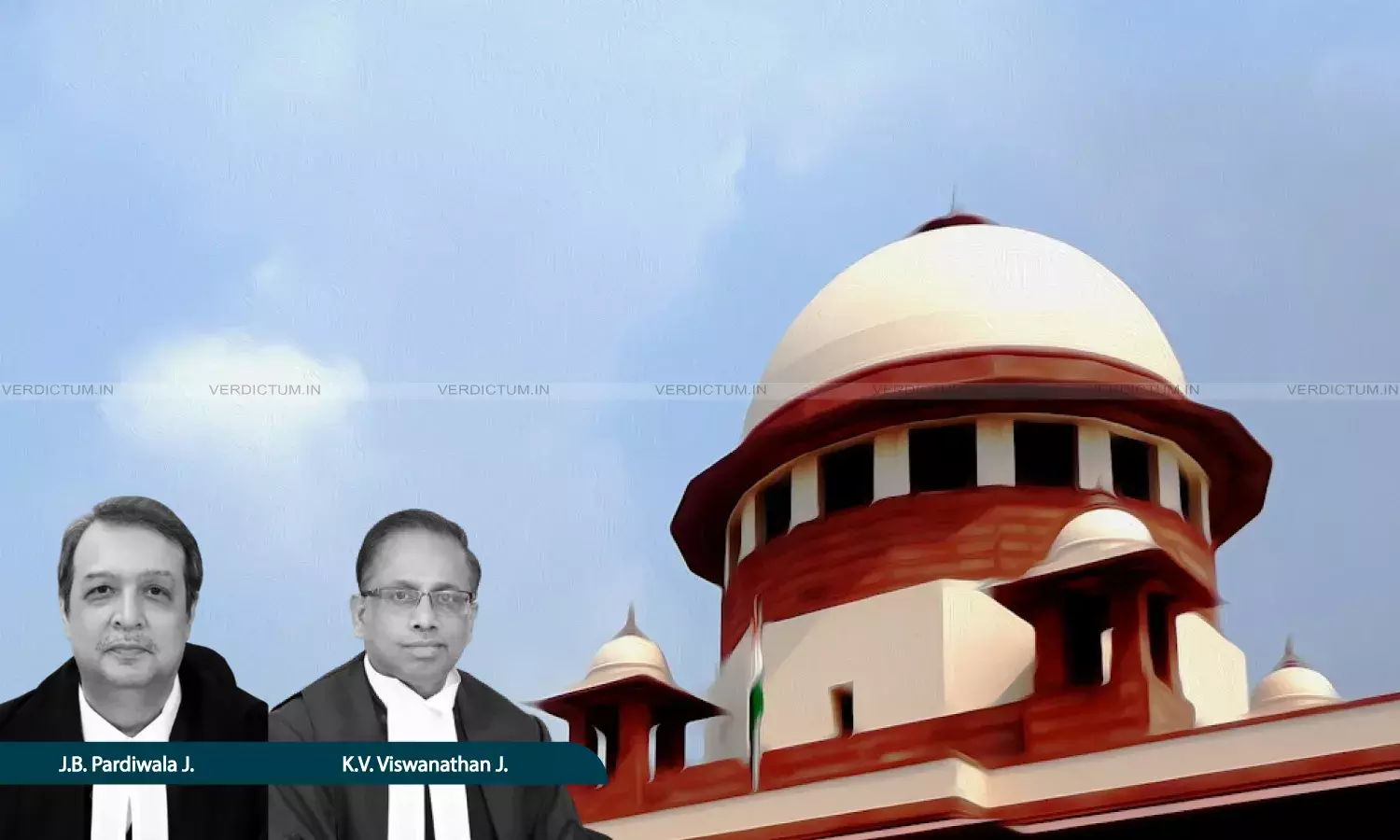
Justice J.B. Pardiwala, Justice K.V. Viswanathan, Supreme Court
The Supreme Court has observed that in matters of academic evaluation, the benefit of the doubt must rest with the examining authority rather than the candidates.
The Court further said that "sympathy or compassion" should not influence these decisions in large-scale examination processes.
The Bench of Justice JB Pardiwala and Justice KV Viswanathan observed, “Having given our thoughtful consideration to all the relevant aspects of the matter, we are of the view that we should not interfere in the matter. As held by this Court in Ran Vijay Singh & Ors. v. State of Uttar Pradesh & Ors. reported in (2018) 2 SCC 357, the Court should presume the correctness of the key answers and proceed on that assumption. In Ran Vijay Singh (supra), this Court also said that in the event of a doubt, the benefit should go to the examination authority rather than to the candidate. In these types of cases sympathy or compassion have no role to play. Courts should be very loath in matter of directing or not directing re-evaluation of an answer sheet.”
Senior Advocate J Sai Deepak and Advocate Luv Virmani appeared for the Appellant, while ASG SD Sanjay and ASG Archana Pathak Dave appeared for the Respondents.
The Staff Selection Commission ('Commission’) of the Department of Personnel & Training (‘the DoPT’) under the Ministry of Personnel, Public Grievances and Pensions issued a Notification dated April 3, 2023, for the Combined Graduate Level Examination, 2023. The Appellants applied to appear in the examination in pursuance of the notification referred to above. The Appellants were in a position to clear Tier-1 of the examination. Thereafter, they appeared for the Tier-2 examination on October 26, 2023. The Commission published a provisional answer key and thereby instructed the candidates to ascertain the preliminary scores.
On December 4, 2023, the Commission published the final result based on the revised answer key dated 30.11.2023. In the final result declared by the Commission, the names of the Appellants did not figure.
The Appellants herein then filed a writ petition before the Delhi High Court. They challenged the validity of the examination and specifically contested the accuracy of several answer keys. The Appellants sought a Mandamus to declare the examination faulty and discriminatory, arguing that the errors violated their fundamental rights under Articles 14, 19, and 21 of the Constitution. They specifically requested the court to order a re-evaluation of seven disputed Question IDs, constitute an expert committee for a neutral review, and stay all ongoing joining procedures until a fresh result was released.
The High Court declined to interfere, citing the legal framework established by the Supreme Court in Ran Vijay Singh v. State of U.P.(2018). The High Court reiterated that judicial review in academic matters is extremely limited; courts must presume the correctness of the official answer key and should only intervene if an error is "demonstrably wrong" without requiring a complex process of reasoning. The High Court held that academic matters are best left to experts, and in any case of doubt, the benefit of that doubt must go to the examination authority rather than the candidate to maintain the finality and integrity of the recruitment process.
The Appellants, being dissatisfied with the judgment and order passed by the Single Judge of the High Court, went in appeal before the Division Bench of the High Court. The Division Bench of the High Court thought fit not to interfere and accordingly dismissed the appeal(s), thereby affirming the judgment and order passed by the Single Judge.
The Counsel for the Appellants explained to the Court as to why the four disputed questions, in some way or another, were wrong or the answer keys were wrong. He vehemently submitted that it is a question of the entire career of the Appellants, and they should not suffer because of some mistake committed by the examining committee.
On the other hand, the Respondents submitted that no error, not to speak of any error of law, could be said to have been committed by the High Court in passing the impugned order. It was submitted that any interference at this point in time may create a lot of difficulties for both the candidates and the Commission.
Another appeal was filed by the Staff Selection Commission & Ors. directed against a finding recorded by the Single Judge, as affirmed by the Division Bench of the High Court with respect to one question.
In paragraphs 32 and 34, the Single Judge focused specifically on Question, which asked how many "meaningful English words" could be formed using the second, fourth, fifth, and sixth letters of the word "HOCKEY" (O, K, E, and Y). While the Court generally deferred to experts on other subjects, it found the expert analysis for this specific reasoning question to be logically flawed and "demonstrably incorrect" on its face.
The High Court rejected the Expert’s justification that "Two" words could be formed. Furthermore, the High Court ruled that a Turkish game cannot be classified as a "meaningful English word," and the word "okey" on its own does not hold a standard, meaningful definition in the English language.
Consequently, the High Court concluded that the Final Answer Key was incorrect and that only one meaningful English word ("Yoke") could be formed from the letters. In paragraph 34, the Judge issued a specific directive: the SSC was ordered to grant additional marks to all candidates who had selected "One" as their answer. The Court further directed the respondents to revise and publish the altered results to reflect this correction.
The Apex Court in this regard said, “Having heard the learned counsel appearing for the parties, applying the dicta in Ran Vijay Singh (supra) and having visualized the consequences that may follow with the direction issued by the learned Single Judge as contained in para 34, we are of the view that we should allow the appeals preferred by the Staff Selection Commission.”
Accordingly, the Court dismissed the Appeal filed by the Students and allowed the appeal filed by the Staff Selection Commission.
Cause Title: Shubham Pal & Ors. v. Staff Selection Commission & Anr. [SLP (C.) No. 21999 of 2024]
Appearances:
Petitioner: Senior Advocate J. Sai Deepak, Advocate on Record Sarvam Ritam Khare, Advocate on Record Shreekant Neelappa Terdal, Advocate Luv Virmani, Advocate Avinash K Sharma, Advocate Avinash Kumar Sharma, Advocate R Abhishek, Advocate Kushagra Sharma, Advocate Akarsh Khare.
Respondents: Additional Solicitor General S.D. Sanjay, Additional Solicitor General and Senior Advocate Archana Pathak Dave, Advocate on Record Divyesh Pratap Singh, Advocate on Record Sarvam Ritam Khare, Advocate on Record Shreekant Neelappa Terdal, Advocate on Record Luv Virmani, Advocate Piyush Beriwal, Advocate Amit Sharma-ii, Advocate B.L. Shivani, Advocate Aarushi Singh, Advocate Jagdish Chandra, Advocate Santosh Ramdurg, Advocate Yogesh Vats, Advocate Divyam Aggarwal, Advocate Khushal Kolwar, Advocate Akshat Agarwal, Advocate Shubham Prakash Mishra, Advocate Parthvi Ahuja, Advocate Nikita Sethi, Advocate Navroop Jawanda, Advocate Avinash K Sharma, Advocate R. Abhishek, Advocate Kushagra Sharma, Advocate Akarsh Khare.