

Where Forgery Is Alleged & Documents Sent For Handwriting Examination, FIR Cannot Be Quashed Before Expert Report: Supreme Court
The Court held that when an investigation involving allegations of forgery is underway and disputed documents have been forwarded to a forensic laboratory for handwriting examination, quashing the FIR before the expert report is received would be premature and unjustified.
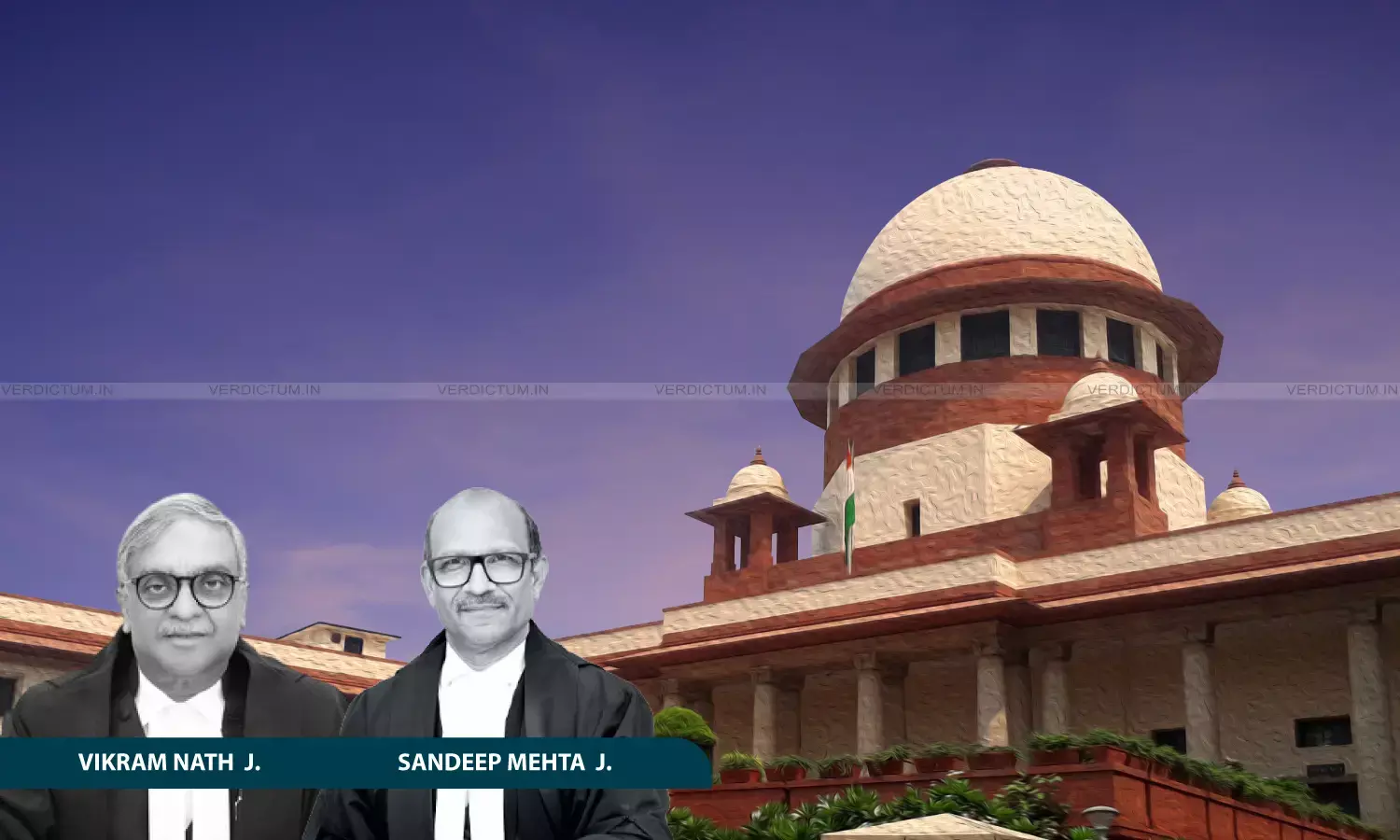
Justice Vikram Nath, Justice Sandeep Mehta, Supreme Court
The Supreme Court has held that where allegations of forgery are specifically made in an FIR, and the investigating agency has already initiated forensic examination of disputed documents through a handwriting expert, the High Court would be unjustified in quashing the FIR before the outcome of such examination is available.
The Court was hearing criminal appeals filed by the original complainant and the State of Himachal Pradesh challenging an order of the Himachal Pradesh High Court which had quashed an FIR registered for offences under Sections 420, 465, 467, 468, 471 and 120-B of the Indian Penal Code relating to alleged fraudulent transfer of property and bank funds.
A Bench comprising Justice Vikram Nath and Justice Sandeep Mehta observed that the High Court had interfered with the investigation at a premature stage and stated: “where allegations of forgery are set out in the FIR and Investigating Agency has undertaken the exercise of getting the disputed documents examined through the handwriting expert, an order quashing the FIR without awaiting the outcome of the handwriting expert’s report would be totally unjustified.”
Advocate Pragya Baghel, AOR, represented the appellant, while Kartikeya Rastogi, D.A.G., represented the respondents.
Background
The case arose from an FIR lodged by the complainant alleging that the accused persons had entered into a criminal conspiracy to grab the property and assets belonging to her father by forging documents, fabricating false evidence and fraudulently transferring funds from bank accounts.
According to the FIR, the complainant’s family owned ancestral agricultural land in Shimla. It was alleged that the accused persons took advantage of the deteriorating health and mental condition of the complainant’s father and induced him to transfer large sums of money and execute property transactions in their favour.
The FIR further alleged that significant amounts were transferred from the bank accounts of the complainant’s father to one of the accused without any lawful transaction. It was also alleged that the family land was sold through a registered sale deed by falsely portraying the property as self-acquired property and by recording incorrect recitals regarding the consent of family members.
During the course of the investigation, the investigating agency discovered discrepancies between the circle rates of land and the values reflected in the sale deeds. The disputed documents were forwarded to the State Forensic Science Laboratory for forensic document examination.
However, the High Court, exercising its inherent powers under Section 482 of the Code of Criminal Procedure, quashed the FIR at the threshold, holding that the allegations did not disclose the ingredients of offences such as fraud or forgery.
Aggrieved by this order, the complainant as well as the State approached the Supreme Court.
Court’s Observation
The Supreme Court noted that the High Court had quashed the FIR at a stage when the investigation was still underway, and vital material was yet to be collected.
The Court observed that the investigating agency had already taken possession of the disputed documents and had forwarded them to the forensic laboratory for handwriting examination. In such circumstances, the Court held that it was improper for the High Court to terminate the investigation prematurely.
The Bench observed that where allegations of forgery are set out in the FIR, and the Investigating Agency has undertaken the exercise of getting the disputed documents examined through the handwriting expert, an order quashing the FIR without awaiting the outcome of the handwriting expert’s report would be totally unjustified.
The Court further noted that the High Court had been apprised that the disputed signatures were under examination by the State Forensic Science Laboratory, yet this crucial aspect was overlooked while exercising inherent jurisdiction to quash the FIR.
The Court stated: “Once the Court was apprised that an investigation into the genuineness of the signatures on the disputed/questioned documents was being undertaken and the signatures were in the process of being analysed by the SFSL, there was no reason whatsoever for the High Court to have proceeded to quash the FIR by exercising jurisdiction under Section 482 CrPC.”
The Bench also held that the High Court had relied upon an earlier judgment of the Supreme Court relating to proof of forgery without appreciating that the handwriting expert’s report had not yet been received and therefore the investigation into the authenticity of the documents was still incomplete.
In this regard, the Court observed: “the questioned documents having already been forwarded for examination, the proof of forgery would evidently depend upon the outcome of the comparison to be conducted by the handwriting expert.”
The Court noted that the allegations made in the FIR prima facie disclosed offences of fraud, misappropriation and forgery and therefore the prosecution could not be stifled at the threshold by invoking the High Court’s inherent powers.
Conclusion
The Supreme Court held that the High Court had prematurely terminated the criminal proceedings despite the existence of specific allegations of forgery and ongoing forensic examination of disputed documents.
Accordingly, the Court set aside the High Court’s order quashing the FIR and directed the investigating officer to conclude the investigation and submit the final report before the competent court in accordance with the law.
Cause Title: Sharla Bazliel v. Baldev Thakur & Others (Neutral Citation: 2026 INSC 252)
Appearances
Appellant: Pragya Baghel, AOR; Yuvraj Kashyap, Advocate; Charu Nirula, Advocate; Natasha Dalmia, AOR.
Respondents: Kartikeya Rastogi, Advocate (Deputy Advocate General); Inderdeep Kaur Raina, Advocate; Tamanna Kavida, Advocate; Akshay Girish Ringe, AOR; Ankur Mittal, Advocate; Satya Mitra, AOR; Deepak Bashta, Advocate; Shagun Matta, AOR; Vandana Sehgal, AOR.
