Suit Dismissed For Default Not A “Decision On Merits” To Trigger Res Judicata U/S 11 CPC: Supreme Court
The Court held that dismissal of a suit for default does not amount to a final adjudication and cannot attract the bar of res judicata, which requires that the matter must have been “heard and finally decided”.
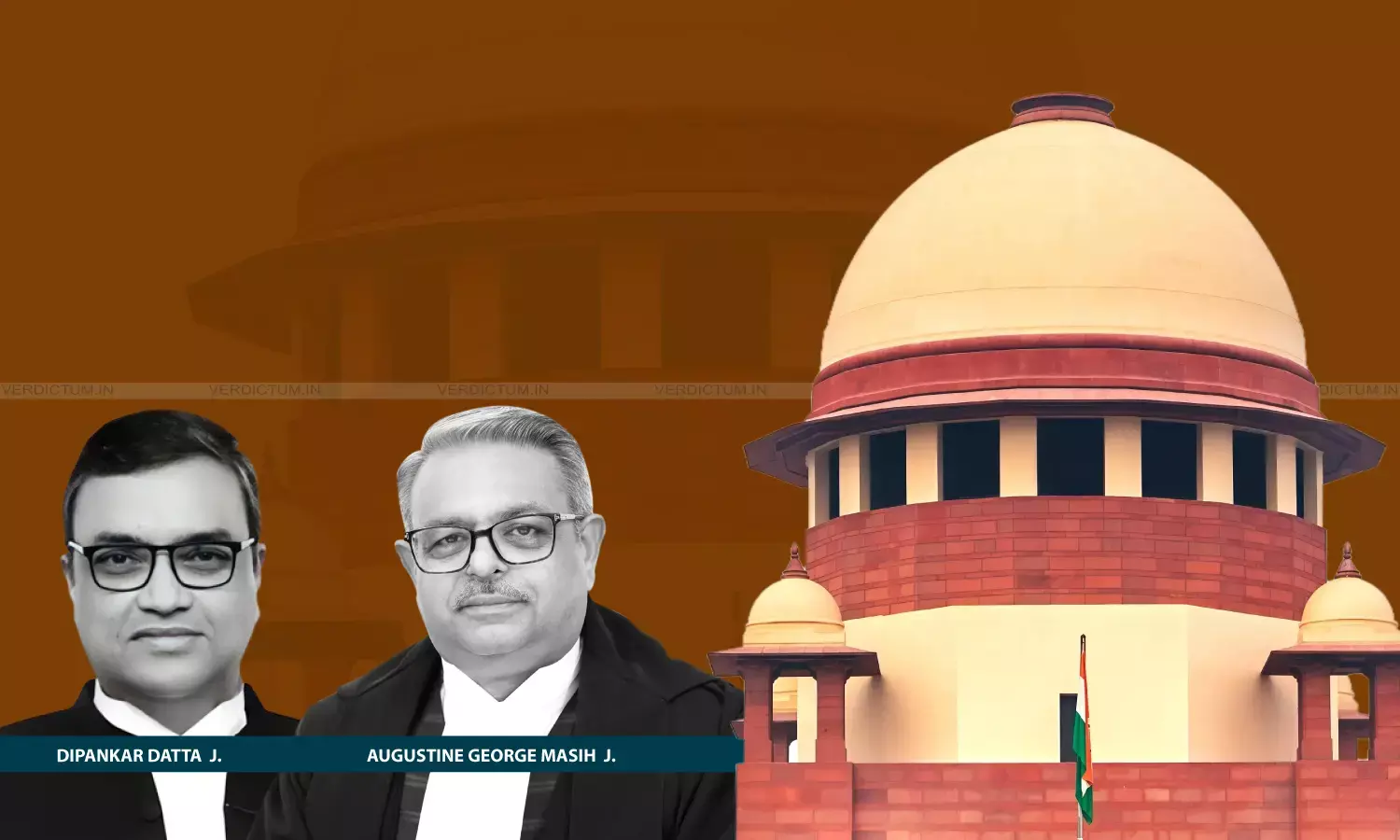
Justice Dipankar Datta, Justice Augustine George Masih, Supreme Court
The Supreme Court has held that dismissal of a suit for default cannot, by itself, operate as res judicata under Section 11 of the Code of Civil Procedure, since such dismissal is not a decision on merits.
The Court was hearing a civil appeal arising out of execution proceedings where the issue was whether dismissal of earlier suits for default barred adjudication of subsequent claims relating to the same property.
A Bench of Justice Dipankar Datta and Justice Augustine George Masih observed: “… we record our inability to concur with the reasoning of the Appellate Court, which has since been affirmed by the High Court, that dismissal of a suit for default would, by itself, operate as res judicata within the meaning of Section 11, CPC to bar adjudication of proceedings initiated by the appellants for execution”.
“Section 11 postulates that the matter must have been ‘heard and finally decided’, … dismissal of a suit for default, not being a decision on merits, cannot ordinarily be regarded as a final adjudication so as to attract the strict application of Section 11, CPC”, the Bench added.
B. Sunita Rao, AOR, appeared for the appellants. Senior Advocate Harin P. Raval appeared for the respondents.
Background
The dispute arose from a suit for specific performance filed by the appellants in respect of an immovable property, which culminated in a decree in their favour.
During execution proceedings, third parties resisted delivery of possession by asserting independent title based on separate sale deeds. The appellants had earlier filed suits challenging those sale deeds, but both suits were dismissed for default, and even restoration applications failed.
The executing court rejected the objections of the third parties, holding that they had failed to establish a valid title. However, the appellate court reversed this finding, holding that dismissal of earlier suits operated as res judicata and that the appellants must pursue a separate suit.
The High Court affirmed this view, leading to the present appeal before the Supreme Court.
Court’s Observation
The Supreme Court at the outset rejected the reasoning of the appellate court and High Court that dismissal of suits for default would operate as res judicata.
It held that Section 11 postulates that the matter must have been "heard and finally decided", while further adding that the dismissal of a suit for default cannot ordinarily be regarded as a final adjudication.
The Court clarified that res judicata requires adjudication on the merits, and mere dismissal for non-prosecution does not satisfy this requirement.
While rejecting the application of Section 11 CPC, the Court proceeded to examine broader principles rooted in public policy.
It referred to the maxim "nemo debet bis vexari", explaining that even in the absence of a decision on merits, a party may be precluded from re-agitating issues if it had an opportunity to pursue them earlier but chose not to. The Court emphasised that this principle operates independently of strict res judicata and is aimed at preventing repeated litigation over the same cause.
The Court took note of the fact that the appellants themselves had instituted earlier suits challenging the title of the respondents, but allowed those suits to be dismissed for default. It was observed that these proceedings were central to the dispute, and their dismissal due to non-prosecution was a significant circumstance.
The Court held that once a party initiates proceedings and then abandons them, it cannot later attempt to revive the same issues in collateral proceedings, such as execution.
The Court also analysed the consequences of dismissal under Order IX Rule 8 CPC and the bar under Order IX Rule 9 CPC, which prevents the filing of a fresh suit on the same cause of action after dismissal for default.
It further referred to principles underlying Order XXIII Rule 1 CPC, emphasising that a litigant cannot repeatedly invoke the jurisdiction of courts on the same subject matter after abandoning earlier proceedings.
The Court strongly deprecated the conduct of the appellants, observing that permitting them to raise the same issues again would amount to abuse of process. It reiterated that "a party cannot act recklessly with the judicial process, invoking it as per his convenience and abandoning it when inconvenient, only to resurrect advantage in execution".
The Court also highlighted that the relief of specific performance, as it stood prior to amendment, was discretionary and based on equitable considerations. It was observed that the conduct of the appellants, including failure to pursue earlier proceedings and omission to implead necessary parties, was relevant in determining whether equitable relief should be granted.
Conclusion
The Supreme Court held that although dismissal of suits for default does not attract res judicata under Section 11 CPC, the conduct of the appellants in abandoning earlier proceedings disentitled them from relief.
Upholding the ultimate conclusion of the appellate court and High Court on different reasoning, the Court dismissed the appeal and declined interference, holding that the appellants were precluded from re-agitating the same issues in execution proceedings.
Cause Title: Sharada Sanghi & Ors. v. Asha Agarwal & Ors. (Neutral Citation: 2026 INSC 292)
Appearances
Appellants: B. Sunita Rao, AOR
Respondents: Senior Advocates Harin P. Raval, R. Anand Padmanabhan; Advocates Urmi H. Raval, Shreya Bansal, Shrestha Narayan, Siddharth H. Raval, Arimardhan Sharma, Ilashri Gaur; Nidhi Sharma, AOR; Shashi Bhushan Kumar, AOR