Recovery From Body Of Accused Cannot Be Converted Into Disclosure U/S 27 Evidence Act: Supreme Court
The Apex Court held that when material objects are found on the body of the accused at the time of arrest and could have been seized by a routine search, such recovery cannot be projected as a disclosure under Section 27 of the Evidence Act.
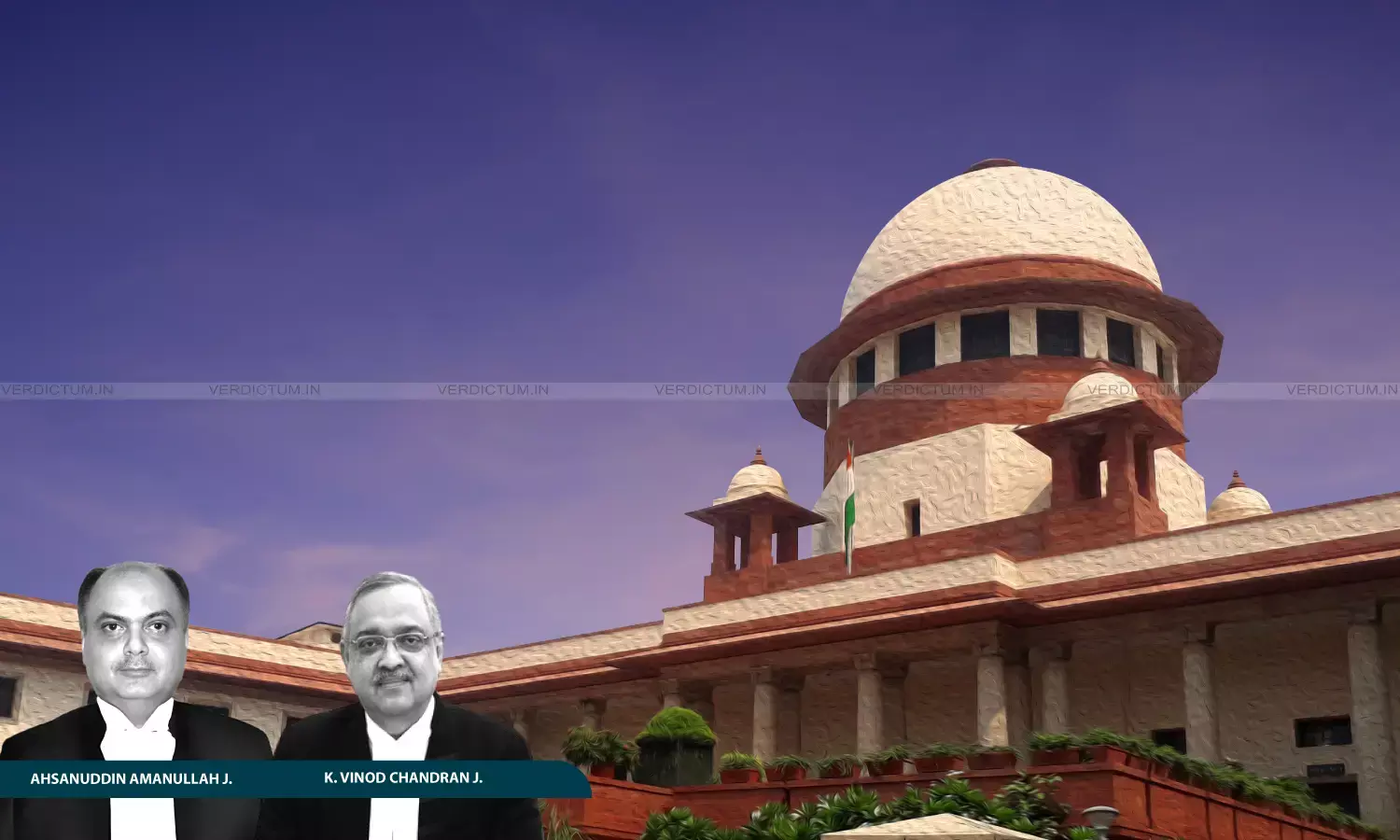
Justice Ahsanuddin Amanullah, Justice K. Vinod Chandran, Supreme Court
While upholding the conviction of the accused in a rape and murder case, the Supreme Court held that recoveries effected from the person of an accused at the time of arrest cannot be treated as recoveries under Section 27 of the Indian Evidence Act.
The Apex Court was hearing a criminal appeal arising from a judgment of the Telangana High Court which had upheld the conviction of the accused for offences of rape and murder, relying inter alia on recoveries claimed to be admissible under Section 27 of the Evidence Act.
A Bench comprising Justice Ahsanuddin Amanullah and Justice K. Vinod Chandran observed: “When the material objects could have been seized from the body of the accused on a mere search by the police, the attempt to convert it as a recovery under Section 27 cannot at all be accepted. It goes against the very principle of Section 27, insofar as the disclosure relied upon can only relate to the concealment and the recovery of material objects on such disclosure made, which recovery has to be made in the persons of witnesses”.
Advocate Praveen Chaturvedi, AOR, represented the appellant, while Advocate Kumar Vaibhaw represented the respondents.
Background
The prosecution's case arose from the disappearance and subsequent murder of a woman who had gone to a village to pursue her vocation of hawking utensils. Her body was discovered the following day in bushes near a roadside, following which criminal law was set in motion.
Three accused were charged with gang rape and murder. The prosecution alleged that the accused followed the victim, sexually assaulted her in an isolated area, and thereafter killed her to prevent disclosure of the crime. The trial court convicted all the accused and imposed the death penalty, which was later modified by the High Court.
The High Court upheld the conviction for rape and murder, while modifying the sentence. One of the accused approached the Supreme Court, challenging the conviction and sentence.
Court’s Observation
The Supreme Court examined the evidentiary circumstances relied upon by the High Court, including the alleged recoveries of material objects claimed to be admissible under Section 27 of the Evidence Act.
The Court noted that, as per the prosecution’s own version, the mobile phone, knife, cash, and clothes were already in the possession of the accused at the time of arrest and were handed over during custody. The Court found that there was no concealment involved in respect of these articles.
The Bench observed that when material objects could have been seized from the body of the accused on a mere search at the time of arrest, any attempt to project such seizure as a recovery under Section 27 cannot be accepted. It held that such an approach goes against the very principle of Section 27.
The Court reiterated that disclosure under Section 27 is admissible only to the extent it relates to the fact discovered, namely, the concealment and subsequent recovery of material objects pursuant to such disclosure. The recovery must follow the disclosure and be made in the presence of witnesses.
Applying these principles, the Court rejected the recoveries relied upon by the prosecution as inadmissible under Section 27. It held that the High Court erred in placing reliance on such recoveries as incriminating circumstances.
The Supreme Court further scrutinised other circumstances relied upon by the High Court, including alleged extra-judicial confession and the invocation of the “last seen” theory. The Court expressed serious reservations about reliance on an alleged confession made while the accused were in police custody and held that such a confession could not be relied upon.
On the invocation of the “last seen theory”, the Apex Court clarified that when “there is no acquaintance proved between the accused and the deceased, there cannot be any ‘last seen together theory’ propounded as a circumstance”
However, the Court found that the prosecution had independently established a complete chain of circumstances through credible ocular evidence, medical evidence, forensic evidence, and DNA analysis, which conclusively proved the commission of rape and murder by the accused.
The Court also held that the essential ingredients of offences under the SC/ST (Prevention of Atrocities) Act were not established, as there was no evidence to show that the accused were aware of the caste of the victim. Consequently, convictions under the SC/ST Act were set aside.
Conclusion
The Supreme Court partly allowed the appeal by setting aside the convictions under the SC/ST (Prevention of Atrocities) Act and under Section 404 IPC, while affirming the conviction of the appellant under Sections 302 and 376D read with Section 34 IPC.
The sentence of imprisonment for the remainder of life was modified to rigorous imprisonment for a fixed term of twenty-five years without remission, with the sentences to run concurrently.
The Court also directed that legal assistance be provided to the co-accused for filing appeals before the Supreme Court.
Cause Title: Shaik Shabuddin v. State of Telangana (Neutral Citation: 2025 INSC 1449)
Appearances
Appellant: Advocate Praveen Chaturvedi, AOR
Respondent: Advocates Kumar Vaibhaw, Devina Sehgal, AOR, Yatharth Kansal