

Courts May Invoke Inherent Powers To Prevent Injustice Where Unimpeachable Evidence Displaces Prosecution’s Case: Supreme Court
The Bench said that continuation of trial despite electronic evidence disproving physical participation constitutes an abuse of judicial process.

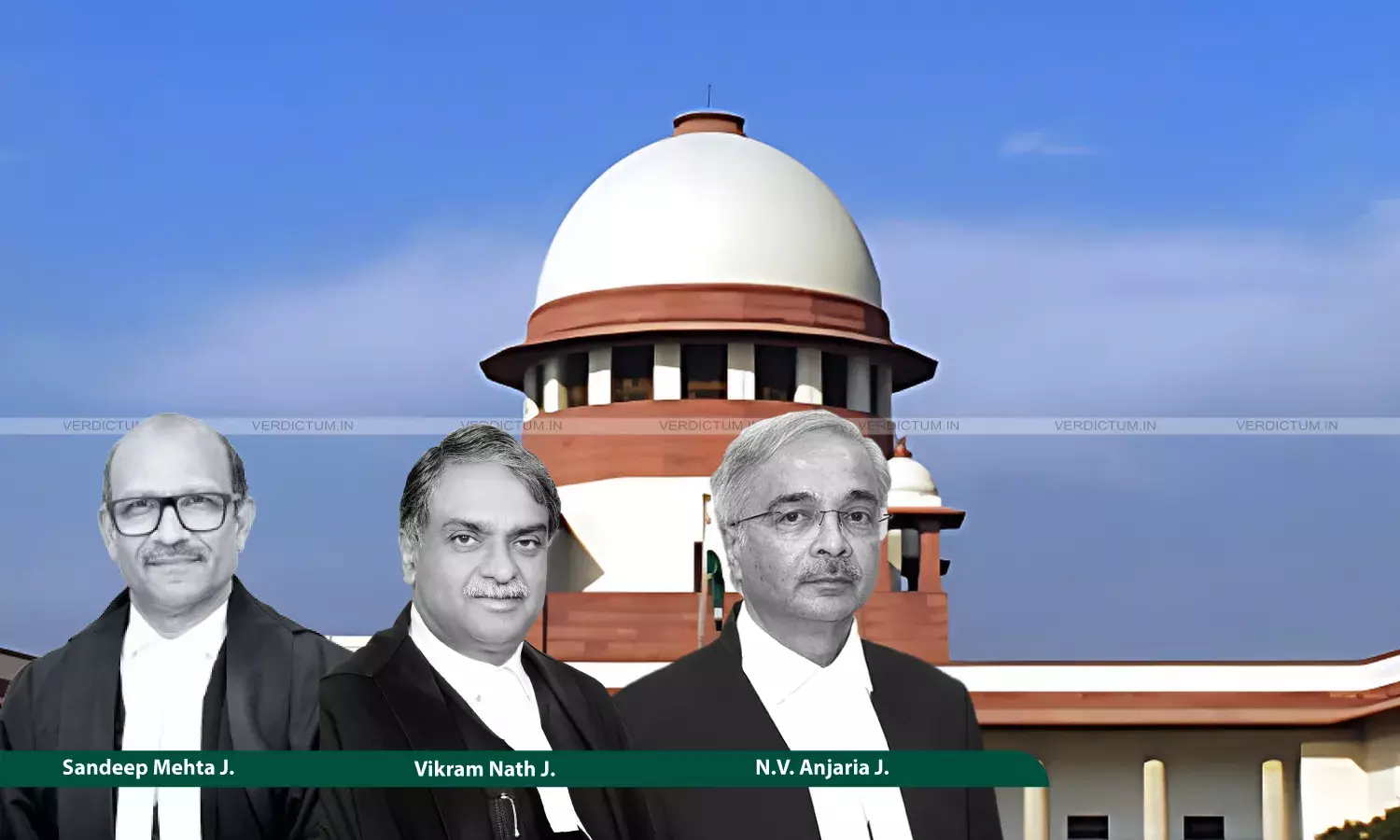
Justice Vikram Nath, Justice Sandeep Mehta, Justice N.V. Anjaria, Supreme Court
The Supreme Court has quashed a Calcutta High Court order that had declined to quash criminal proceedings against three individuals, holding that the High Court failed to adequately consider unimpeachable electronic evidence. The Bench noted that in the absence of a clear rationale justifying differential treatment, the approach adopted by the High Court was legally and factually unsustainable.
The Court noted that when CCTV footage collected during investigation clearly demonstrates the non-participation of the accused in an alleged assault, allowing the trial to proceed would amount to a gross abuse of the process of law, and therefore, the Court would be justified in invoking its inherent jurisdiction vested in the High Court under Section 482 of CrPC (Section 528 of Bharatiya Nagarik Suraksha Sanhita, 2023) to prevent injustice.
A Bench comprising Justice Vikram Nath, Justice Sandeep Mehta, and Justice N.V. Anjaria, while referring to Pradeep Kumar Kesarwani v. State of Uttar Pradesh 2025 SCC OnLine SC 1947, observed “…Where reliable and unimpeachable material demonstrably displaces the factual basis of the accusations and the prosecution is unable to effectively counter the same, the Court would be justified in invoking its inherent jurisdiction to prevent injustice. Such an approach not only accords justice to the accused but also obviates the wastage of precious judicial time on proceedings which, on the admitted material, do not hold a reasonable prospect of culminating in conviction”.
Senior Advocate Gaurav Agarwal appeared for the appellant and Senior Advocate Siddharth Luthra appeared for the respondent.
The dispute originated from a minor altercation on October 11, 2022, between residents of an apartment complex in West Bengal regarding the main entrance door and the parking of a scooter. The complainant, a 77-year-old former Public Prosecutor, alleged that several persons formed an unlawful assembly, hurled abuses, and physically assaulted him and his family members, specifically targeting his pacemaker.
While the FIR and subsequent chargesheet invoked multiple sections of the Indian Penal Code including Section 354 (outraging modesty), the allegations against the current appellants were largely limited to verbal threats and intimidation.
Following the filing of the chargesheet, the appellants approached the Calcutta High Court seeking to quash the proceedings. While the High Court quashed the charges against two female co-accused, it permitted the trial to continue against the three male appellants without providing a clear rationale for the differential treatment.
The appellants subsequently challenged this partial relief before the Supreme Court, arguing that the proceedings were maliciously instituted due to prior personal animosity.
The Court noted that the CCTV footage showed the appellants arrived at the scene only after the initial altercation had concluded and, rather than participating in the violence, were seen attempting to pacify the parties. The Court applied the "four-step test" from the Pradeep Kumar Kesarwani precedent, determining that the electronic evidence was of such provenance that it effectively dislodged the prosecution’s narrative.
The Bench further observed that the allegations were vague and lacked specific attribution of overt acts, fitting the categories of cases identified in State of Haryana v. Bhajan Lal 1992 Supp (1) SCC 335 where quashing is mandatory to secure the ends of justice.
“…The impugned judgment does not disclose any cogent or discernible reasoning for drawing such a distinction, particularly when the allegations stem from a common incident and are founded on substantially similar assertions. In the absence of a clear rationale justifying differential treatment, the approach adopted by the High Court is legally and factually unsustainable”, it noted.
The Court, thus, observed “…the uncontroverted material available on record, to be specific, the CCTV footage, completely belies the allegation of their participation in the alleged offences so as to justify their being put to trial.…the attendant circumstances, particularly the admitted pre-existing disputes between the parties and the absence of specific and distinct overt acts attributed to the appellants, lend substance to their contention that the criminal proceedings are manifestly attended with malafide and have been initiated with an ulterior motive. In such circumstances, permitting the continuation of prosecution of the appellants would not advance the cause of justice but would instead amount to an abuse of the process of law”.
Accordingly, the Court allowed the appeals and quashed the chargesheet and all related proceedings pending before the Additional Chief Judicial Magistrate at Alipore insofar as they related to the three appellants.
Cause Title: Sajal Bose v. The State of West Bengal & Ors. [Neutral Citation: 2026 INSC 322]
Appellant: Mrinmayee Sahu, AOR, Gaurav Agarwal, Sr. Adv., Diwakar Maheshwari, Karun Mehta, Shounak Mitra, Pratiksha Mishra, Shreyash Edupuganti, Kaarunya Lakshmi, M/s Khaitan & Co., AOR, Advocates.
Respondents: Kunal Chatterji, AOR, Maitrayee Banerjee, Rohit Bansal, Varij Nayan Mishra, Kunal Mimani, AOR, Shraddha Chirania, Vanshaja Shukla, AOR, Siddhant Yadav, Anwesha Saha, AOR, Salim Ansari, Nitish Shani, Siddharth Luthra, Sr. Adv., Vipin Nair, AOR, Ramya MB, Karl P. Rustom Khan, Suhail Ahmed, Parv Arora, Advocates.