

Parity In Bail Cannot Be Claimed As A Matter Of Right; Accused’s Role Must Be Independently Assessed: Supreme Court
The Apex Court reiterated that the principle of parity does not mandate automatic bail based on another accused having been granted bail, and that the accused’s individual role, conduct, and circumstances must be examined before extending such a concession.
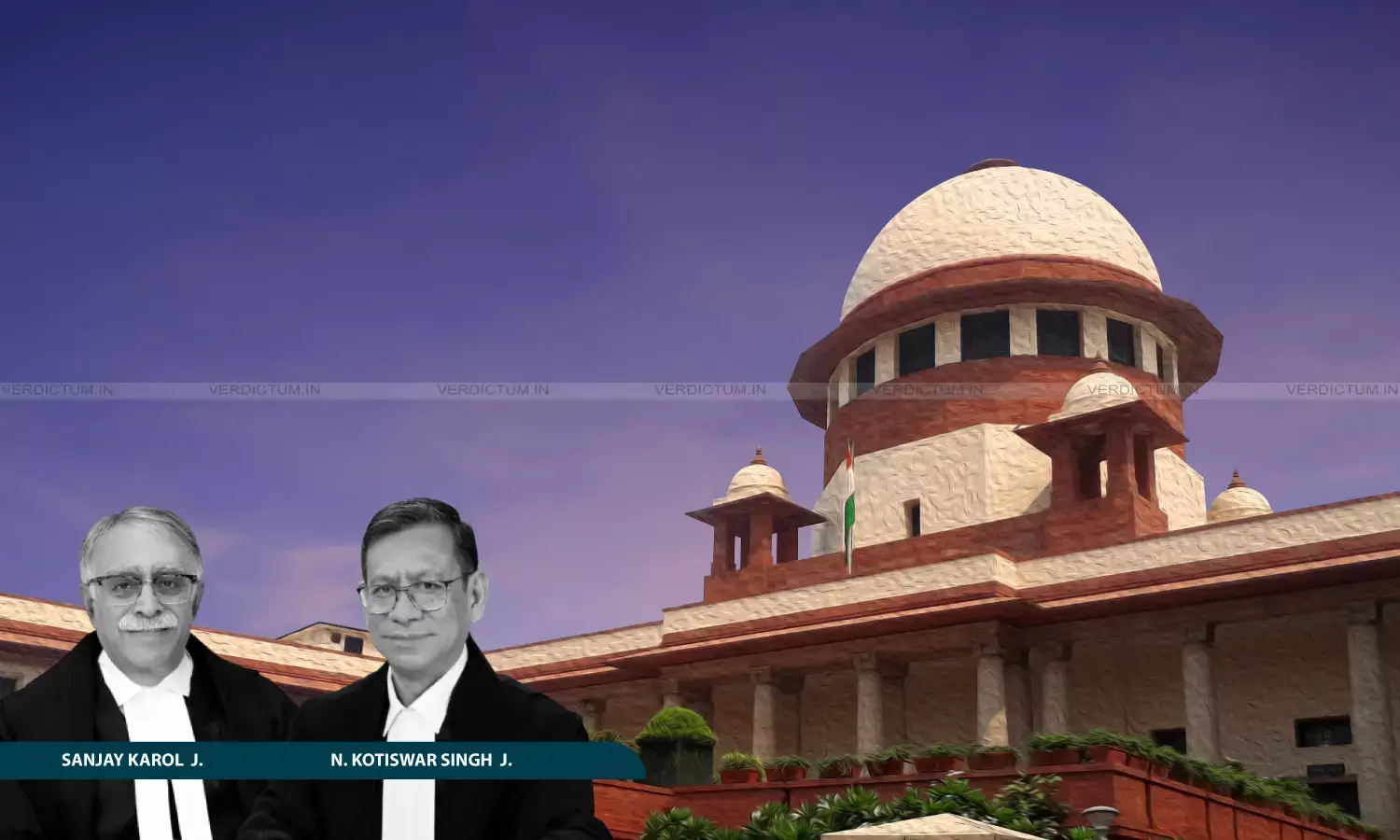
Justice Sanjay Karol, Justice Nongmeikapam Kotiswar Singh, Supreme Court
The Supreme Court has reiterated that while parity with the other accused is a relevant consideration in bail matters, it cannot serve as the sole ground for granting bail, particularly in serious offences such as murder.
The Apex Court reaffirmed that the role and involvement of each accused must be independently evaluated before arriving at a bail decision.
The Court was hearing criminal appeals filed by the complainant challenging orders of the Allahabad High Court granting bail to two co-accused in a case involving offences under Sections 147, 148, 149, 302 and 506 of the Indian Penal Code.
A Bench comprising Justice Sanjay Karol and Justice N Kotiswar Singh analysed the material placed on record, including the FIR, orders of the Sessions Court, and the reasoning adopted by the High Court, and reiterated that “while utilizing parity as a ground for bail, the same must focus on the role of the accused and cannot be utilized solely because another accused person was granted bail in connection with the same offence, and neither can this ground be claimed as a matter of right”.
Advocate Anshul Sharma appeared on behalf of the appellant, while Advocate Vijendra Singh, AOR, represented the respondents.
Background
The case arose from an FIR alleging that the complainant and his family were intercepted by the accused persons, who were armed with pistols. The FIR stated that one of the accused had threatened the family and had instigated another accused to shoot the complainant’s father, who died on the spot. The accused was arrested, and his bail applications were twice rejected by the Sessions Court, considering the nature of the injuries and the gravity of the allegations.
The Allahabad High Court, however, granted him bail primarily on the ground that his alleged role was similar to that of the co-accused who had earlier been granted bail. This reliance on parity formed the core of the complainant’s challenge before the Supreme Court. The complainant also challenged a separate order granting bail to another co-accused, in connection with the same incident.
The Supreme Court had earlier set aside the bail granted to a third co-accused.
Court’s Observation
The Supreme Court, upon examining the material placed on record, reiterated that parity is not an absolute rule but a principle grounded in the equality of position and circumstances. Referring to Ramesh Bhavan Rathod v. Vishanbhai Hirabhai Makwana (2021), the Bench held that parity “must focus on the role of the accused” and cannot be claimed merely because another accused has been granted bail.
The Court further emphasised that bail considerations require an assessment of several factors, such as the gravity of the offence, antecedents, possibility of tampering with evidence, and prima facie involvement, none of which the High Court had properly evaluated.
The Bench reviewed the High Court’s order and noted that the only reasoning provided was that the accused had no criminal history and that another co-accused had been enlarged on bail. The Court held that this approach was flawed. Drawing from its judgment in Ashok Dhankad v. State of NCT of Delhi (2025), the Court highlighted the need for judicial application of mind and the necessity of reflecting relevant considerations in bail orders, especially in serious offences like murder.
The Apex Court also undertook a detailed comparative examination of how various High Courts have consistently approached the doctrine of parity. From decisions of the Allahabad, Delhi, Himachal Pradesh, Karnataka, Madhya Pradesh, and Calcutta High Courts, the Supreme Court concluded that “the High Courts speak in one voice that parity is not the sole ground on which bail can be granted”.
The Court explained that parity in bail matters does not merely arise from co-accused being implicated in the same offence. What must be compared is the “position” of the applicant in the crime, meaning their specific role, level of involvement, and individual conduct. A person who merely accompanied a group, the Court elaborated, cannot claim equality with another who instigated violence or inflicted serious injuries. Thus, parity exists only among those whose actions and roles in the alleged offence are similar in nature and gravity, and it cannot be invoked as an automatic or absolute right.
Applying these principles to the present case, the Bench emphasised the distinct roles attributed to the accused. The appellant was alleged to have been the instigator who had asked to shoot the deceased. By contrast, the third co-accused was part of the group and initially issued threats. Since their roles were materially different, the Court held that the High Court’s reliance on parity was misplaced and legally unsustainable.
With respect to the second appeal, the Court found that the High Court’s order did not record any reasons at all. The order merely referred to earlier Supreme Court judgments without explaining how they applied to the facts of the case. Holding that a bail order cannot be a non-speaking order, the Court remanded the matter to the High Court for fresh consideration.
Conclusion
The Supreme Court set aside the bail order and directed the appellant-accused to surrender before the concerned Court within two weeks. The appeal relating to the co-accused was allowed, and the matter remanded to the High Court for fresh adjudication in accordance with settled principles governing bail.
Cause Title: Sagar v. State of UP & Anr. (Neutral Citation: 2025 INSC 1370)
Appearances
Petitioner: Advocates Anshul Sharma, Krishan Kumar, Sakshi Chahar, Devesh Maurya, Sukhamrit Singh, Geetha Rani, Praveen Swarup, AOR
Respondents: Advocates Vijendra Singh, AOR, Vikas Bansal, Apurva Singh
