

Adverse Presumption For Non-Appearance In Witness Box Is Rebuttable And Not Fatal If Case Is Otherwise Proved: Supreme Court
The Court held that non-appearance of a plaintiff does not automatically defeat the suit where cogent and reliable evidence on record sufficiently establishes the pleaded case.
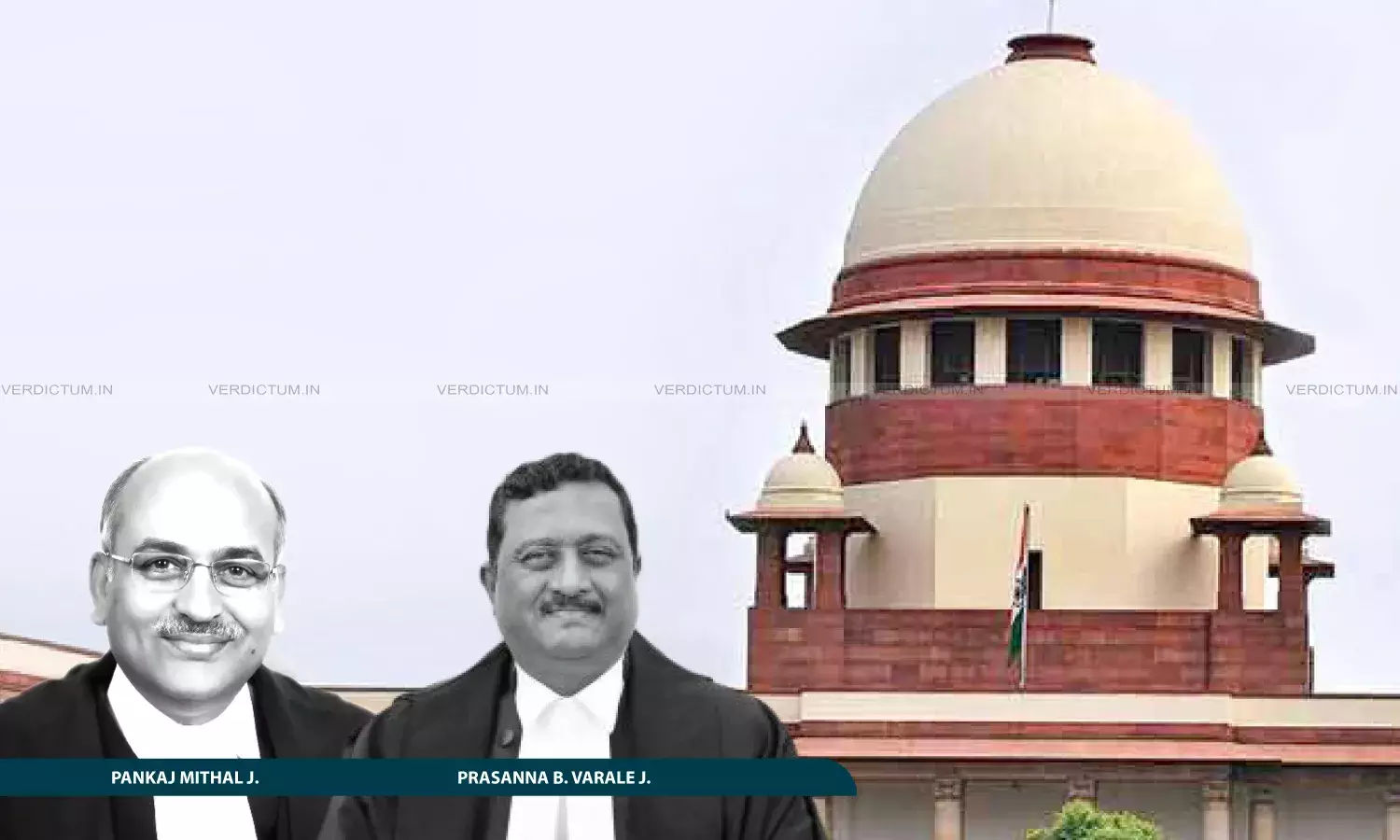
Justice Pankaj Mithal, Justice Prasanna B. Varale, Supreme Court
The Supreme Court observed that an adverse inference drawn against a plaintiff for not entering the witness box is not conclusive in nature and can be displaced by other credible evidence establishing the case.
It held that where such presumption stands rebutted through reliable testimony and supporting material, the non-appearance of the plaintiff would not be fatal to the claim.
The Court was hearing a civil appeal arising out of a suit for specific performance of an agreement to sell, wherein the primary challenge was directed against the decree granted in favour of the plaintiff despite his non-appearance as a witness.
A Bench of Justice Pankaj Mithal and Justice Prasanna B. Varale, while affirming the decree of specific performance, observed: “The adverse presumption, if any, drawn for non-appearing in the witness box by the plaintiff, is a rebuttal presumption and if the aforesaid presumption is successfully rebutted by the other cogent evidence on record, the said presumption would not be material and applicable”.
Senior Advocate K. Parameshwar appeared for the appellants, while Senior Advocate Pawanjit Singh Bindra appeared for the respondents.
Background
The dispute arose from an agreement to sell agricultural land executed between the parties, under which part consideration was allegedly paid, and the time for execution of the sale deed was extended on multiple occasions. The plaintiff claimed readiness and willingness to perform his part of the contract and asserted that he had appeared before the Sub-Registrar on the stipulated date. Still, the defendants failed to execute the sale deed.
The trial court dismissed the suit for specific performance while granting a refund of the admitted amount. However, the first appellate court reversed the findings and decreed specific performance, holding that the plaintiff had proved payment of consideration, extension of time, and readiness to perform the contract. The High Court upheld this finding in the second appeal.
Before the Supreme Court, one of the principal contentions raised by the defendants was that the plaintiff had failed to enter the witness box, thereby attracting an adverse presumption against him, which should have been fatal to his case.
Court’s Observation
The Court examined the settled legal position on adverse presumption arising from non-appearance of a party and reiterated that such presumption is not absolute but rebuttable in nature.
Referring to the principle laid down in Vidhyadhar v. Manikrao (1999), the Court noted that while non-appearance of a party may give rise to an adverse inference, such inference is limited in scope and does not automatically result in dismissal of the claim.
The Court held that the adverse presumption, if any, drawn for non-appearing in the witness box by the plaintiff, is a rebuttal presumption, and if the other cogent evidence on record successfully rebuts the aforesaid presumption, the said presumption would not be material and applicable.
Applying this principle to the facts of the case, the Court found that the plaintiff’s Manager (PW-4), who had a long-standing association with the plaintiff and personal knowledge of the transaction, had deposed in detail regarding execution of the agreement, payment of consideration, and extension of time.
The Court further held, “His testimony substantially corroborates the case as set up by the plaintiff… the adverse inference drawn on account of non-appearance of the plaintiff stands rebutted by his evidence and other evidence on record.”
Addressing the competency of such a witness, the Court relied on Janki Vashdeo Bhojwani v. Indusind Bank Ltd. (2005) and Rajesh Kumar v. Anand Kumar (2024), reiterating that “a power of attorney holder may depose on behalf of the principal in respect of such acts which are within his personal knowledge but he cannot certainly depose for the principal, for the acts done by the principal and not known personally by him”.
The Court observed that in the present case, the manager “had deposed about the entire transaction based upon his personal knowledge as he was attached to the plaintiff as the Manager”, while concluding that “in such circumstances, his evidence cannot be discarded.”
The Court also undertook a broader examination of the evidentiary record, including proof of payments, extension of time, and readiness and willingness of the plaintiff, and found that the findings of the first appellate court were neither perverse nor based on inadmissible evidence.
Conclusion
The Supreme Court held that the adverse presumption arising from non-appearance of the plaintiff stood effectively rebutted by cogent and reliable evidence on record. It found no infirmity in the findings of the first appellate court and upheld the decree of specific performance.
Accordingly, the appeal was dismissed.
Cause Title: Russi Fisheries Pvt. Ltd. & Anr. v. Bhavna Seth & Ors. (Neutral Citation: 2026 INSC 339)
Appearances
Appellants: Senior Advocate K. Parameshwar; Advocates Manish Gandhi, Dhiraj Abraham Philip (AOR), Febin Mathew Varghese, Veda Singh, Lija Merin John, Prasad Hegde, N. Sai Kaushal, Soyarchon Khangrah.
Respondents: Senior Advocate Pawanjit Singh Bindra; Advocates Sriharsh Nahush Bundela (AOR), Rahul Jain, Naveen Kumar Yadav, Raghav Dikshit.
