Computing Point Of Limitation U/S 468 CrPC Is Date Of Filing Complaint Or Lodging Of FIR: Supreme Court
The Court held that a delay in taking cognizance by the Magistrate cannot defeat a prosecution initiated within the limitation.
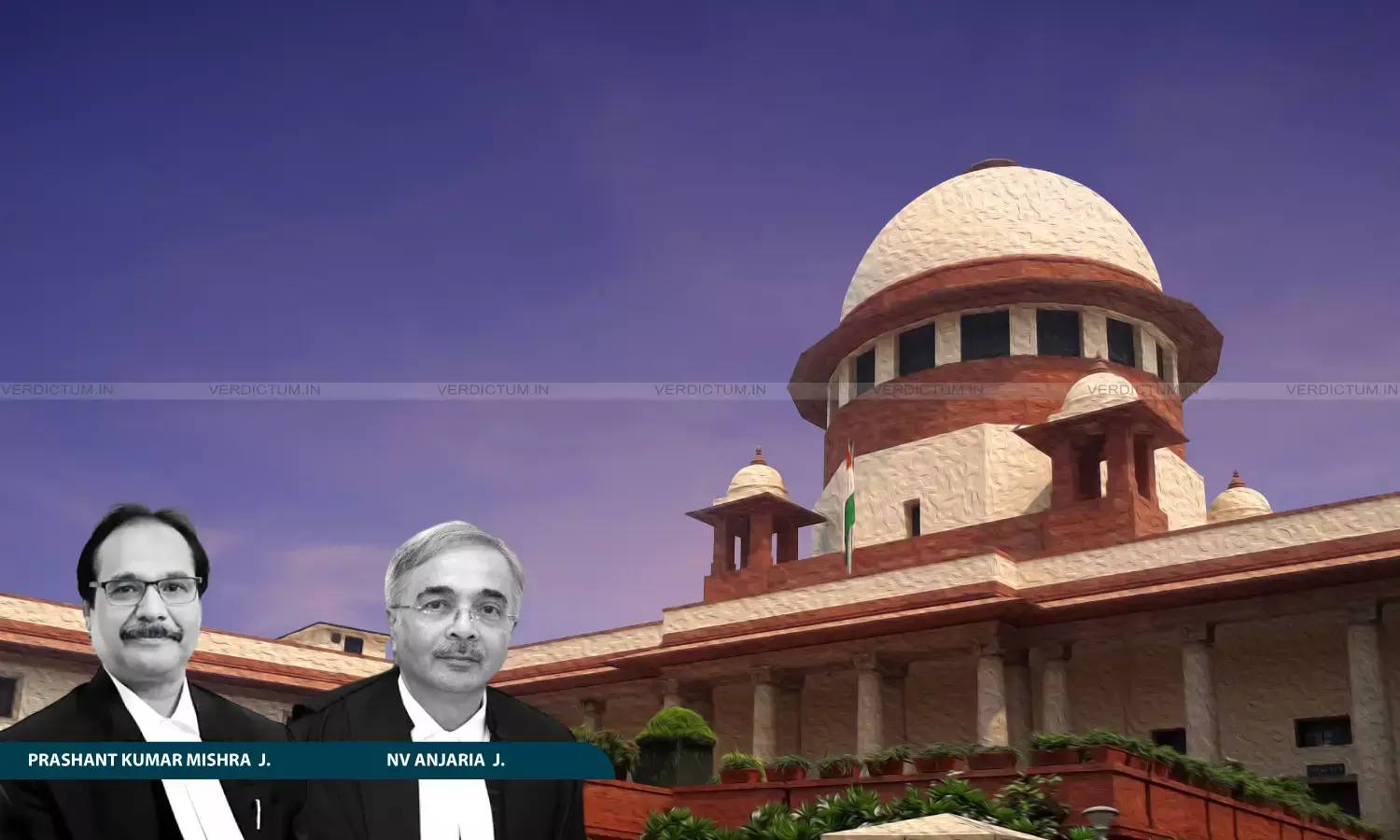
Supreme Court, Justice Prashant Kumar Mishra, Justice N.V. Anjaria
The Supreme Court has held that for computing limitation under Section 468 of the Code of Criminal Procedure, 1973, the relevant date is the date of filing of the complaint or initiation of criminal proceedings, and not the date on which the Magistrate takes cognizance.
The Court was hearing criminal appeals challenging the judgment of the Delhi High Court, which had quashed an FIR on the ground that the charge-sheet was filed beyond the prescribed limitation period.
A Division Bench comprising Justice Prashant Kumar Mishra and Justice N.V. Anjaria observed: “... the computing point of limitation for the purpose of Section 468, Cr.PC is held to be the date of filing the complaint – the date of initiation of criminal proceedings. Whether the case belongs to one instituted before the Magistrate under Section 173 or it is upon a complaint filed before the police, what matters is the date of initiation of criminal proceedings”.
“The criminal proceedings can be said to have been initiated in both categories of complaint when the complaint is filed before the Magistrate or FIR is lodged before the police, as the case may be. It remains a complaint made either to the Magistrate or to the police to become the starting point of initiation of criminal proceedings”, the Bench added.
Advocate Shivani Vij appeared for the appellant, while Additional Solicitor General Rajkumar Bhaskar Thakare appeared for the respondents.
Background
The case arose from an incident leading to the registration of cross-FIRs between the parties. The FIR was lodged by the appellant alleging offences under Sections 323 and 341 read with Section 34 IPC.
The police filed the charge sheet. The Magistrate thereafter took cognizance under Section 190(1)(b) CrPC.
The accused challenged the proceedings on the ground that the charge-sheet was filed beyond the limitation period of one year prescribed under Section 468 CrPC for offences punishable up to one year.
The Trial Court rejected this contention. The Revisional Court affirmed the same. However, the Delhi High Court allowed the accused’s petition and quashed the FIR, holding that the bar of limitation applied since cognizance was taken beyond the prescribed period.
This led to the present appeals before the Supreme Court.
Court’s Observation
The Supreme Court undertook a detailed analysis of Chapter XXXVI of the CrPC, dealing with limitation for taking cognizance of certain offences. It noted that Section 468 prescribes limitation periods depending on the severity of punishment, and Section 469 provides for commencement of limitation from the date of offence or knowledge thereof.
The core issue before the Court was whether the limitation is to be computed from the date of filing of the complaint/FIR or from the date of taking cognizance. The Court referred extensively to the Constitution Bench judgment in Sarah Mathew v. Institute of Cardiovascular Diseases (2014), which had resolved conflicting precedents on the issue.
It reiterated: “For the purpose of computing the period of limitation… the relevant date is the date of filing of the complaint or the date of institution of prosecution and not the date on which the Magistrate takes cognizance.”
The Court explained that taking cognizance is an act of the Magistrate, over which the complainant has no control, and may be delayed due to systemic or administrative reasons. It observed: “Taking cognizance may be delayed… for several reasons… It cannot be the intention of the legislature to throw a diligent complainant out of the court in this manner.”
The Court further clarified that the principle applies equally to cases initiated by complaint before a Magistrate as well as cases initiated by FIR before the police. It categorically held: “The criminal proceedings can be said to have been initiated… when the complaint is filed before the Magistrate or FIR is lodged before the police…”
Rejecting the contention that a distinction exists between “complaint” and “police report” for limitation, the Court held that both constitute initiation of criminal proceedings.
The Court also emphasised the binding nature of Constitution Bench decisions and deprecated attempts to re-argue settled legal positions.
Conclusion
The Supreme Court held that the High Court erred in quashing the FIR by computing the limitation from the date of cognizance. It held that since the FIR was lodged within the prescribed limitation period, the proceedings were not barred under Section 468 CrPC.
Accordingly, the impugned judgment of the High Court was set aside, and the appeals were allowed. The Court directed that the trial shall proceed expeditiously in accordance with the law.
Cause Title: Roma Ahuja v. State And Another (Neutral Citation: 2026 INSC 336)
Appearances
Appellant: Advocate Shivani Vij, AOR
Respondents: ASG Rajkumar Bhaskar Thakare; Advocates Praveen Swarup