Evidence U/S. 8 Of Evidence Act Only Corroborative; Cannot By Itself Result In Conviction: Supreme Court
The Apex Court held that conduct evidence admissible under Section 8 of the Evidence Act can at best supplement other circumstances and cannot independently sustain a conviction, particularly where investigation lapses and gaps in the prosecution chain raise reasonable doubt.
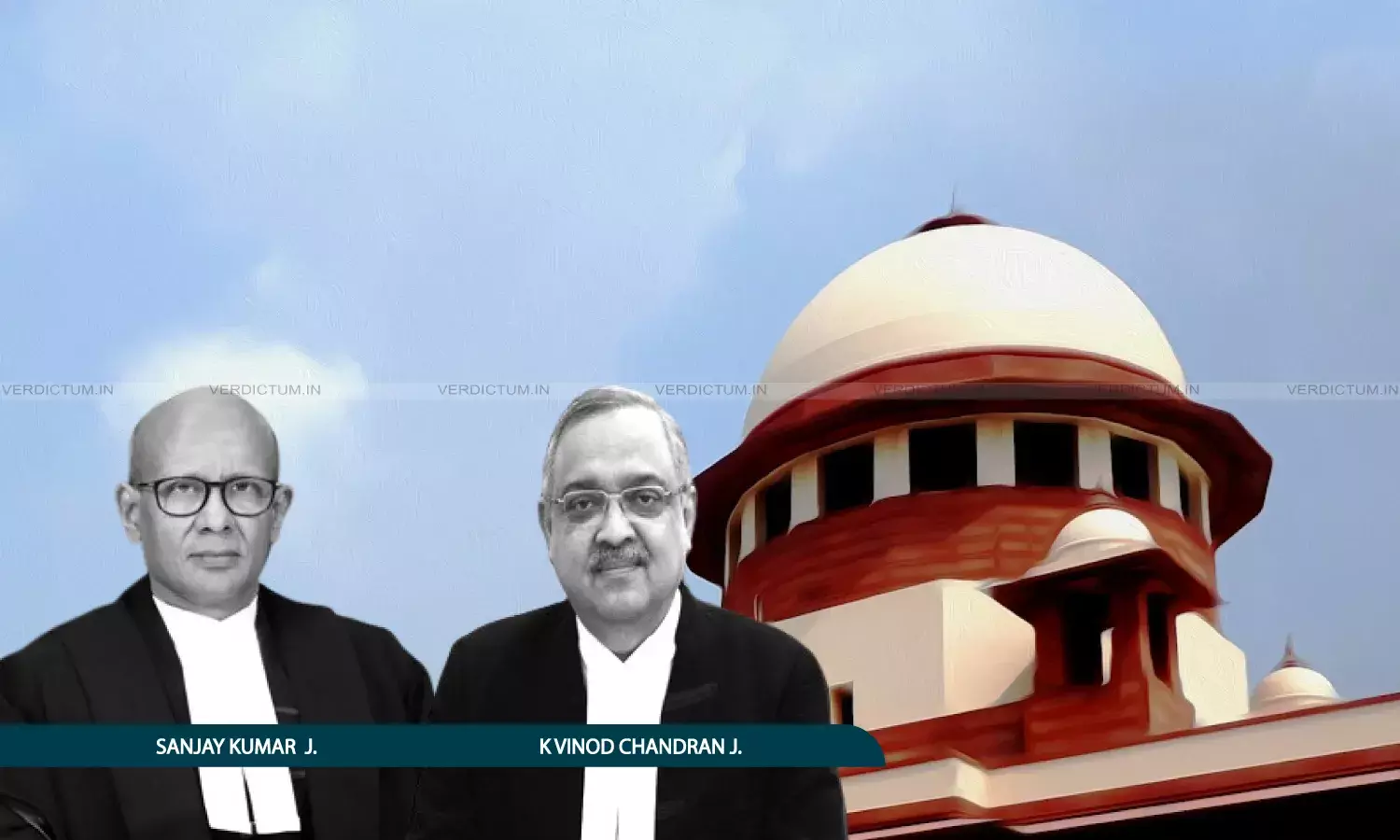
The Supreme Court held that evidence admissible under Section 8 of the Indian Evidence Act is only corroborative in nature and cannot by itself form the basis of a conviction, while setting aside the conviction of a man accused of murdering a six-year-old child.
The Court was hearing a criminal appeal challenging the High Court's judgment, which had affirmed the conviction based on circumstantial evidence, including the last-seen theory, the recovery of bone remnants, and DNA analysis.
A Bench of Justice Sanjay Kumar and Justice K. Vinod Chandran, while relying on the Apex Court’s previous ruling in Dharam Deo Yadav v. State of Uttar Pradesh (2014), in which it was held that even if the recovery was not in terms of Section 27, on the premise that the accused was not in the custody of the police while the statement was made, it would be admissible as conduct under Section 8 of the Act, observed that “the evidence under Section 8 can only offer corroboration and cannot by itself result in a conviction.”
Background
The prosecution alleged that the accused stepfather murdered a six-year-old girl whose charred bone remnants and skull fragments were later recovered from different locations.
The conviction rested on three primary circumstances: a neighbour’s testimony that the accused was last seen with the child, recovery of skeletal remains allegedly at his instance, and DNA matching with the biological parents.
According to the prosecution, a domestic quarrel occurred between the accused and his wife, following which the wife left the matrimonial home.
When relatives later went to collect the children, they were informed that the accused had taken the younger child.
Notably, no missing complaint was filed immediately, and the FIR was lodged several days later.
Court’s Observations
The Supreme Court noted interpolation in official documents concerning the date and time of arrest, which created doubt about whether the accused had been in custody during the relevant period.
This discrepancy weakened the prosecution’s reliance on the last-seen theory, since the timeline suggested the alleged incident may have occurred when the accused was already in custody.
The Bench reiterated that a defective investigation does not automatically benefit an accused, but a conviction cannot stand unless evidence independently proves guilt beyond a reasonable doubt.
The Court found that the prosecution’s last-seen evidence was unreliable. The alleged eyewitness disclosed the information only several days later, even though the family and police were already aware that the child had left with the accused earlier.
Further, despite knowledge that the child was missing, no complaint was lodged immediately, and the FIR was registered only after several days. The Bench held that these circumstances seriously undermined the credibility of the prosecution’s narrative.
The Court examined the alleged recovery of bones based on the accused’s disclosure statement. It was observed that the memorandum showed the statement was recorded before the accused was arrested.
Since Section 27 requires disclosure to be made while the accused is in police custody, the disclosure did not satisfy the statutory requirements and could not be admitted under that provision.
However, relying on precedent, the Court held that such evidence may still be admissible as conduct under Section 8 of the Evidence Act.
The Bench clarified that conduct evidence, even if admissible, is only a link in the chain and cannot independently establish guilt. It cited authority holding that knowledge of a discovered fact may be incriminating but does not necessarily prove direct connection with the offence.
Accordingly, the accused’s knowledge of the location of remains could not by itself establish culpability.
The Court noted that DNA matching occurred only with some bone fragments recovered from a canal, while other remains did not match. It was also observed that a piece of cloth found with the remains was not properly identified through witness confrontation, further weakening the evidentiary value.
The Bench concluded that only two circumstances were proved: the death of the child and the accused’s knowledge of the recovery location. Crucially, the corpus delicti was not fully recovered, and no definite time of death was established.
The long delay in reporting the disappearance and the absence of questioning of the accused during that period further raised doubt. The Court held that these deficiencies prevented the formation of a complete chain of circumstances pointing solely to guilt.
Conclusion
The Supreme Court held that the prosecution failed to establish guilt beyond a reasonable doubt and that reliance on conduct evidence without corroborative circumstances was legally insufficient.
Granting the benefit of doubt, the Court allowed the appeal, set aside the conviction affirmed by the High Court, and directed that the accused be released forthwith if not required in any other case.
Cause Title: Rohit Jangde v. The State of Chhattisgarh (Neutral Citation: 2026 INSC 162)
Appearances
Petitioner: Dr Rajesh Pandey, Sr. Adv.; Chandrika Prasad Mishra, AOR; Prashasti Singh, Adv.; Ayushi Pandey, Adv.; Utsav Madan, Adv.; Swati Surbhi, Adv.
Respondent: Ankita Sharma, AOR; Arjun D. Singh, Adv.; Ishika Neogi, Adv.; Divya Tripathi, Adv.