

Financial Assistance Under 2006 Haryana Compassionate Assistance Rules Can Be Deducted From Compensation Awarded Under Motor Vehicles Act: Supreme Court
The Supreme Court was considering the appeals filed by Reliance General Insurance Company Limited, questioning the correctness of the judgment of the Punjab and Haryana High Court.

The Supreme Court has affirmed that the financial assistance granted or already received under the Haryana Compassionate Assistance to Dependents of Deceased Government Employees Rules, 2006, can be deducted from compensation awarded under the Motor Vehicles Act to avoid double recovery.
The Apex Court was considering the appeals filed by Reliance General Insurance Company Limited, questioning the correctness of the judgment of the Punjab and Haryana High Court.
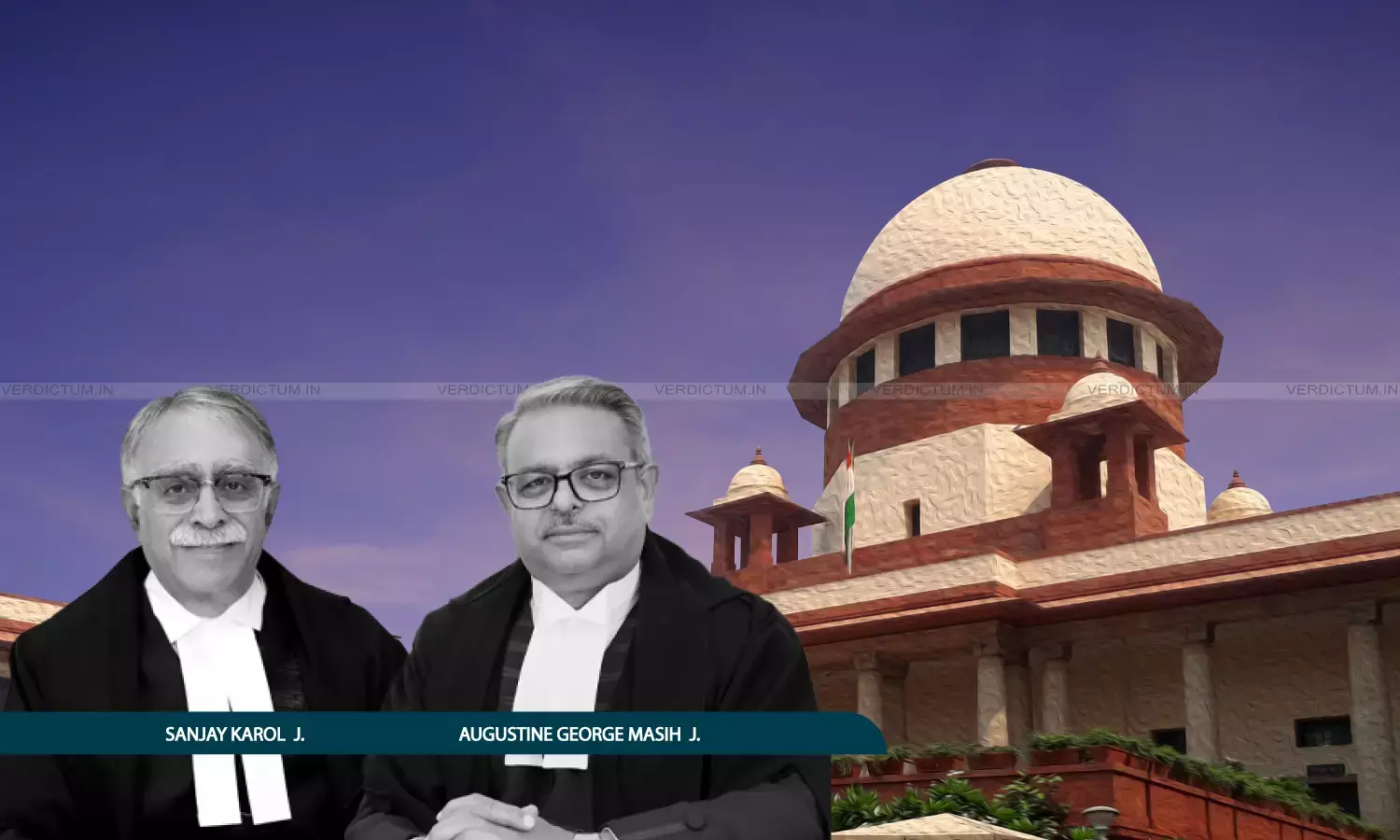
Referring to the judgments in Reliance General Insurance v. Shashi Sharma (2016) and National Insurance Company Ltd. v. Birender & Ors. (2020), the Division Bench of Justice Sanjay Karol and Justice Augustine George Masih held, “On a close reading of the two judgments, Shashi Sharma (supra) and Birender (supra) it can be concluded that they are not inconsistent on any point of law. Both decisions operate within the same conceptual framework governing the deduction of financial assistance under the 2006 Rules from compensation awarded under the MVA.”
Senior Advocate Atul Nanda represented the Appellant, while AOR Aditya Singh represented the Respondent.
Factual Background
The case dates back to the year 2009, when a motorcycle being driven by one Ravinder Kumar, carrying two pillion riders, Hom Devi and Kanika (first respondent), collided with a jeep, on account of the latter’s rash and negligent driving. Hom Devi passed away, and the other two people on the motorcycle received multiple injuries. The deceased was employed as an MPHW in PHC Chhara, drawing a salary of Rs 21805 per month. The first Respondent, along with her two brothers, filed a claim petition before the Motor Accidents Claims Tribunal, which was allowed, and the amount awarded was Rs 8,80,000, to be borne by the respondents, jointly and severally. The claimants-respondents approached the High Court seeking enhancement thereof.
The Court allowed the prayer for enhancement but held that the amount received by the family as per the Haryana Compassionate Assistance to Dependents of Deceased Government Employees Rules, 2006, had to be deducted from the total amount of compensation awarded to them. As such, the total compensation awarded by the High Court in terms of the Main Order was Rs. 29,09,240 while holding that the amount received by the claimant-respondents as part of compensation under the 2006 Rules and any part of the compensation as awarded by the Tribunal would be deducted. The claimant-respondents filed an application for clarification, as the deduction of the amount received as per the 2006 Rules was ordered. By way of the Clarification Order, the position of the Main Order was reversed. The Order in Review recorded that the application was withdrawn, seeking liberty to challenge the same.
Reasoning
The Bench stated that, as per the judgment in Shashi Sharma (Supra) , deduction is permissible only to the extent that financial assistance overlaps with the same pecuniary loss for which compensation is awarded under the MVA, most notably the loss of income. Benefits that are not income substitution or otherwise unconnected to the accident-related loss are not deductible.
The Bench mentioned that the judgment in Birender (Supra) addresses the stage at which such deductions may be made and the evidentiary basis required for doing so. The Court held that the High Court was not justified in deducting a portion of the financial assistance merely on the assumption that the claimants were entitled to it. It emphasised that eligibility or actual receipt must be established on record before any deduction is effected.
“Thus, the two decisions are consistent in principle. Shashi Sharma defines what is deductible, while Birender clarifies when and how such deductions should be made. The latter does not depart from the former; rather, it ensures that the substantive rule is applied with appropriate procedural safeguards and without speculative assumptions. Together, they form a coherent legal position governing both the nature and the timing of deductions under the 2006 Rules”, it added.
Thus, allowing the appeal, the Bench set aside the Order in Review and restored the main order. “The amount received by the claimant-respondents in terms of the 2006 Rules will be deducted from the award as modified by the Main Order. The rate of interest as awarded by the Tribunal will remain unchanged, payable from the date of institution of the claim petition.”
Cause Title: Reliance General Insurance Company Limited v. Kanika (Neutral Citation: 2026 INSC 188)
Appearance
Appellant: Senior Advocate Atul Nanda, Advocates Kshitij Mittal, Abhyuday Singh, AOR Mukesh Kumar
Respondent: AOR Aditya Singh, Advocates Shubham Singh, Kamal Kishor, Vaseem