

Supreme Court Refuses To Review Survey Report, Videography And Objections In Bhojshala Temple-Kamal Maula Mosque Dispute
The Court left all legal issues open for the Madhya Pradesh High Court, including concerns regarding the production of video evidence and alleged excavations during the ASI survey.

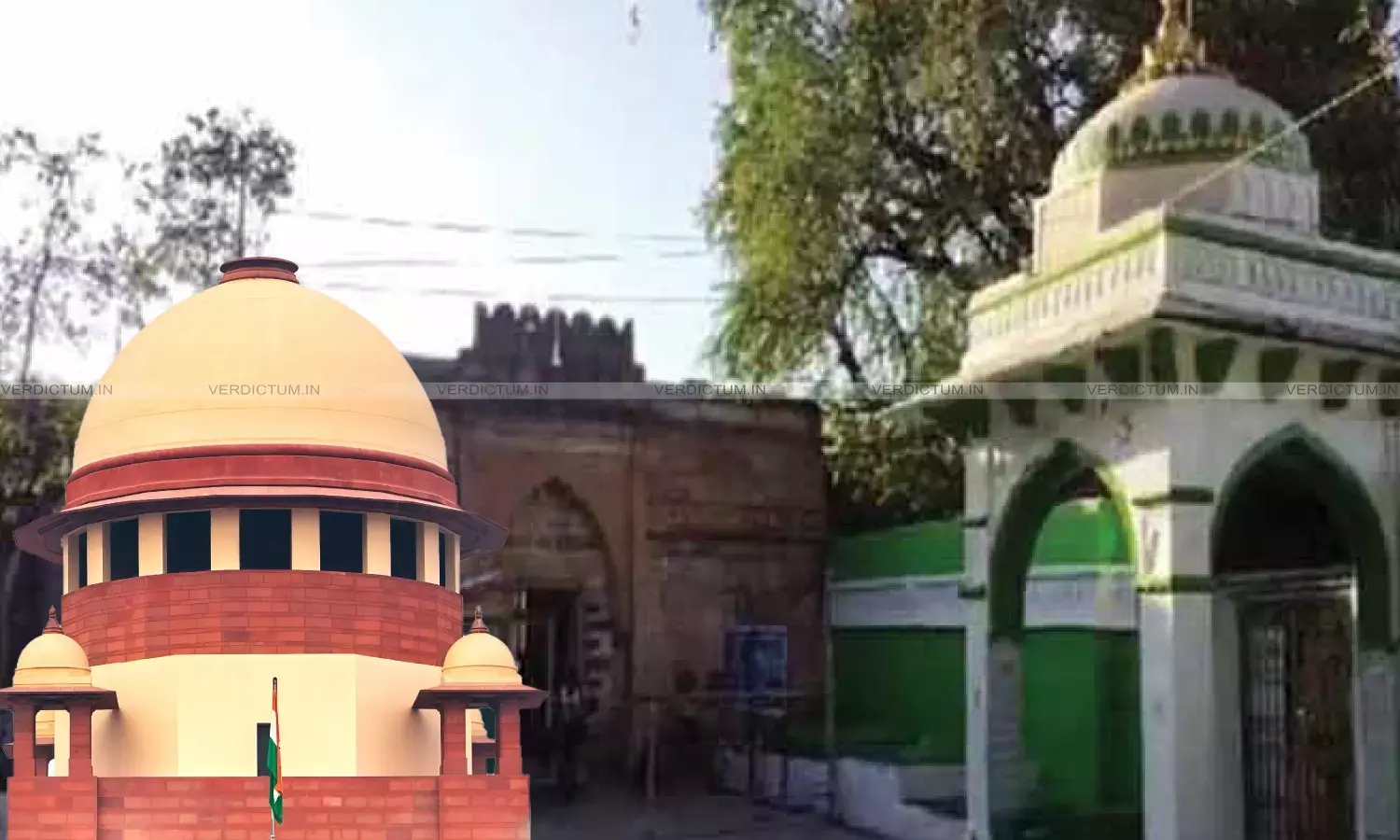
The Supreme Court refused to review the survey report, videography and objections made by the Maulana Kamaluddin Welfare Society in the dispute pertaining to the Bhojshala Temple-Kamal Maula Mosque.
It noted that the High Court intends to consider all objections, including those related to survey videography and colored photographs, during the final hearing.
The Bench of Chief Justice Surya Kant, Justice Joymalya Bagchi and Justice Vipul Pancholi ordered, "That the survey report was supplied and some of the parties have submitted their objections against the same...It further appears that the Archaeological Survey of India also conducted videography of the site, and during the course of such videography...the Appellant raised several objections. That's what the High Court has now, by the date of the order dated 22nd January, 2026, passed the impugned order to the effect that the objections submitted by the parties shall be considered at the time of handling the case....It thus seems that according to the Appellant, he raised some objections which are duly recorded in the course of videography...We have no reason to doubt that the High Court will, after seeing the videography, consider those objections to, along with the other objections made by the parties and take an appropriate decision on such objections...In this regard, we have not expressed anything on the matter. All the issues are left open to be articulated by the Appellant."
Senior Advocate Salman Khurshid appeared for the Petitioner, while ASG KM Nataraj and AOR Vishnu Shankar Jain appeared for the Respondents.
Senior Advocate Salman Khurshid, representing the mosque management, raised concerns that unauthorized excavations occurred during the Archaeological Survey of India (ASI) proceedings and requested access to the full videography to substantiate these claims.
While declining to express an opinion on the merits, the Supreme Court emphasized that the High Court must act in accordance with the principles of natural justice when reviewing the electronic evidence and objections before making a final decision on the religious character of the 11th-century monument.
Senior Advocate Khurshid said, "Your lordships directed videography...the presence of both sides will be established. All we need is videography to be handed over in colored pictures. No need for haste that this can't be given. The issue of maintainability can be decided when it's taken up. The videography issue is critical. They were doing the survey in four places at the same time and only two people were allowed, and so we couldn't be everywhere."
Chief Justice said, "We can ask the high court to decide those objections."
Justice Bagchi said, "You are saying the survey report lists 1-5 objections, but it does not list 6-8 objections. The videography will be played in court, and parties can raise objections about the correctness of the same. The report will include all electronic or documentary evidence annexed with the same."
AOR Vishnu Jain said, "The High Court has not rejected the request. High Court has just said we will see at the time of the final hearing."
Senior Advocate Khurshid said, "One of the issues is that Your lordships had said no excavavtion will happen. Now, our objection is that excavations did happen. Now if excavation happened, and if the videography is there then the whole picture changes...Heavens wont fall in a week's time if we are given."
The legal dispute over the Bhojshala Temple-Kamal Maula Mosque complex in Madhya Pradesh centres on the religious identity of the 11th-century monument. Hindus worship at the site as a temple dedicated to Goddess Vagdevi (Saraswati), while Muslims recognize the structure as the Kamal Maula Mosque. The Archaeological Survey of India (ASI) protects the site and recently conducted a court-mandated scientific survey to determine its original character.
On March 16, 2026, a division bench of the Madhya Pradesh High Court, comprising Justice Vijay Kumar Shukla and Justice Alok Awasthi, heard the ongoing writ petition filed by the Hindu Front for Justice. During this hearing, the Court allowed various parties to intervene in the case, noting that the matter is a Public Interest Litigation (PIL). The Court also permitted the government respondents to adopt replies from connected cases to expedite the proceedings.
The High Court informed its intention to personally visit and inspect the disputed site before the next hearing. The judges directed all parties to submit their final objections or suggestions regarding the ASI report. The Court also ordered the parties to be ready to argue the matter finally during the next scheduled hearing on April 2, 2026.
Previously, in January 2026, the Supreme Court allowed Hindu prayers from sunrise to sunset on Basant Panchami on Friday at the disputed Bhojshala-Kamal Maula Mosque in Madhya Pradesh's Dhar district, while permitting Muslims to offer namaz from 1 pm to 3 pm on the day. The Apex Court today also directed that a list of persons from the Muslim community coming for namaz be given to the district administration. Hindu and Muslim groups have sought nod for religious activities at the Bhojshala complex on January 23, a Friday, when Saraswati Puja will also be held on the occasion of Basant Panchami.
The Madhya Pradesh High Court in the Bhojshala Saraswati Temple Demolition Case had also issued directions to the Archaeological Survey of India (ASI) to inspect the premises of the Maulana Kamal Maula Mosque. A Trust named Hindu Front for Justice had filed a writ petition before the Indore Bench seeking issuance of directions to the ASI Director in terms of Sections 75(e) and Order 26 Rule 10A of the Civil Procedure Code (CPC).
In May 2022, the High Court had issued notice in the matter. The petitioners submitted historic facts about Bhojshala and its photos before the High Court to challenge the ASI's arrangement under different provisions of the Constitution. They have also urged the court to give a religious right to Hindus to perform puja round the year and withdraw the permission given to the Muslim community to offer namaz on Fridays. The petitioners have also demanded that the statue of Waghdevi, which is in a museum in London, be brought back to India and re-established in the Bhojshala premises as per the religious sentiments of Hindus. The petition has cited that the then rulers of Dhar had installed the holy statue at Bhojshala in 1034 AD, and it was taken to London in 1857 by the British.
Cause Title: Maulana Kamaluddin Welfare Society v. Hindu Front For Justice [SLP(C) No.11468/2026]