

AFGIS Is Subject To "Deep And Pervasive Government Control"; Qualifies As State Under Article 12: Supreme Court
The Apex Court held that the Air Force Group Insurance Society (AFGIS), though registered as a society under the Societies Registration Act, functions under deep and pervasive administrative control of the Government and performs a public duty towards armed forces personnel, thereby qualifying as “State” within the meaning of Article 12 of the Constitution.
The Supreme Court held that the Air Force Group Insurance Society (AFGIS) qualifies as “State” within the meaning of Article 12 of the Constitution, observing that the body operates under deep and pervasive administrative control of the Government and performs a public function by providing insurance and welfare protection to members of the Indian Air Force.
The Court was hearing a civil appeal filed by employees of AFGIS challenging the dismissal of their writ petitions by the Delhi High Court. The High Court had held that AFGIS was not “State” under Article 12 and consequently ruled that writ petitions concerning service conditions and pay parity were not maintainable.
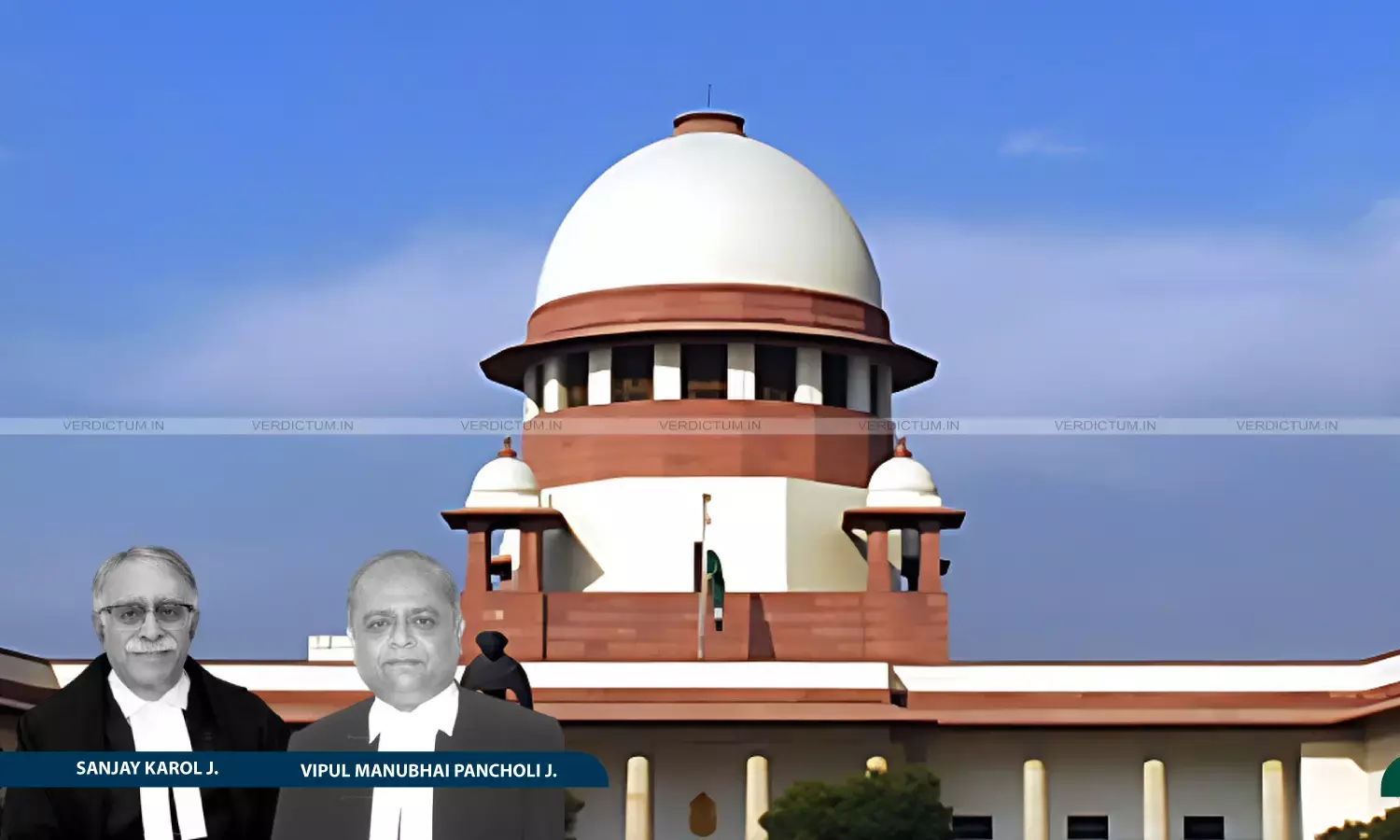
A Bench of Justice Sanjay Karol and Justice Vipul M. Pancholi set aside the High Court’s view and held that the writ petitions were maintainable. The Court observed: “the documents extracted supra make out a case for AFGIS to be considered ‘State’ within the meaning of Article 12. For the aspect of deep and pervasive control, we observe that the Hon’ble President of India granted sanction for AFGIS to be established and also specifically approved the deputation Rules; the Principal Director (AFGIS), every month is to apprise the Assistant Chief of Air Staff regarding the cash flow of AFGIS which ensures monitoring by a core member of the IAF on the activities of AFGIS; the membership and deductions arising therefrom are a compulsory aspect of serving in the IAF, meaning thereby that there is no choice of the individual officer in that matter and instead is a mandate from the employer. When the aspect of administrative control is examined, it is seen that all the members of the Board of Trustees, so also the Managing Committee, are serving members of the IAF and are deputed to AFGIS for a fixed period. In essence, therefore, the administration of the Body is entirely in the hands of Government servants even though the body itself is a purportedly private, self-contained society”.
Background
The appellants were employees of AFGIS, a society established for the welfare and insurance of members of the Indian Air Force and their families. The dispute arose after the Board of Trustees initially resolved to revise employees’ pay scales in accordance with the Sixth Central Pay Commission, but subsequently decided to delink the pay structure from Central Government pay commissions. Employees were required to accept revised terms, removing pay parity with government scales.
Aggrieved by the decision, the employees approached the Delhi High Court seeking relief through writ petitions under Article 226. The High Court dismissed the petitions on the ground that AFGIS, being a self-financed society registered under the Societies Registration Act and funded through member contributions, did not satisfy the requirements to be treated as “State” under Article 12.
Court’s Observation
The Supreme Court examined the legal framework governing the determination of whether an entity qualifies as “State” under Article 12. The Court reiterated that earlier jurisprudence had evolved from a narrow formalistic approach to a broader functional test focusing on the nature of functions performed, degree of governmental control, and public character of the activity.
Referring to precedents such as Ramana Dayaram Shetty v. International Airport Authority of India, Ajay Hasia v. Khalid Mujib Sehravardi, and Pradeep Kumar Biswas v. Indian Institute of Chemical Biology, the Court noted that the determination requires a cumulative assessment of financial, administrative and functional control exercised by the Government.
Applying these principles, the Court identified several factors indicating governmental control over AFGIS.
First, the establishment of AFGIS itself was sanctioned by the President of India, and the deputation rules governing officers posted to the society were also approved by the President.
Second, the Court observed that membership of AFGIS is compulsory for officers and airmen, with insurance premiums automatically deducted from their salaries. These salaries are drawn from the Consolidated Fund of India, reflecting the close linkage between the organisation and the Government structure.
Third, the Court noted that the Board of Trustees and the Managing Committee consist entirely of serving Indian Air Force officers, deputed to AFGIS for fixed tenures. Consequently, the administration of the society is effectively conducted by government servants.
Further, the Court pointed out that the Principal Director of AFGIS is required to periodically report financial activities to senior officers of the Indian Air Force, thereby ensuring institutional oversight by the Air Force leadership.
Beyond administrative control, the Court emphasised the public character of AFGIS’s functions. The Bench observed that the welfare and protection of armed forces personnel is intrinsically linked to the sovereign responsibility of the State.
The Court noted that the role of the armed forces in safeguarding national sovereignty and security requires service members to function under strict discipline and often in hazardous conditions. Insurance protection for such personnel, therefore, serves a broader public purpose.
The Court explained that insurance coverage provided by AFGIS acts as a critical instrument for safeguarding the dignity, economic security, and welfare of service members and their dependents, ensuring support in cases of disability, illness or death during or after service.
The Bench observed that this welfare function enables members of the armed forces to perform their duties with assurance that financial protection and support systems exist for them and their families.
The Court also took note of documents showing that AFGIS had previously described itself as functioning under the authority of the Ministry of Defence while seeking tax exemptions. In such correspondence, the society had stated that it was controlled by the Government and acted as a governmental entity for service tax exemptions.
The Court observed that AFGIS could not claim to be “Government” for the purpose of securing statutory exemptions while simultaneously denying such status when faced with constitutional scrutiny.
Conclusion
The Supreme Court ultimately held that the cumulative effect of the administrative structure, compulsory membership, governmental oversight, and the public duty performed by the organisation established that AFGIS functions as an instrumentality of the State.
Accordingly, the Court held that AFGIS qualifies as “State” under Article 12 and that the writ petitions filed by the appellants were maintainable.
The impugned judgment of the Delhi High Court was set aside, and the writ petitions were restored for adjudication on merits. The Court requested the High Court to decide the matter expeditiously.
Cause Title: Ravi Khokhar & Ors. v. Union of India & Ors. (Neutral Citation: 2026 INSC 233)
Appearance
Appellants: Senior Advocate Shoeb Alam
Respondents: Additional Solicitor General Vikramjeet Banerjee, Advocate Ankur Chibber
