High Courts Must Uphold Principles Of Equality And Fairness In Their Administrative Actions: Supreme Court
The Apex Court held that High Courts, as constitutional institutions entrusted with enforcing equality and fairness, are equally bound to embody these principles in their own administrative functioning.
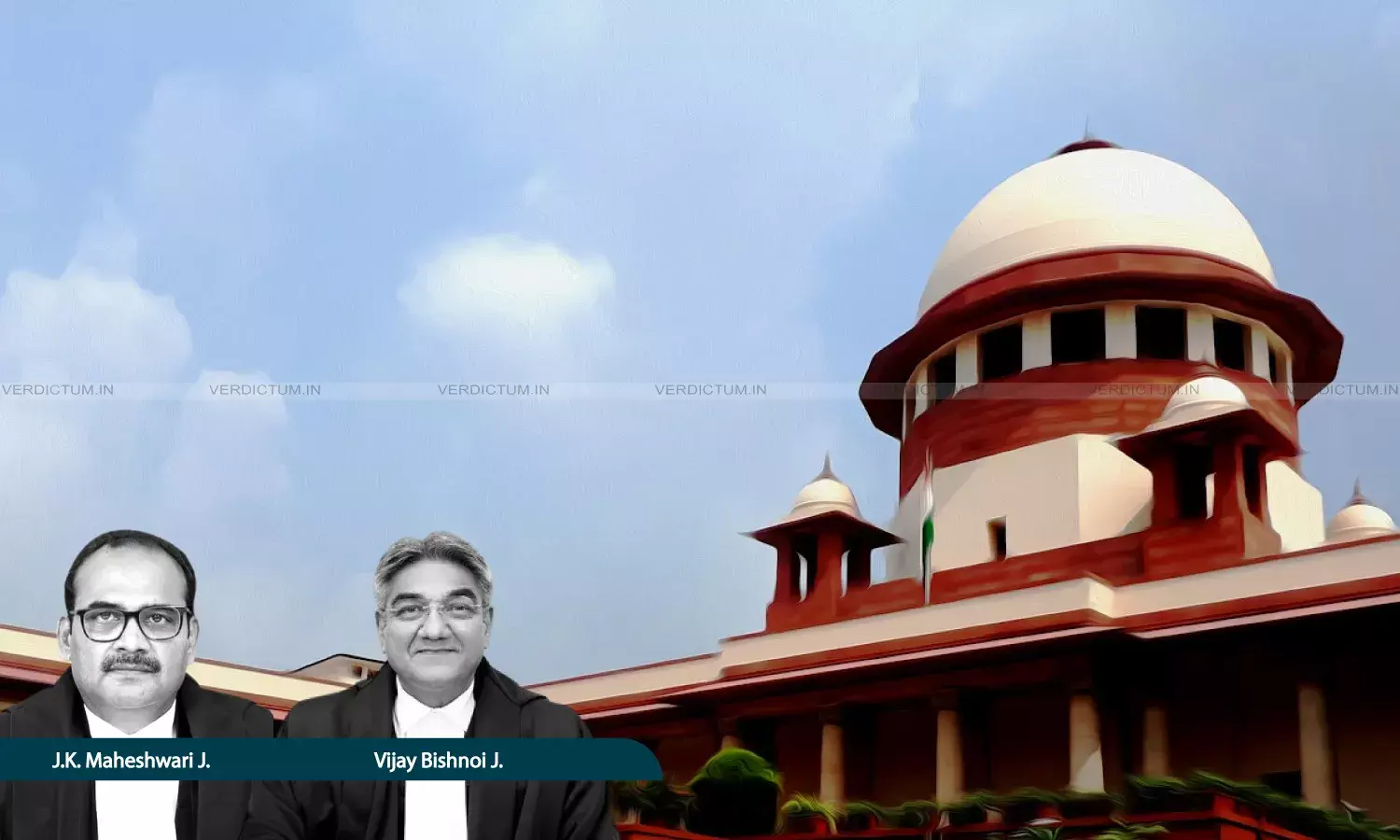
Justice J.K. Maheshwari, Justice Vijay Bishnoi, Supreme Court
The Supreme Court has held that High Courts, being constitutional courts entrusted with upholding equality, fairness and the rule of law, are expected to exemplify these values in their own administrative functioning.
The Court was hearing a batch of appeals arising from the denial of regularisation and consequent discontinuance of services of several employees engaged as Operator-cum-Data Entry Assistants and Routine Grade Clerks in the High Court of Judicature at Allahabad, despite similarly placed employees having been regularised.
A Bench comprising Justice J.K. Maheshwari and Justice Vijay Bishnoi examined whether distinctions drawn solely based on stipulations contained in appointment letters could justify denial of regularisation, and observed that “High Courts, being Constitutional Courts entrusted to uphold equality and fairness, are expected to encompass such principles within their own administrative functioning as well, and must exemplify the standards of a model employer.”
Senior Advocate Paramjit Singh Patwalia represented the appellants, while Advocate Preetika Dwivedi, AOR, represented the respondents.
Background
The appellants were engaged by the Allahabad High Court through the same channel of appointment and were assigned identical duties. Over time, their services were discontinued, and they were denied regularisation.
The High Court upheld such discontinuance, accepting the administrative distinction drawn on the basis that some appointment orders described the engagement as ad-hoc or imposed conditions such as passing examinations, while others did not.
Aggrieved by the denial of regularisation and continuation, the appellants approached the Supreme Court challenging the legality of such differential treatment.
Court’s Observation
The Supreme Court examined whether distinctions based solely on appointment letter conditions could justify denial of regularisation, and observed that “ merely because the appointment orders contained different stipulations regarding the nature of appointment i.e. whether labeled ad-hoc or not, or whether containing a condition for examination or not, cannot be a rational basis for differential treatment for purpose of regularization when the channel of such appointments is identical”.
The Bench further remarked that “such a distinction solely on the basis of stipulations as contained in the appointment letter, when the nature of work performed is identical, violates the fundamental principle that equals must be treated equally.”
The Court held that the decisive factor is not the wording of appointment letters but the identity of the recruitment channel and the nature of duties performed. The Court observed that when appointments originate from the same source, and employees discharge identical functions, artificial distinctions based on appointment conditions cannot withstand constitutional scrutiny.
The Bench applied the principle that equals must be treated equally and that any differential treatment must rest on a rational and intelligible differentia. It held that in the present case, no such rational basis existed to justify the exclusion of some employees from regularisation.
The Court further emphasised that High Courts are not ordinary employers but constitutional authorities entrusted with enforcing equality, fairness, and the rule of law, while stating that High Courts, being Constitutional Courts entrusted to uphold equality and fairness, are expected to encompass such principles within their own administrative functioning as well, and must exemplify the standards of a model employer.
The Court further stressed that discriminatory treatment of similarly situated employees within the same institution poses a grave threat to the principles of non-arbitrariness and reasonableness embedded in Articles 14, 16, and 21 of the Constitution.
“In the conspectus of these facts, the distinction sought to be established by the Respondents between the Appellants and ‘Category A’ employees as well as between the Appellants and ‘Category B’ employees, in our considered view, is arbitrary, unreasonable and superficial”, the Court concluded.
Invoking its inherent powers under Article 142 of the Constitution, the Court held that complete justice required restoration of service and regularisation, while clarifying that the relief was confined strictly to the facts of the case and would not operate as a precedent.
Conclusion
Allowing the appeals, the Supreme Court set aside the impugned judgments of the High Court and directed the reinstatement of the appellants on the posts held at the time of discontinuance. The Court further directed that their services be regularised after one year from their respective dates of appointment.
The appellants were held entitled to all consequential benefits, including seniority, promotion, pay fixation, increments, and retirement benefits, except salary for the period during which they had not worked. The directions were ordered to be complied with within eight weeks.
Cause Title: Ratnank Mishra & Ors. v. High Court of Judicature at Allahabad Through Registrar General (Neutral Citation: 2025 INSC 1477)
Appearances
Appellants: Senior Advocate Paramjit Singh Patwalia, with Advocates Nischal Kumar Neeraj, AOR, Shantanu Sagar, AOR, Anil Kumar, Gunjesh Ranjan, Deveshi Chand
Respondents: Advocates Preetika Dwivedi, AOR, Abhisek Mohanty, Ansh Rajauria, Anupam Mishra