

Adhyaksha Or Up-Adhyaksha Removable Only With Support Of More Than Half Of Total Elected Members U/S 70(4) Of Bihar Panchayat Raj Act: Supreme Court
Court holds statutory majority cannot be diluted by absence of members, emphasises protection of democratic participation in local self-governance.

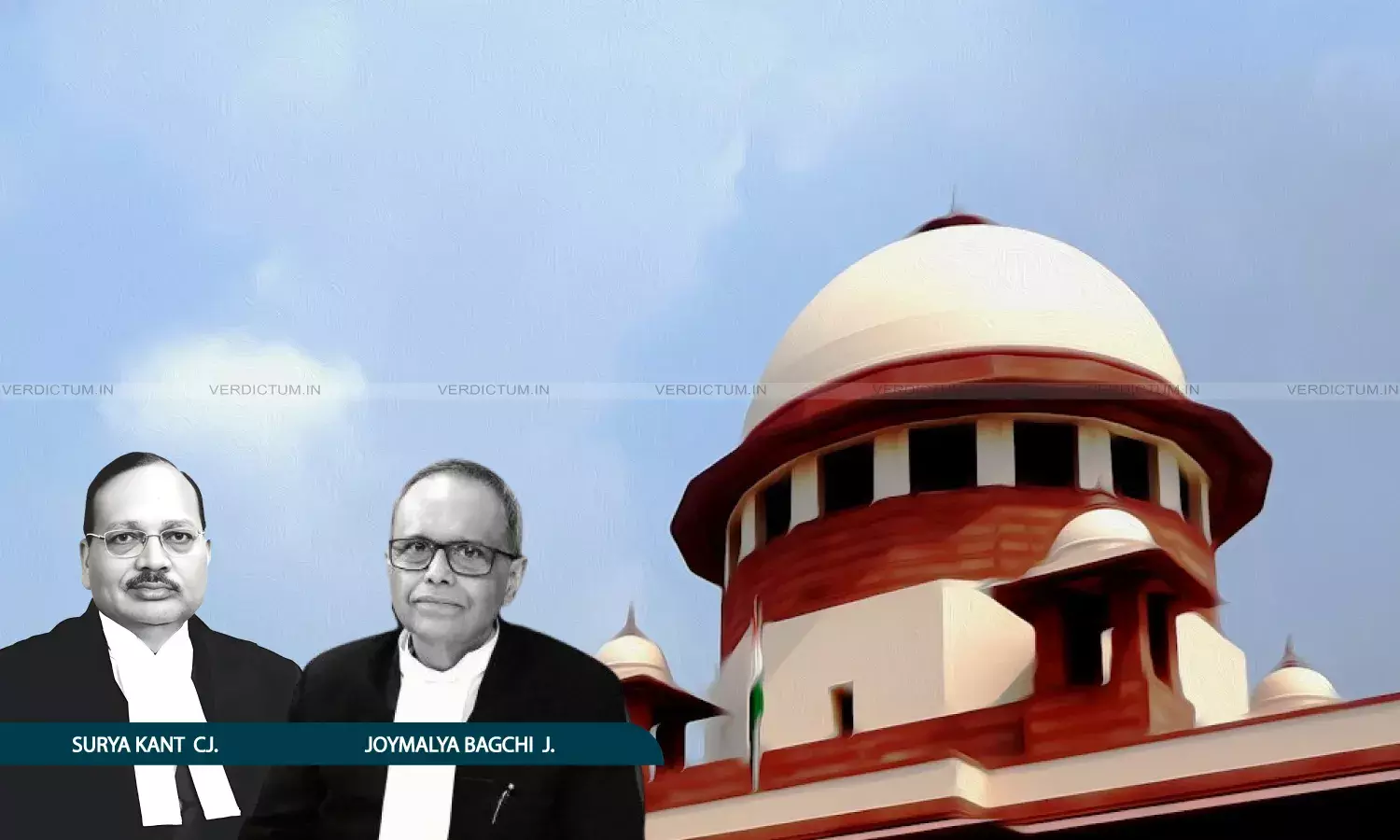
The Supreme Court has held that an Adhyaksha or Up-Adhyaksha of a Zila Parishad can be removed only when a no-confidence resolution secures the support of more than half of the total number of elected members, as mandated under Section 70(4) of the Bihar Panchayat Raj Act, 2006 (the Act). The Court clarified that the statutory requirement of majority refers to the entire elected strength of the body and cannot be interpreted as a mere majority of members present or participating in the meeting.
Holding the judgment of the High Court to be erroneous in law, the Bench also clarified that the finding would also apply analogously to Section 44(3) of the Act. On the democratic implication, the Court observed that permitting removal on the basis of attendance alone would erode the participatory rights of directly elected representatives. It held that absence of members, whether voluntary or induced, cannot reduce the statutory threshold fixed by the legislature, as such an interpretation would undermine democratic functioning and weaken institutional stability in local self-governance bodies.
Chief Justice of India Surya Kant and Justice Joymalya Bagchi while deciding appeals challenging a Full Bench decision of the High Court interpreting the scope of Sections 70(4) and 44(3) of the Act governing no-confidence motions against Zila Parishad office-bearers, observed, “We, thus, find that the text of Section 70(4) is plain and clear, and it falls in line with the underlying legislative intent. Accordingly, we hold that an Adhyaksha or Up-Adhyaksha can be removed only if the resolution of no-confidence is supported by more than half of the total number of elected members for it to pass. This interpretation is warranted not only by the expressions used in the provision but also is directed at protecting the democratic integrity of the framework of local self-governance in the State of Bihar”.
“Beyond the literal and intention-based reading of Section 70(4), there is another reason why the conclusion of the High Court cannot sustain. If the threshold re: majority required to remove an Adhyaksha or Up Adhyakasha is put into effect, it would open the doors to rampant misuse of Section 70(4) and present a real danger to democracy. We say so for the reason that the High Court’s opinion permits a no confidence motion to be passed by just a handful of elected members. Since the majority required under Section 70(4) is held to be only from those elected members who are present at the Special Meeting, if most of the elected members remain absent, the no-confidence motion may be decided by a small minority of the electorate. Such an interpretation, thus, has the potential to trigger extraordinary, anomalous situations, shaped by the specific facts of each case”, it noted further.
Senior Advocate Sharan Dev Singh Thakur appeared for the appellant and Anshul Narayan, Addl. Standing Counsel appeared for the respondent.
In the matter, the controversy was built up from no-confidence proceedings initiated against elected office-bearers of Zila Parishads, where resolutions were treated as having been validly passed despite not receiving support from more than half of the total elected members. The affected office-bearers contended that the statutory language required a higher numerical threshold and that counting only members present distorted legislative intent.
The High Court, while addressing challenges to such proceedings, had confined its consideration largely to situations involving alleged misuse or obstruction by rival political factions. It accepted the validity of the motion even where the required majority of the total elected strength had not supported it, reasoning that similar concerns could arise even when minimum numerical approval is prescribed.
Before the Supreme Court, the appellants argued that such an interpretation diluted the statutory safeguard protecting elected representatives from removal through fluctuating attendance patterns.
“The High Court’s construction of Section 70(4) of the Panchayat Act, nonetheless, effectively erodes the crucial right of each directly elected representative in the Zila Parishad to have a say on the matter of removing the Adhyaksha or Up-Adhyaksha. We need not repeat the Page 19 of 22 issues that may arise due to the meaning placed on the term ‘majority’, other than to say that the opinion of the Full Bench can lead to disproportionate consequences. A single instance of absence can render the role of an elected representative illusory. Such procedural frameworks may impair the voice of the people and consequently undermine the democratic process”, it held.
“The Impugned Judgement, thus, is likely to incentivise mischievous and mala fide attempts to surreptitiously remove elected heads, endangering democracy at the grassroots level, which would inevitably affect the entire State”, it noted further.
The Bench noted that the representative democracy in India ensures that the will of the people, expressed through elected representatives, is paramount. Panchayats strengthen this by enabling grassroots participation, and once elected, both representatives and their chosen leaders must be respected to uphold the sanctity of the electoral process.
Therefore, it observed in the judgment that “…the elected leaders in our democracy stand in as the voice of their entire constituency. Their choices carry the same weight as all the people they represent, and their decisions are considered to have been taken by the collective citizenship. It is for this reason that even the Leader of Opposition, i.e., the person whose party did not obtain the support of the larger majority of the people, is a celebrated and respected position in Indian democracy. These ideals of democracy form part of the Basic Structure of our Constitution. As such, it is incumbent on the Legislative organs to recognise these principles and give them shape through Statutes like the Panchayat Act”.
Allowing the appeals, the Bench modified the earlier decision in Dharamsheela Kumari v. Hemant Kumar 2021 SCC OnLine Pat 1276 to the extent inconsistent with its interpretation, and affirmed the decision in Sarita Kumari v. State of Bihar 2008 SCC OnLine Pat 1485. It directed that all pending and future no-confidence motions across the State under Sections 44(3) and 70(4) shall be conducted strictly in accordance with the statutory procedure and the majority threshold clarified in the judgment.
Cause Title: Rashmi Singh v. The State of Bihar and others [Neutral Citation: 2026 INSC 308]
Appearances:
Appellant: Sharan Dev Singh Thakur, Sr. Adv., Sudeep Kumar, AOR, Kumar Harshvardhan, Manisha, Rupali, Amit Pawan, AOR, Advocates.
Respondents: Anshul Narayan, Addl. Standing Counsel, Anshuman Harsh, Prem Prakash, AOR, Sarim Naved, Nand Sagar, Saurabh Sagar, Maulshree Pathak, AOR, Zeeshan Ahmad, Mohd Noumaan, Kumar Mihir, AOR, Vivek Kumar, Dr. Priyanka, Sanskriti Mishra, Akshat Srivastava, AOR, Advocates.