Chief Justice Of High Court Empowered To Appoint Additional Places Of Sitting: Supreme Court Upholds Bombay HC Notification Declaring Kolhapur As A Place Of Sitting
The Apex Court held that the power under Section 51(3) of the States Reorganisation Act, 1956, is an independent and continuing authority vested in the Chief Justice of a High Court to appoint additional places of sitting for the convenient transaction of judicial business, subject to the approval of the Governor.
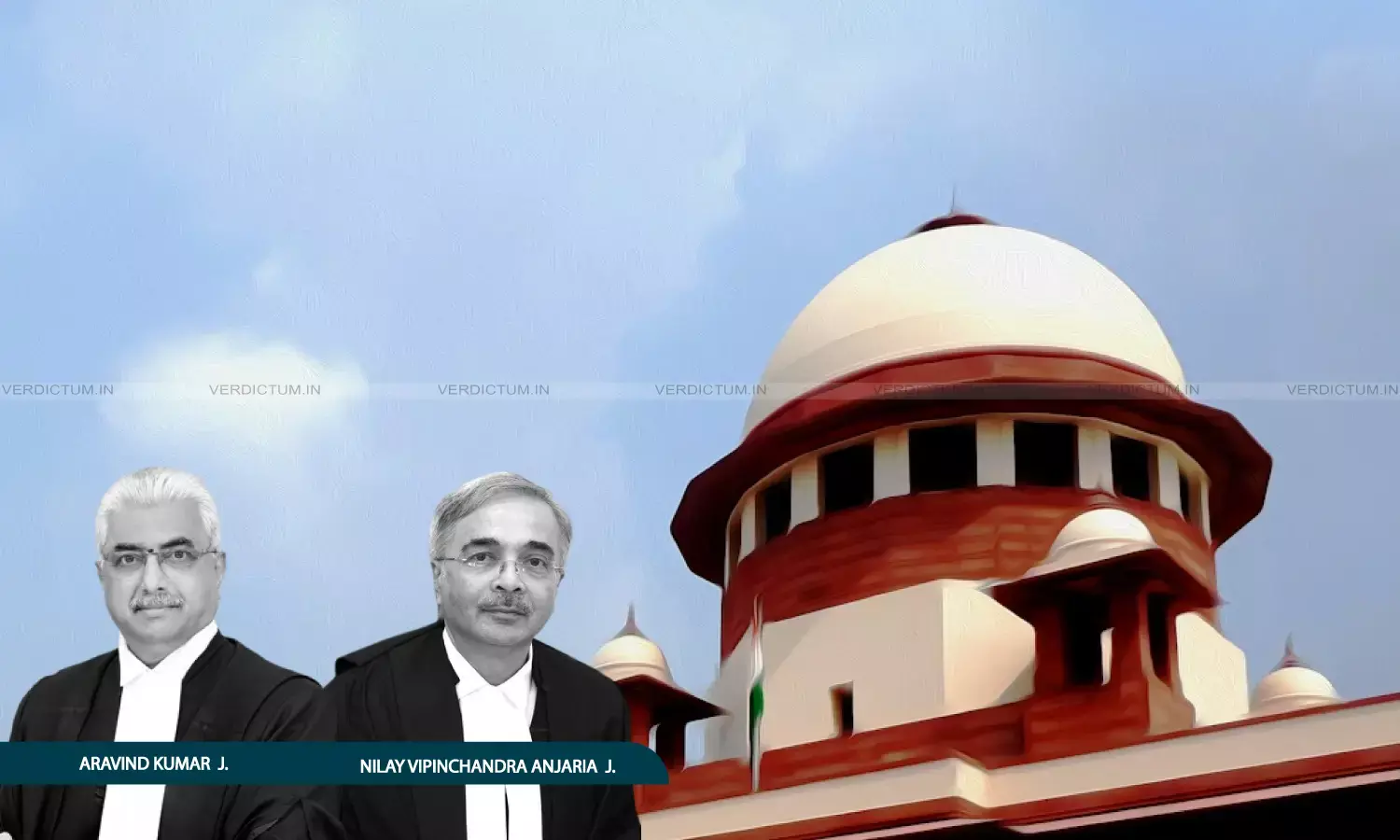
Justice Aravind Kumar, Justice N.V. Anjaria, Supreme Court
The Supreme Court has upheld an administrative notification issued by the Bombay High Court appointing Kolhapur as a place at which Judges and Division Courts of the High Court may sit, holding that the exercise of power under Section 51(3) of the States Reorganisation Act, 1956, falls squarely within the administrative domain of the Chief Justice
The Court was hearing a writ petition under Article 32 of the Constitution challenging an administrative notification issued by the Bombay High Court appointing Kolhapur as a place where Judges and Division Courts may sit, asserting that the decision effectively created a permanent additional Bench by using Section 51(3), and alleged infirmities relating to the decision-making process, consultation, and arbitrariness.
A Bench of Justice Aravind Kumar and Justice NV Anjaria, meticulously examined the scope of Section 51 and the statutory framework governing principal seats, permanent Benches, and additional places of sitting, and observed that “…the power under Section 51(3) of the States Reorganisation Act, 1956 is an independent and continuing power vested in the Chief Justice of a High Court to appoint additional places of sitting for the more convenient transaction of judicial business, subject to the approval of the Governor.”
Senior Advocate Balbir Singh appeared on behalf of the petitioner. The respondents were represented by Solicitor General of India Tushar Mehta.
Background
The petitioner had challenged an administrative notification issued by the Bombay High Court on its administrative side, appointing Kolhapur as an additional place of sitting under Section 51(3) of the States Reorganisation Act, 1956, with the approval of the Governor of Maharashtra. The arrangement was stated to have been operationalised with effect from August 18, 2025.
Court’s Observation
The Supreme Court, at the outset, noted that on a plain reading of the pleadings, the writ petition could have been dismissed “in limine” as it did not disclose any clear infringement of a fundamental right warranting interference under Article 32. It was observed that the challenge was essentially to an administrative arrangement within statutory bounds, and did not disclose an enforceable fundamental right to prevent an additional place of sitting. However, having regard to the nature of the issues raised, the Court proceeded to examine the matter on the merits and framed broad heads for analysis.
The Court examined Section 51 of the States Reorganisation Act, 1956, including the distinct role of sub-sections (1), (2) and (3). It noted that sub-section (1) concerns appointment of the principal seat, sub-section (2) contemplates establishment of permanent Benches through a Presidential order after consultation, and sub-section (3) begins with a non obstante clause enabling the Chief Justice, with the Governor’s approval, to appoint other places where Judges and Division Courts may also sit.
The Court held that the non obstante clause reflects a “conscious legislative choice to preserve, in the Chief Justice, a residuary and overriding authority to organise the sittings of the High Court in a manner that best subserves the more convenient transaction of judicial business”.
The Court rejected the contention that Section 51(3) is meant only for temporary or exceptional exigencies. It held that the statute does not speak in restricted terms and, read with Section 14 of the General Clauses Act, 1897, Section 51(3) admits of repeated and continuing exercise as circumstances demand.
The Court treated the interpretation as not res integra and relied on State of Maharashtra v. Narayan Shamrao Puranik, to emphasise that the power under Section 51(3) lies in the “unquestioned domain of the Chief Justice” subject only to the Governor’s approval, and that an appointment under Section 51(3) does not bring about territorial bifurcation.
Rejecting the contention that the continued functioning of the High Court at Kolhapur, without any fixed time limit, amounted in substance to the creation of a permanent Bench, which could only be established under Section 51(2) of the States Reorganisation Act after following the prescribed constitutional and consultative process, the Court explained that permanence, in the sense urged by the petitioner, is not a statutory criterion under sub-section (3).
The Apex Court clarified that what is determinative is the absence of territorial bifurcation of the High Court and the continued retention of administrative and judicial control with the Chief Justice, and that mere continuity of sittings at a place appointed under Section 51(3) does not, by itself, convert such an arrangement into the establishment of a permanent Bench under Section 51(2).
On the role of the Union Government, the Court held that “where Parliament contemplated the establishment of a permanent Bench involving territorial bifurcation and enduring structural consequences, it expressly vested the power in the President under sub-section (2), to be exercised after consultation with the Governor and the Chief Justice, thereby ensuring Central Government participation”.
The Apex Court, however, clarified that “in contradistinction, sub-section (3) consciously excludes any role for the Union executive and vests the power in the Chief Justice of the High Court, subject only to the approval of the Governor.”
The Court further situated the Section 51(3) power within the constitutional framework of High Court administration and reiterated that the Chief Justice is entrusted with ensuring the institution functions efficiently and coherently. It referred to Federation of Bar Associations in Karnataka v. Union of India to state that the Chief Justice is an important consultee and that when he expresses an opinion, it is the institutional opinion of the High Court, and relied on State of Rajasthan v. Prakash Chand to reiterate the primacy of the Chief Justice in administrative matters connected with distribution and management of judicial work.
Dealing with reliance on past administrative decisions and committee reports where requests for appointing other places of sitting were rejected, the Court held that administrative decisions of this nature are contextual, do not stand on the same footing as judicial determinations, and do not operate as permanent or inflexible conclusions.
The Court further clarified that administrative and policy decisions remain open to reconsideration as circumstances evolve, and that past decisions do not create an estoppel against the exercise of statutory power by a successor Chief Justice, provided the decision is bona fide, within authority, and for legitimate institutional reasons.
The Court highlighted that the statutory scheme had historically been used to address considerations of distance, litigation volume, and access to justice, including continuation of the Nagpur Bench as a permanent Bench, appointment of Aurangabad as an additional place of sitting under Section 51(3) in 1981 and its later conversion into a permanent Bench under Section 51(2), and establishment of a permanent Bench at Panaji.
The Court also noted that representations were made over time by Bar and litigant bodies from Kolhapur and adjoining districts seeking a High Court sitting in the region, pointing to the distance from the principal seat and the absence of a proximate High Court forum. It was observed that the proposal contemplated assigning cases from specified districts to the Kolhapur sitting as per the administrative directions of the Chief Justice, and that approval of the Governor was received before issuance of the notification.
Conclusion
The Supreme Court concluded that the petitioner’s challenge did not warrant interference under Article 32, stating that "...the notification has been issued in exercise of the statutory power expressly conferred by Section 51(3) of the States Reorganisation Act, 1956. The authority competent to exercise such power, namely the Chief Justice of the High Court, has acted within the bounds of the statute and has obtained the approval of the Governor, as required by law”.
Accordingly, the writ petition was dismissed.
Cause Title: Ranjeet Baburao Nimbalkar v. State of Maharashtra & Anr. (Neutral Citation: 2025 INSC 1460)
Appearances:
Petitioner: Senior Advocate Shri Balbir Singh
Respondents: Solicitor General of India Tushar Mehta; Advocate-on-Record Shri Sandeep Deshmukh; Shri Shrirang Varma and Others