

Arbitral Tribunal Can Interpret Implied Terms Or Fill Contractual Gaps Where Contract Is Silent: Supreme Court
The Apex Court restored an arbitral award after holding that an arbitral tribunal is empowered to interpret implied contractual terms or fill gaps where the contract is silent, provided such interpretation does not contradict any express provision of the contract.
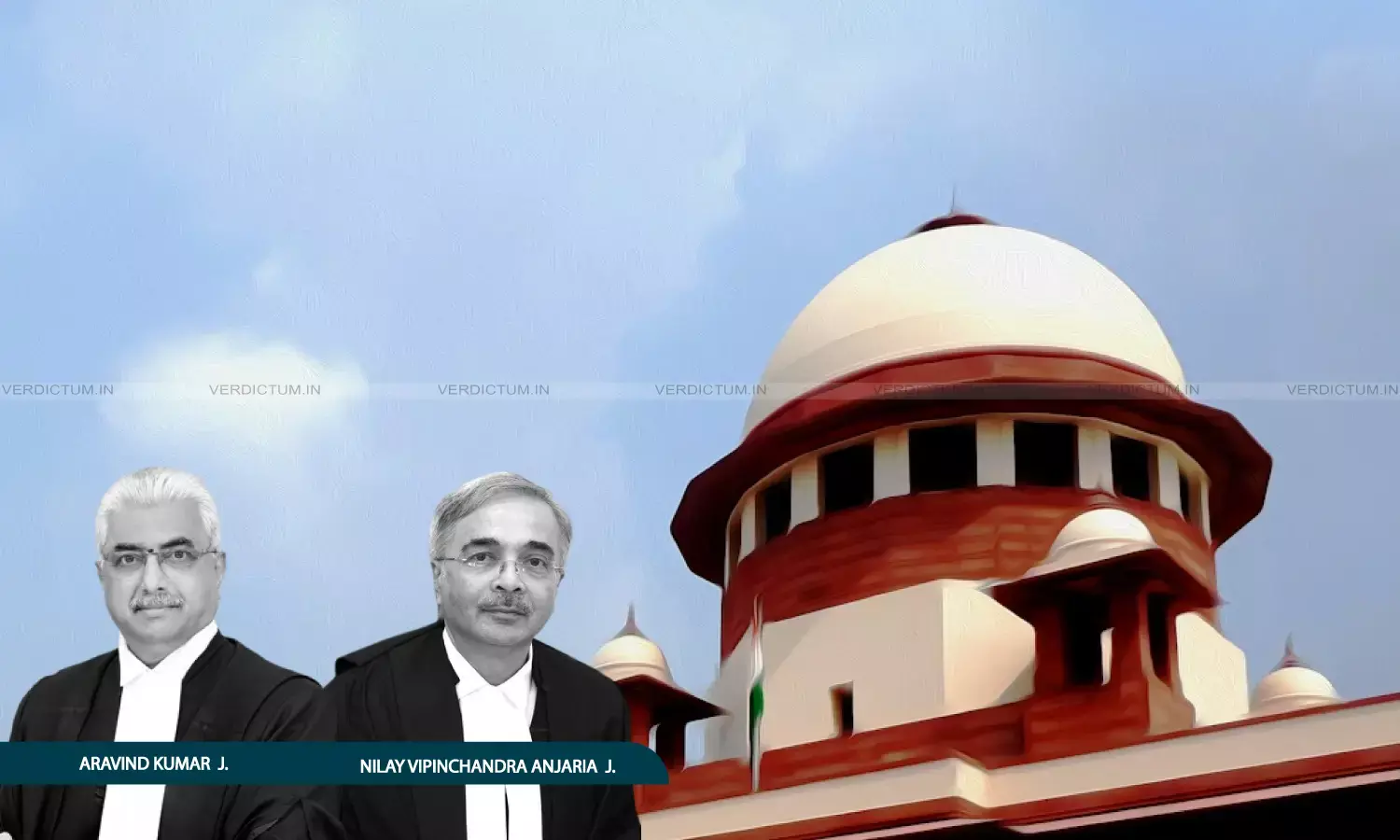
Justice Aravind Kumar, Justice N.V. Anjaria, Supreme Court
The Supreme Court has held that arbitral tribunals may interpret implied terms or fill contractual gaps where the agreement is silent, so long as such interpretation does not contradict any express stipulation.
The Apex Court also underscored that arbitration law recognises the tribunal as the master of evidence, and courts exercising jurisdiction under Sections 34 and 37 of the Arbitration and Conciliation Act, 1996, cannot interfere merely because another view is possible.
The ruling came while examining the correctness of a judgment of the Chhattisgarh High Court, which had set aside an arbitral award affirmed by the Commercial Court, on the ground of 'patent illegality'.
A Bench comprising Justice Aravind Kumar and Justice NV Anjaria observed: “It is a fundamental principle that the arbitrator cannot award anything that is contrary to the contract. The arbitrator is bound by clear stipulations inter se the parties, and an award ignoring such stipulations would violate public policy by undermining freedom of contract. However, that does not mean that not every award which gives a benefit not expressly mentioned in the contract is in violation. The arbitral tribunal in exercise of their power can very well interpret the implied terms or fill gaps where the contract is silent, so long as doing so does not contradict any express term”.
Senior Advocate Mukul Rohtagi represented the appellant, while Advocate Ravi Raghunath, AOR, represented the respondent.
Background
Bharat Aluminium Company Limited (BALCO) had invited tenders for mining and transportation of bauxite. The appellant emerged as the successful bidder and agreed with BALCO for mining and transportation of a specified quantity of bauxite at an agreed rate.
After completion of the contracted quantity, BALCO requested the appellant to continue mining and transporting additional quantities of bauxite. While the work was performed, the rate for the additional work was left open to be finalised later. Disputes subsequently arose regarding payment for the extra work, additional transportation costs, idle machinery and manpower, and delayed payments.
The disputes were referred to arbitration. The sole arbitrator passed an award allowing certain claims after assessing oral and documentary evidence, including compensation for additional work based on the principle of ‘quantum meruit’. The Commercial Court dismissed BALCO’s challenge under Section 34 of the Act and upheld the award.
However, the High Court, exercising appellate jurisdiction under Section 37, set aside the arbitral award on the ground of patent illegality, holding that the arbitrator had rewritten the contract and awarded damages based on guesswork. This led to the present appeal before the Supreme Court.
Court’s Observation
The Supreme Court commenced its analysis by reiterating that the Arbitration and Conciliation Act, 1996, is founded on the principle of minimal judicial interference, as expressly reflected in Section 5 of the Act. The Court noted that judicial scrutiny under Sections 34 and 37 is narrowly circumscribed and does not permit courts to sit in appeal over arbitral awards.
Referring to settled precedents, the Court reiterated that an arbitral award may be interfered with only on limited grounds such as contravention of public policy, patent illegality, or violation of the fundamental policy of Indian law. The Court further held that "arbitral awards are not liable to be set aside merely on the ground of erroneous in law or alleged misappreciation of evidence and there is a threshold that the party seeking for the award to be set aside has to satisfy, before the judicial body could enter into the realm of exercising its power under section(s) 34 & 37".
The Bench also explained that “patent illegality” must go to the root of the matter and cannot be invoked merely because the court disagrees with the arbitrator’s factual conclusions or contractual interpretation. An award may be interfered with, the Court explained, only where it is based on no evidence, ignores vital evidence, or is so irrational that "no reasonable person could have arrived at such a conclusion".
The Court further held that while an arbitrator is bound by the express terms of the contract, this does not prohibit interpretation of implied terms or filling gaps where the contract is silent. The Bench observed that an arbitral tribunal may do so provided such interpretation does not contradict any express contractual stipulation.
The Court while citing an example of “a contract is silent on interest on delayed payments", elaborated that "an arbitrator awarding reasonable interest is not contradicting the contract rather it is a power exercised by the arbitrator to fulfill the gap on the basis of equity which also mandated under Section 31(7)(a) of the A&C Act”.
The Court relied upon Section 70 of the Contract Act, 1872, observing that it creates an independent statutory obligation where a party enjoys the benefit of a non-gratuitous act, the arbitrator, in such circumstances, may assess reasonable compensation based on the evidence available.
Furthermore, while stating that "arbitrators are not bound by the strict rules of evidence as per Section 19 of the A&C Act and may draw on their knowledge and experience", the Apex Court held that "a court should not interfere simply because the arbitrator’s reasoning is brief or because the arbitrator did not cite chapter and verse of the contract as long as the path can be discerned by which the arbitrator arrived at his conclusions".
On the scope of Judicial interference in the re-appreciation of facts, the Court observed that "the arbitrator is considered as the master on question of facts and even an erroneous interpretation of facts would not lead us to invoke our extra-ordinary jurisdiction, the only caveat being the said interpretation of facts is patently illegal that is it is based on no evidence or beyond the scope of contract".
Applying these principles to the present case, the Court found that the arbitrator had examined oral testimony, documentary correspondence, and surrounding circumstances before allowing or rejecting individual claims. The arbitrator had not accepted the appellant’s claims wholesale but had reduced or rejected claims where evidence was insufficient.
The Supreme Court concluded that the High Court exceeded its jurisdiction under Section 37 by re-appreciating evidence and substituting its own interpretation of the contract. Such interference, the Court held, was contrary to settled law governing arbitral review.
Conclusion
In view of the foregoing analysis, the Supreme Court held that the High Court’s judgment setting aside the arbitral award could not be sustained. The appeal was accordingly allowed, the High Court’s judgment was set aside, and the order of the Commercial Court affirming the arbitral award was restored.
Case Title: Ramesh Kumar Jain v. Bharat Aluminium Company Limited (BALCO) (Neutral Citation: 2025 INSC 1457)
Appearances
Appellant: Mukul Rohatgi, Senior Advocate, with Advocates Anil Kumar Mishra-1, Aditya Jain, AOR, Sanjeevi Seshadri, Supantha Sinha, Satyam Shivaach, Mansi Gupta, and others
Respondent: Advocates Ravi Raghunath, AOR, Namanjeet Singh Bhatia
