

Dispute Ceases To Be Merely Contractual & Strikes At Root Of Arbitral Jurisdiction Where Arbitration Agreement Is Alleged To Be Forged: Supreme Court
The appeals before the Supreme Court arose from a partnership dispute in which the appellant claimed entry into the firm by virtue of a document whose execution was stoutly denied and was alleged to be forged.

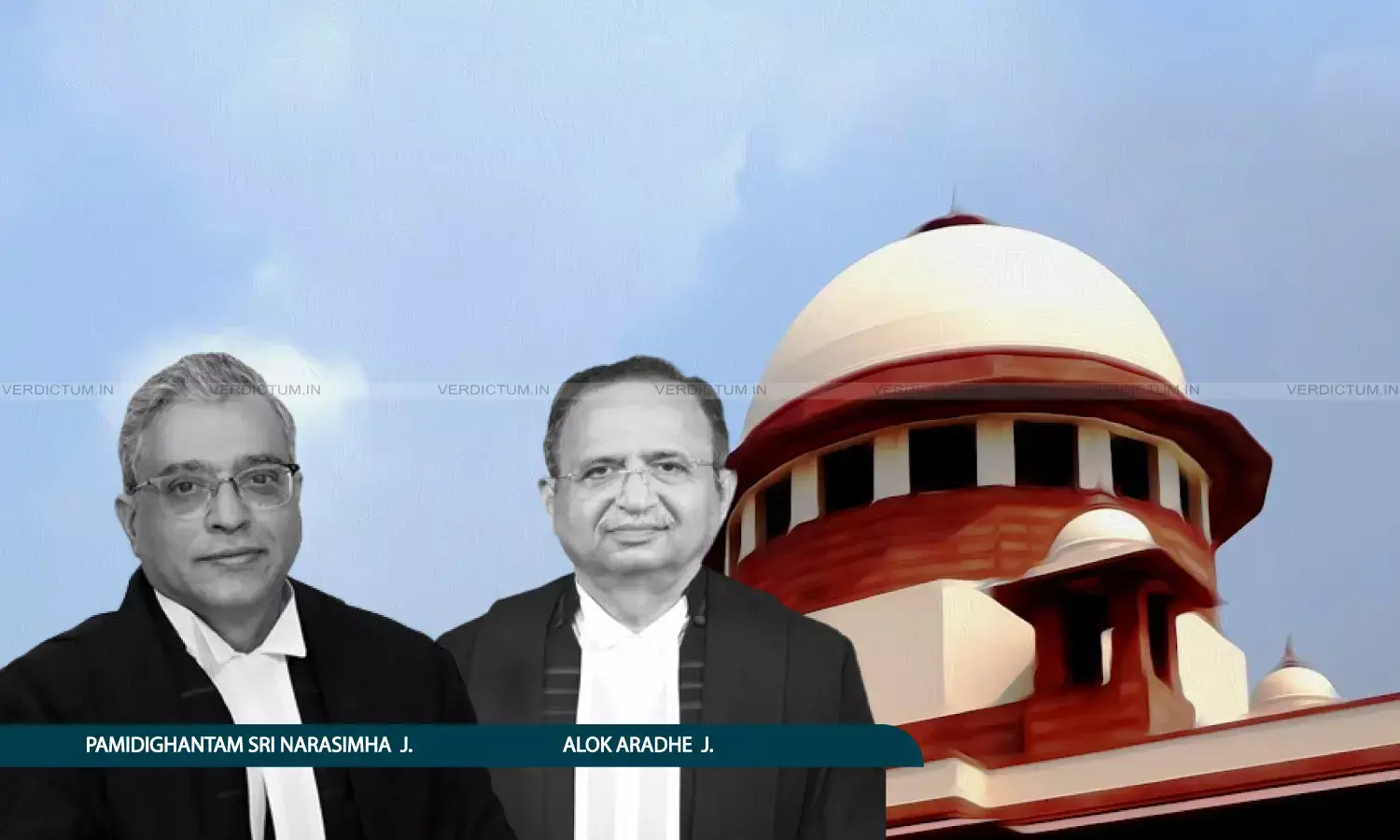
Justice Pamidighantam Sri Narasimha and Justice Alok Aradhe, Supreme Court
While dealing with a case where the arbitration clause did not exist independently but was embedded in the document whose existence was seriously disputed, the Supreme Court has held that the disputes cease to be merely contractual and strike at the very root of arbitral jurisdiction where the arbitration agreement itself is alleged to be forged or fabricated.
The appeals before the Apex Court arose from a partnership dispute in which the appellant claimed entry into the firm by virtue of a document whose execution was stoutly denied and was alleged to be forged.
The Division Bench of Justice Pamidighantam Sri Narasimha and Justice Alok Aradhe held, “A party may be bound by the arbitral process only if it is first shown, even at a prima facie level, that such a party had agreed to submit disputes to arbitration. Where the arbitration agreement itself is alleged to be forged or fabricated, the disputes ceases to be merely contractual and strikes at the very root of arbitral jurisdiction. A controversy of this nature falls squarely within the category of disputes that are generally recognized as non-arbitrable.”
Factual Background
The appellant, Barnali Mukherjee, Aftabuddin (second respondent) and Raihan Ikbal (third respondent) constituted a partnership firm styled as ‘M/s RDDHI Gold’ (firm) by virtue of a partnership deed. Rajia Begum (first respondent) claimed that the other two respondents executed a power of attorney empowering her to manage the affairs of the firm on their behalf, pursuant to which she executed a deed of admission and retirement (Admission Deed) by which the two respondents retired from the firm. The appellant contended that the business of the reconstituted partnership firm was absorbed and taken over by a company named RDDHI Gold Pvt. Ltd. (company) pursuant to the absorption deed. The first respondent issued a notice to the appellant asserting that she had acquired an interest to the extent of 50.33% in the erstwhile partnership firm, and the second and third respondents had retired as partners. The appellant took a stand that the Admission Deed was a forged and fabricated document, concocted by the first respondent.
The first respondent applied to the Trial Court under Section 9 of the Arbitration and Conciliation Act, 1996 (Act), for preservation of the subject matter of dispute and for appointment of a receiver for the Company, which came to be allowed. The appellant filed a civil suit before the competent civil court seeking the relief of declaration and injunction against the first respondent, seeking a declaration that the ‘Admission Deed’ is a forged document. The respondent, in the said suit, preferred an application to the Trial Court under Section 8, to refer the suit to arbitration, which was dismissed. In appeal, the High Court allowed the revision filed by the first respondent by referring the dispute for resolution through arbitration. The first respondent had also filed a petition under Section 11 seeking the appointment of an arbitrator to resolve the disputes between the parties, but the same was dismissed. In the appeal, the appellant assailed the judgment by which the petition filed by the first respondent under Article 227 was allowed and the title suit filed by the appellant was referred to arbitration.
Reasoning
Dealing with the aspect of the impact of fraud on the arbitrability of a dispute under the Act, the Bench explained that in a case where a plea is taken with regard to the nonexistence of an arbitration clause or agreement, the same would amount to a serious allegation of fraud and would render the subject matter of an agreement non-arbitrable “Thus, it is evident that when an allegation of fraud is made with regard to arbitration agreement itself, such a dispute is generally recognised as a dispute, which is in the realm of nonarbitrability and the court will examine it, as a jurisdictional issue only to enquire whether the dispute has become nonarbitrable due to one or the other reason”, it stated.
The Bench took note of the fact that in the proceedings under Section 9 of the Act, the High Court had recorded a prima facie finding that the existence of the Admission Deed was doubtful and declined to grant interim protection. The Bench gave considerable credence to the contention of the appellant that the Admission Deed was not genuine. “At the very least, the Admission Deed is under grave cloud of doubt, requiring a detailed and full-fledged inquiry. In the present case, arbitration clause does not exist independently but is embedded in the document whose existence is seriously disputed. Arbitration, it bears reiteration, is founded upon consent”, it added.
The Bench held, “While findings in Section 9 proceedings are undoubtedly prima facie in nature, such findings, when they attain finality, cannot be ignored in subsequent proceedings founded on the very same issue. The prima facie satisfaction recorded by the High Court regarding the doubtful existence of the arbitration agreement was, therefore, a relevant consideration while examining applications under Sections 8 and 11 of the Act.”
As per the Bench, both the Trial Court and the First Appellate Court had concurrently held that the allegations of fraud in the present case were serious and the first respondent had failed to produce the original Admission Deed or a certified copy thereof, as required under Section 8(2). “The aforesaid findings were not perfunctory, but were grounded in the material on record and in the statutory requirements”, it stated while also adding, “When the existence of the arbitration agreement itself is in serious dispute and requires adjudication, appointment of an arbitrator would be premature and legally impermissible.”
Thus, quashing the order of the High Court allowing the first respondent’s application under Section 8, the Bench allowed the appellant’s appeal.
Cause Title: Rajia Begum v. Barnali Mukherjee (Neutral Citation: 2026 INSC 106)