Presumption Of Innocence Ends After Conviction; Suspension Of Sentence In Murder Cases To Be Granted Only In Exceptional Circumstances: Supreme Court
The Apex Court set aside the Patna High Court’s order suspending the life sentence of a convict in a murder case, holding that once a conviction is recorded, the presumption of innocence ceases to operate and that suspension of sentence in cases under Section 302 IPC can be granted only in rare and exceptional situations.
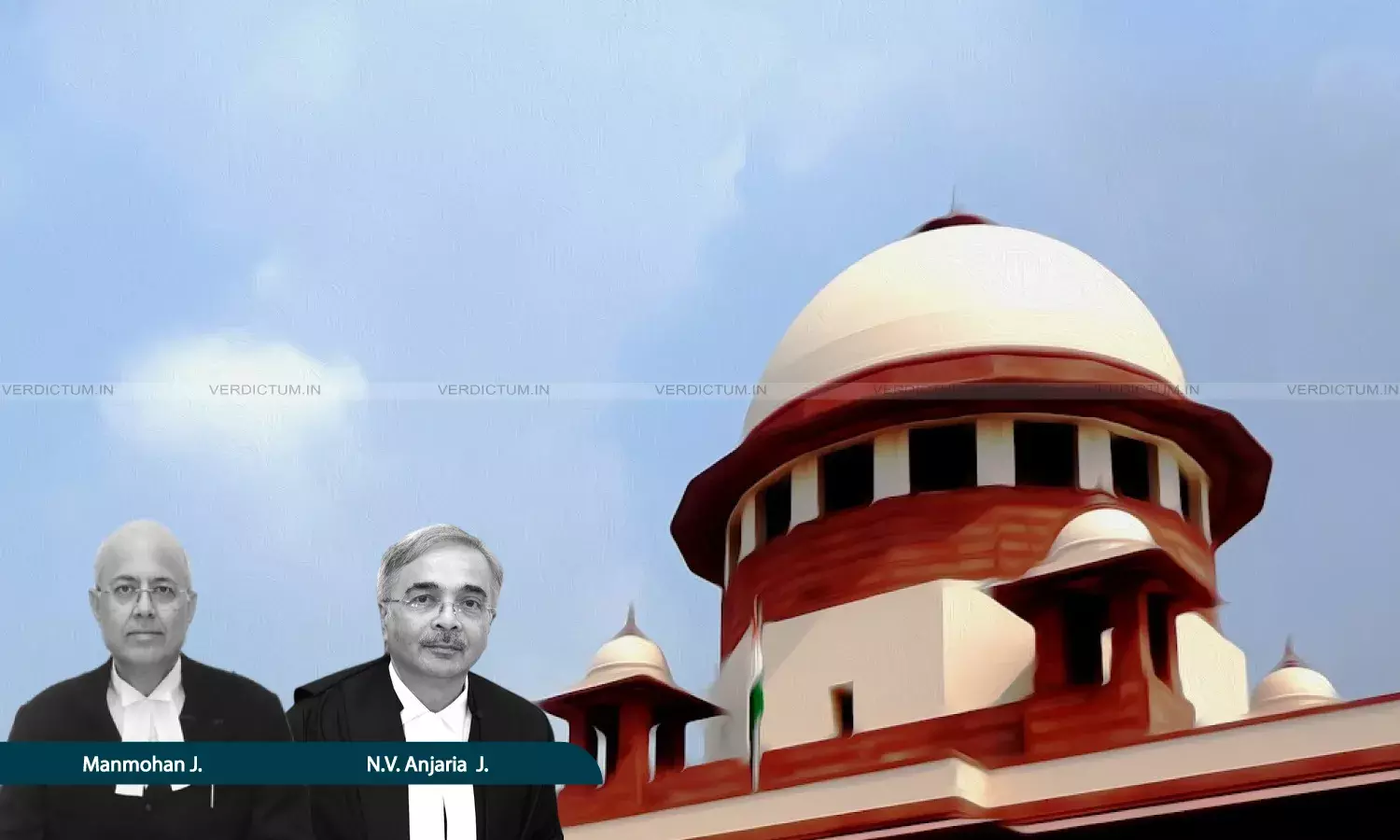
Justice Manmohan, Justice N.V. Anjaria, Supreme Court
The Supreme Court has reiterated that the presumption of innocence does not survive once an accused stands convicted after trial, emphasising that suspension of sentence in cases involving murder convictions must be an exception rather than the rule.
The Court was dealing with an appeal challenging orders of the Patna High Court, which had suspended the sentences of two convicts, each sentenced to life imprisonment under Section 302 read with Section 149 of the Indian Penal Code, during the pendency of their criminal appeals.
A Bench comprising Justice Manmohan and Justice NV Anjaria, while stating that “the presumption of innocence of the accused which is a principle applied in criminal jurisprudence, holds good only until the accused is tried, once the accused is convicted at the end of the trial, the presumption of innocence does not continue”, further reiterated that “the benefit of suspension of sentence, if at all to be granted in the cases involving conviction under Section 302, IPC, it has to be only in exception cases.”
Advocate Adarsh Kumar Tiwari, AOR, appeared on behalf of the petitioners, while Anshul Narayan, Addl. Standing Counsel represented the respondents.
Background
The case arose from the murder of the father of the appellant-informant, inside a village temple. According to the prosecution, the deceased and the informant had gone to the temple to perform rituals when a group of accused persons, armed with firearms and other weapons, arrived at the spot, hurled abuses, and forcibly entered the temple.
During the incident, the deceased was caught hold of by some of the accused, while one of them fired at him with a revolver. The present respondents, though not alleged to have fired the fatal shot, were stated to be armed and to have instigated the killing by exhorting others to shoot the deceased. After the incident, all the accused fled the scene. The deceased was declared dead at the hospital.
An FIR was registered, the investigation was completed, and charges were framed. The Trial Court convicted the respondents for offences including Section 302 read with Section 149 IPC and Section 27 of the Arms Act, sentencing them to life imprisonment along with other sentences for allied offences.
During the pendency of their criminal appeals, the Patna High Court suspended their sentences and released them on bail, primarily because their role was limited to instigation, there was a delay in forwarding the FIR to the Magistrate, and the original inquest report was not produced. These orders were challenged before the Supreme Court by the informant.
Court’s Observations
The Supreme Court began by examining the scope and parameters of Section 389 of the Code of Criminal Procedure, which governs suspension of sentence pending appeal. The Court reiterated that suspension of sentence is conceptually distinct from the grant of bail and that such power cannot be exercised as a matter of routine, particularly after a conviction for serious offences.
The Bench emphasised that the presumption of innocence, which protects an accused during trial, ceases once the trial culminates in a conviction. After conviction, the appellate court is not to proceed on the assumption that the accused continues to be innocent. Consequently, the standards for suspending a sentence after conviction are significantly higher.
Relying on settled precedents, the Court held that appellate courts must not reappreciate evidence or search for minor inconsistencies at the stage of considering suspension of sentence. The focus must instead remain on the nature of the offence, the manner of its commission, the role attributed to the convict, and whether any exceptional circumstances exist which would justify suspension.
The Court referred to and reaffirmed the principle that in cases involving conviction under Section 302 IPC, suspension of sentence can be granted only in exceptional cases. It noted that life imprisonment stands on a different footing from fixed-term sentences, and that suspension in such cases requires the convict to demonstrate a “gross or palpable error” in the judgment of the Trial Court.
Applying these principles to the facts, the Court found that the High Court had erred in treating the respondents’ role as insignificant. The evidence on record showed that the respondents were present at the scene, armed with firearms, had instigated the killing, and fled together with the principal assailant.
The Bench further held that the High Court’s reliance on the delay in forwarding the FIR and the non-production of the original inquest report was misplaced. These factors, according to the Supreme Court, had “no bearing on the credibility of the prosecution's case”, which had already been evaluated and accepted by the Trial Court after a full-fledged trial.
Reiterating settled law, the Court held that once a murder conviction has been recorded, suspension of sentence cannot be justified unless the case falls within clearly identifiable exceptional circumstances. No such circumstances were found to exist in the present matter.
Conclusion
Holding that the Patna High Court had failed to exercise its jurisdiction under Section 389 CrPC in accordance with settled principles, the Supreme Court set aside the orders suspending the sentences of the respondents.
The Court directed the convicts to surrender within ten days and ordered the police authorities to ensure their incarceration in accordance with the law.
The appeals were accordingly allowed, with the Court clarifying that its observations were confined solely to the issue of suspension of sentence and would not influence the final adjudication of the pending criminal appeals on merits.
Cause Title: Rajesh Upadhyay v. The State of Bihar & Anr (Neutral Citation: 2025 INSC 1468)
Appearances
Appellant: Advocates Adarsh Kumar Tiwari, Vinit Pathak, Vartika Maurya
Respondents: Anshul Narayan, Additional Standing Counsel, Advocates Vineeta Singh, Ashutosh Chaturvedi, Anshuman Harsh, Prem Prakash, AOR and Others