

Vacancies Notified As Open, Unreserved Or General Not Reserved For Any Caste, Tribe, Class Or Gender: Supreme Court
The Supreme Court reiterated that the concept of “equality before law” ingrained in Article 14 of the Constitution contemplates elimination of inequalities in status, facilities, and opportunities not only amongst individuals but also amongst groups of people.
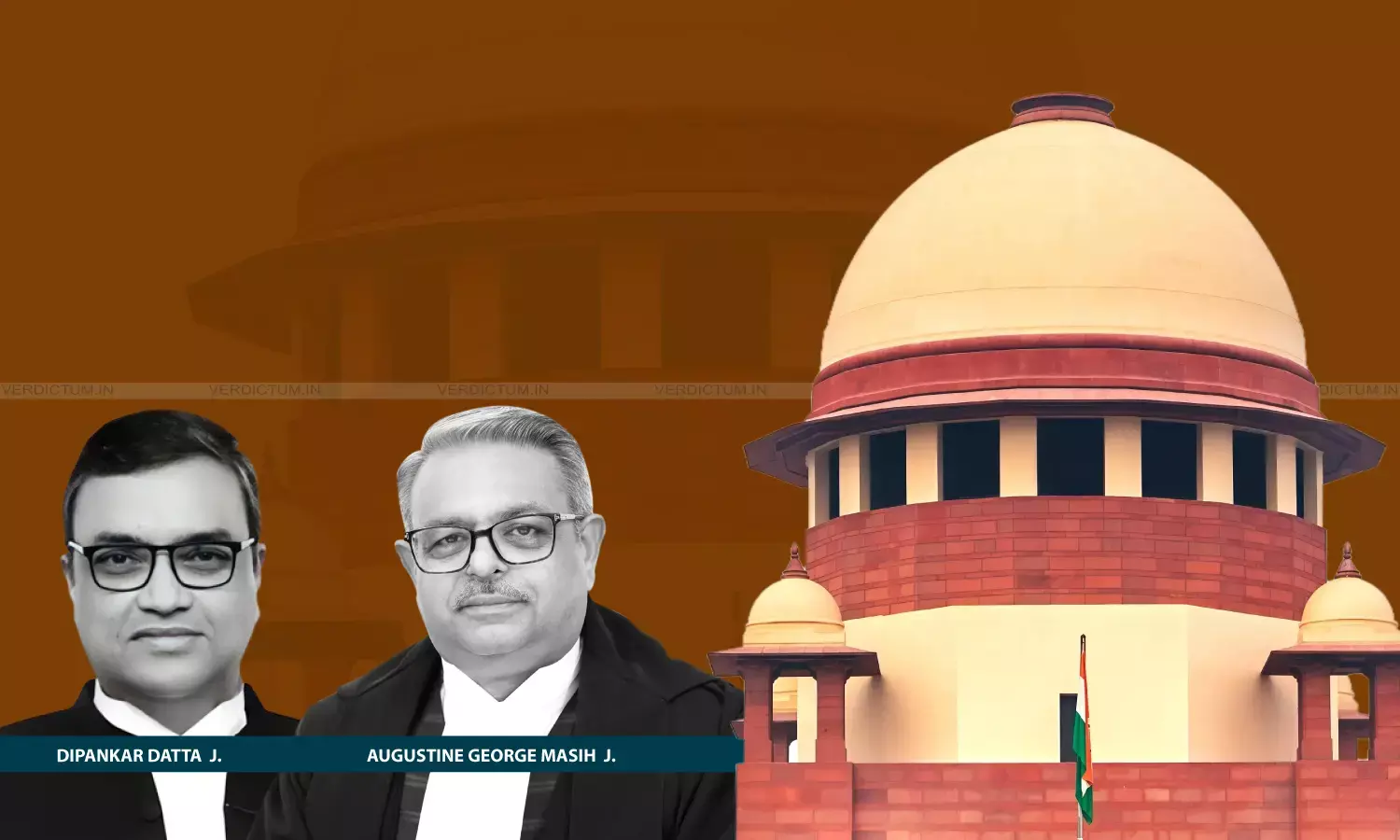
Justice Dipankar Datta, Justice Augustine George Masih, Supreme Court
The Supreme Court has reemphasized that the vacancies on posts which are notified/advertised as open or unreserved or general, are not reserved for any caste/tribe/class/gender.
The Court was deciding Civil Appeals filed by the administration of the Rajasthan High Court and its Registrar, challenging the Order of the Division Bench, which allowed a Writ Petition.
The two-Judge Bench comprising Justice Dipankar Datta and Justice Augustine George Masih observed, “Drawing inspiration from the guiding light provided by Indra Sawhney (supra) and Saurav Yadav (supra), we hold that the word ‘open’ connotes nothing but ‘open’, meaning thereby that vacant posts which are sought to be filled by earmarking it as ‘open’ do not fall in any category. One does find categories like ‘open’ or ‘unreserved’ or ‘general’ being widely used in course of recruitment drives but they are meant to signify the open/unreserved vacant posts on which any suitable candidate can be appointed, regardless of the caste/tribe/class/gender of such candidate. For all intents and purposes, the vacancies on posts which are notified/advertised as open or unreserved or general, as the terms suggest, are not reserved for any caste/tribe/class/gender and are, thus, open to all notwithstanding that a cross-section of society can also compete for appointment on vacant posts which are ‘reserved’ – vertical or horizontal – as mentioned in the notification/advertisement.”
The Bench reiterated that the concept of “equality before law” ingrained in Article 14 of the Constitution of India contemplates, inter alia, elimination of inequalities in status, facilities and opportunities not only amongst individuals but also amongst groups of people and is aimed at securing the educational and economic interests of the weaker sections of the society and to protect them from social injustice and exploitation.
Senior Advocate Nidhesh Gupta appeared on behalf of the Appellants, while Senior Advocates K.S. Chauhan and P.S. Teji appeared on behalf of the Respondents.
Brief Facts
The Rajasthan District Courts Ministerial Establishment Rules, 1986 were framed to regulate appointments and conditions of service in the ministerial establishments of the District Courts. Thereafter, the Rajasthan High Court Staff Service Rules, 2002 were notified on 5th December, 2002, providing for recruitment to the post of Junior Judicial Assistant/Clerk Grade-II by way of a competitive examination comprising two stages, viz. a written test and a computer-based typewriting test. In pursuance thereof, on 5th August, 2022, the High Court issued an advertisement. Applications were invited for appointment on 2756 vacancies in the posts of Junior Judicial Assistant/Clerk Grade-II in the High Court, the Rajasthan State Judicial Academy, the District Courts and allied institutions, including the Legal Services Authorities and Permanent Lok Adalats. The vacancies were distributed category-wise across General, Scheduled Caste (SC), Scheduled Tribe (ST), Other Backward Class (OBC), Most Backward Class (MBC), Economically Weaker Section (EWS), and horizontal reservation for various other categories.
The Respondents had applied pursuant to the advertisement and since they were found prima facie eligible, the Appellants permitted them to appear in the written test. Significantly, the cut-off marks for various reserved categories like SC, OBC-NCL, MBC-NCL and EWS were higher than the cut-off marks provided for the General category. The Respondents, belonging to different reserved categories, secured marks in the written test in excess of the cut-off marks for the General category candidates. Despite securing marks in excess of the cut-off marks for the General category candidates, the Respondents belonging to different reserved categories were treated as aspirants who could compete for the reserved posts only and not the posts which were ‘general’; hence, much to their shock and dismay, they did not figure in the list of successful candidates, eligible to take the typewriting test on computer from their own reserved category in the short-listing process. Relative merit of the reserved category candidates was, thus, given a complete go-bye. Being aggrieved, one of the Respondents instituted a Writ Petition and the High Court allowed the same. This was under challenge before the Apex Court.
Court’s Observations
The Supreme Court in view of the above facts, said, “The equal protection clause urges affirmative action for those who are placed unequally. Affirmative action is also recognised by Article 16. Then again, Article 335 thereof provides for special consideration in the matter of claims of the Scheduled Castes/Scheduled Tribes for public employment. The entire field of law relating to affirmative action is so well occupied by authoritative decisions that we consider it unnecessary to burden this judgment by referring to the same. What particularly concerns us in these appeals is not a sterile invocation of formal legal equality, but an assessment of the real-world consequences flowing from the principle of equality. The focus, therefore, must be on outcomes as much as on rules.”
Turning to the dictionary meaning of the word ‘migration’, the Court noted that the same typically refers to the act of moving from one place to another, often involving a change of residence or location.
“This can apply to various contexts like human migration, animal migration, data migration, etc. In general, migration involves a change of location, often with the intention of settling or establishing a new presence in the new location”, it added.
The Court was of the view that in the context of reservation in public employment, the word ‘migration’ refers to a candidate claiming benefits or entitlements.
“At this stage, there is no question of any migration; merit is the only criterion amongst all candidates who have to be seen as belonging to General/Open category. Once ‘C’ gains the ‘pass’ for the second-tier process and qualifies in the typewriting test on computer obtaining marks in excess of the requisite marks, his/her marks obtained in such test would be required to be added to the marks obtained in the written test”, it observed.
The Court remarked that once again, a broad-sheet has to be prepared based on cumulative scores containing names of all the candidates in order of highest to lowest marks with the more meritorious candidates, figuring at the top.
“Preparation of this broad-sheet is a handy tool for drawing up the final merit list of candidates. From the broad-sheet, names of candidates drawn up in order of merit with candidates ranked according to their marks in descending order, commonly called the Combined Merit List, ought to reflect where each one of the aspiring candidates stand on merit”, it further said.
Coming to the facts of the case, the Court held that there has been no ‘migration’, in the sense of either an adjustment or a shift being made.
“At the time of screening/short-listing of candidates based on their performance in the qualifying examination and even thereafter, initially all the aspiring candidates including the reserved candidates should be seen as General/Open candidates. If such a candidate, notwithstanding that he/she belongs to a reserved category maintains excellence in standard even in the second tier of examination (typewriting test, in this case), he/she would cease to be treated as a candidate belonging to any category and entitled to treatment as a candidate seeking appointment on a vacant post which is categorised as General/Open”, it also noted.
Conclusion
Moreover, the Court observed that no law – either rule or executive instruction – has been shown which prevented the High Court from treating the reserved candidates as General/Open candidates once it transpired that they outshone the latter and question of any migration or deriving twin benefits of migration did not and could not arise in the circumstances.
“If we accept the proposition advanced by the appellants, it would not only have a detrimental impact on candidates from the disadvantaged sections but also erode the principles enshrined in the Constitution. … We appreciate the proactive stance of the Division Bench of the High Court while it rectified a situation where the High Court itself was found to contravene constitutional ideals”, it concluded.
Accordingly, the Apex Court dismissed the Appeals and upheld the impugned Order.
Cause Title- Rajasthan High Court & Anr. v. Rajat Yadav & Ors. (Neutral Citation: 2025 INSC 1503)
Appearance:
Appellants: Senior Advocate Nidhesh Gupta, AOR Mukul Kumar, Advocates Kartik Seth, Shilpa Saini, Raghav Sharma, Shubhankar Singh, Lakshmi Kant Srivastava, K. M. Abish, Ashutosh Anand, and Minesh Joshi.
Respondents: Senior Advocates K.S. Chauhan, P.S. Teji, AORs Avinash Sharma, Ajit Kumar Ekka, Amit, Advocates Ravi Prakash, Abhishek Chauhan, R.S.M. Kalky, R.K. Chauhan, S.P. Singh, Sunil Kumar, Ravi Shankar Singh, Ramesh Kumar, Aditi Chauhan, Nav Parkash Singh Teji, Himanshu Jain, Sandeep Malik, Ajit Kumar, Bhim Kishore, Prabjeet Sandhu, Satpal, and Rishi Raj Maheshwari.
