

Violations Of Building Plans Fall Outside National Green Tribunal’s Jurisdiction U/S 14 Of NGT Act: Supreme Court
The Supreme Court held that allegations relating to violations of sanctioned building plans, in the context of construction of commercial premises, do not fall within the jurisdiction of the National Green Tribunal under Section 14 of the National Green Tribunal Act.
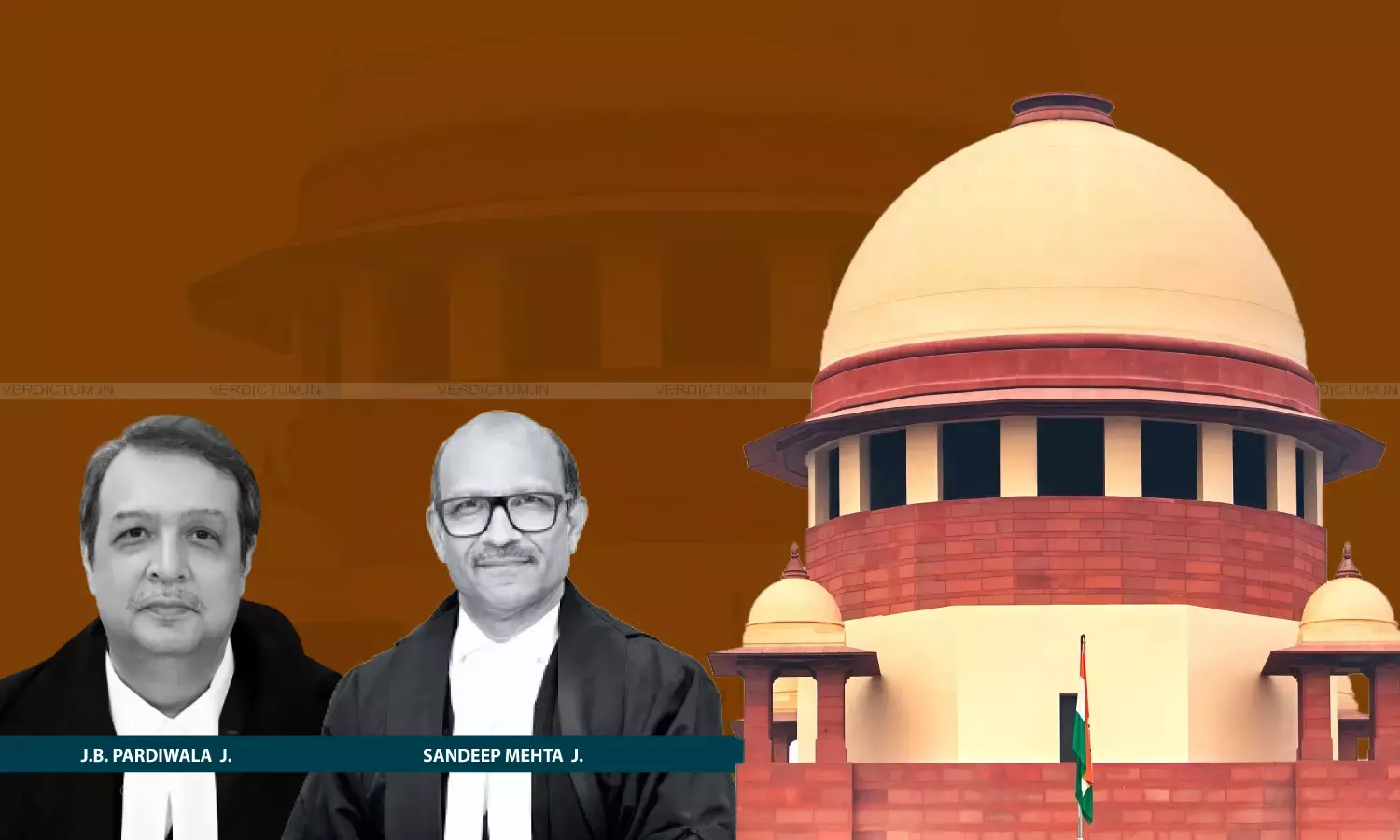
Justice J.B. Pardiwala, Justice Sandeep Mehta, Supreme Court
The Supreme Court held that the National Green Tribunal cannot interfere with issues concerning alleged violations of building plans in relation to the construction of commercial premises, as such matters fall beyond the scope and purview of proceedings under Section 14 of the National Green Tribunal Act.
The Court further held that hat the NGT exceeded its jurisdiction in entertaining issues relating to alleged violations of building plans, when the legality of a change in land use was already under scrutiny before the High Court in pending writ proceedings.
A Bench of Justice JB Pardiwala and Justice Sandeep Mehta, upon examining the material placed on record, observed: “…as the matter relating to alleged illegality in change of land use was already under scanner in the writ petition filed before the High Court in the year 2015, the NGT was not justified in interfering with the issues concerning violation of building plans in relation to the construction of commercial premises. We also feel that the aforesaid issues are beyond the scope and purview of the proceedings before the NGT under Section 14 of the NGT Act.”
Background
The dispute arose in relation to the construction of certain commercial premises situated in Gurgaon, Haryana, including Leela Ambience Hotel, Ambience Mall/Ambience Commercial Tower, and Ambience Lagoons, in respect of which allegations were raised regarding illegal change of land use and violations of sanctioned building plans.
Earlier, in the year 2015, writ petitions had already been filed before the High Court challenging the alleged illegality in the change of land use. Those proceedings remained pending and were under active judicial consideration.
Despite this, proceedings were initiated before the National Green Tribunal, raising issues relating to violations of building plans and construction norms. The NGT proceeded to examine these issues and passed directions affecting the construction activities.
Aggrieved by the NGT’s interference, the appellants approached the Supreme Court, contending that the Tribunal had acted beyond the scope of its jurisdiction under the National Green Tribunal Act.
Court’s Observation
The Supreme Court examined the scope of Section 14 of the National Green Tribunal Act, which confers jurisdiction upon the NGT to adjudicate substantial questions relating to the environment arising out of the implementation of specified enactments.
The Court observed that the core issue relating to the alleged illegality in the change of land use was already under judicial scrutiny before the High Court since 2015. In such circumstances, the Apex Court stated that the NGT was not justified in interfering with the issues.
The Bench further observed that issues relating to violations of sanctioned building plans, particularly when linked to land use disputes already pending before the High Court, do not fall within the purview of Section 14 of the NGT Act.
Referring to its previous decision in Auroville Foundation v. Navroz Kersasp Mody (2025), the Apex Court, while finding favour with the contention raised by the appellant that the NGT had acted without jurisdiction, observed that “the issue of environment was not a substantial question before the NGT thereby justifying the invocation of jurisdiction by the NGT in this matter”.
In Auroville, the Apex Court had clarified that “every question or dispute raised by an applicant before the Tribunal pertaining to the environment cannot be treated as a substantial question. It has to be a substantial question relating to the environment as contemplated in Section 2(1)(m), and such a substantial question must arise out of the implementation of any of the enactment/enactments specified in Schedule I.”
The Supreme Court concluded that “viewed in light of the aforesaid precedent, a serious doubt arises as to the jurisdiction of the NGT to entertain the original application”.
Conclusion
Holding that the National Green Tribunal had acted beyond its jurisdiction, the Supreme Court allowed the appeals and stayed the impugned orders passed by the NGT.
The Court directed that the proceedings before the NGT shall remain in abeyance till the disposal of the aforesaid Civil Writ Petition before the High Court.
Furthermore, the Court directed that the report of the Joint Expert Committee, which recommended the imposition of a fine/environmental compensation, withholding 25–50% of profits, and possible demolition of the commercial complex, shall not be acted upon for now.
The appeals were, accordingly, disposed of.
Cause Title: Raj Singh Gehlot & Ors. v. Amitabh Sen & Ors. (Neutral Citation: 2026 INSC 77)
Appearances
Appellants: Advocates Samar Vijay Singh, AOR, Preetika Dwivedi, AOR, Abhisek Mohanty, Ansh Rajauria; M/s Karanjawala & Co., AOR & Others
Respondents: Tushar Mehta, Solicitor General of India; Aishwarya Bhati, A.S.G., along with other appearing Counsel.
