"Evidence Suffered From Material Discrepancies": Supreme Court Upholds Acquittal In 1996 Murder Of Army Captain
The Apex Court reiterated the settled principles governing interference with an order of acquittal, emphasising that unless the conclusions are perverse or unreasonable, appellate interference is unwarranted.
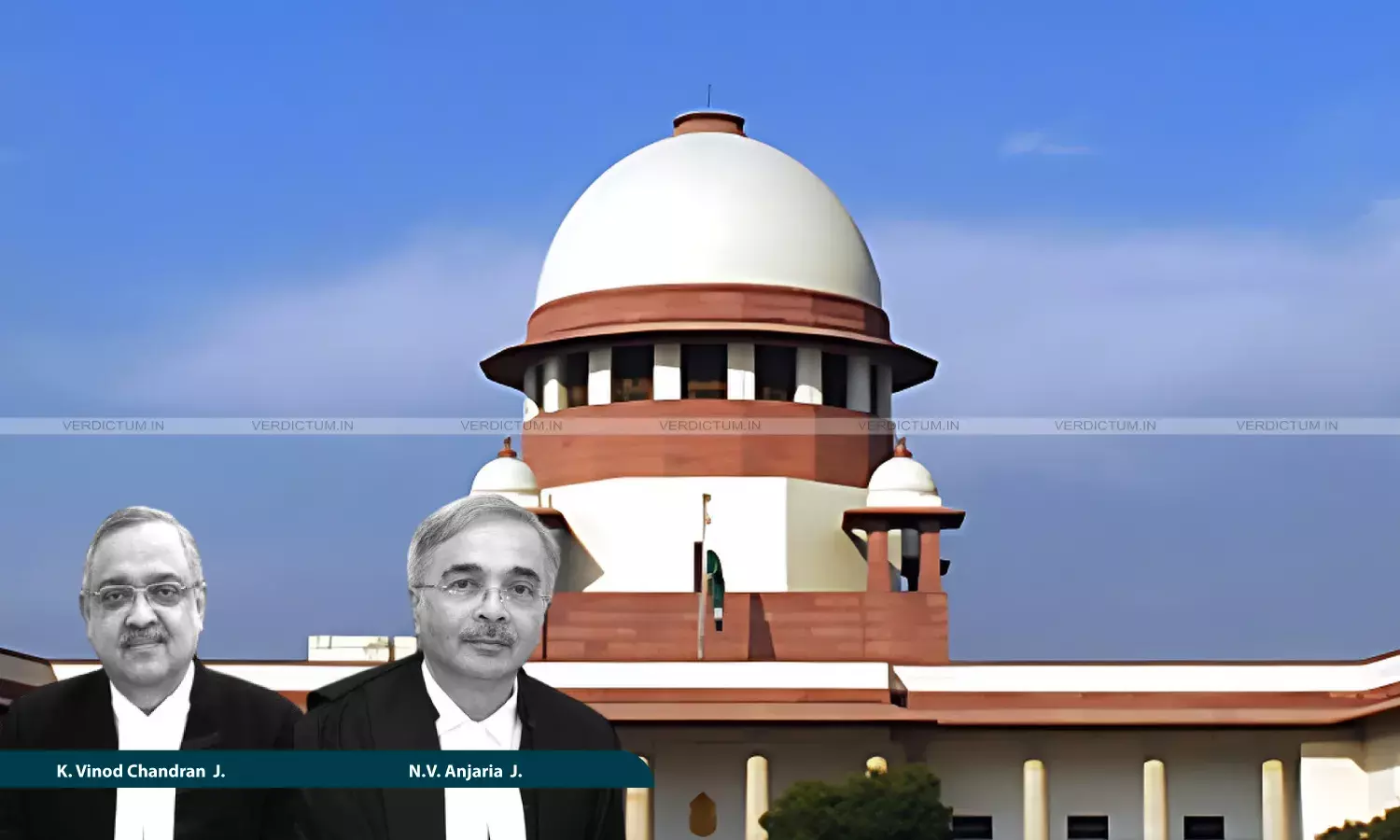
Justice K. Vinod Chandran, Justice NV Anjaria, Supreme Court
The Supreme Court has upheld the acquittal of three accused persons in a 1996 murder case involving an Indian Army officer, holding that the prosecution evidence suffered from material discrepancies and that the High Court had taken a plausible view while reversing the conviction.
The Court was hearing an appeal filed by the original complainant challenging the judgment of the Allahabad High Court, which had set aside the conviction and life sentence imposed on the accused for the murder of an Army Captain during a family property dispute.
The appeal arose from the acquittal of the accused persons, who the Trial Court had earlier convicted under Section 302, read with Section 34 of the Indian Penal Code, for the murder of Captain Praveen Kumar.
The Bench comprising Justice K. Vinod Chandran and Justice N.V. Anjaria, upon a careful re-appreciation of the oral, documentary and medical evidence placed on record, observed that “the reading by the High Court is a plausible reading justifying the conclusion…and does not appear to this Court to be in any way unreasonable or one which would warrant substitution by this Court”.
Advocate Nagendra Singh appeared on behalf of the appellant, while Advocate Yadav Narendra Singh, AOR, appeared on behalf of the respondent.
Background
The prosecution's case was that the deceased, an Army Captain, was murdered by his uncle and cousins following a long-standing dispute over the partition of family property. It was alleged that during a village panchayat convened to resolve the dispute, heated exchanges took place, after which the deceased was allegedly dragged to a staircase and shot at, resulting in his death.
Initially, an offence under Section 307 IPC was registered, which was later converted into one under Section 302 IPC after the deceased succumbed to his injuries. The Trial Court relied primarily on the testimony of the complainant-father and another eyewitness to convict the accused and impose life imprisonment.
On appeal, the Allahabad High Court reversed the conviction, holding that the prosecution's evidence was riddled with inconsistencies and improbabilities. Aggrieved by the acquittal, the complainant approached the Supreme Court.
Court’s Observation
The Supreme Court examined the reasoning adopted by the High Court in detail when acquitting the accused. It noted that the High Court had found serious inconsistencies between the earliest version of events and the subsequent statements made by the complainant. The Court observed that crucial allegations, including the use of a hockey stick and the exact role of each accused, were either absent or materially altered in later versions.
The Bench concurred with the High Court’s finding that the prosecution's story did not inspire confidence, particularly the claim that a serving Army Captain could have been forcibly dragged for several steps by three persons, one of whom was a 65-year-old cancer patient. The Court noted that the physical improbability of this version was a relevant factor in assessing credibility.
It was further observed that the alleged possession and use of firearms by the accused were not satisfactorily explained. The prosecution failed to establish how and from where the weapons were procured at the relevant time, and no ballistic examination was conducted to link the recovered firearm with the fatal injuries. This lapse was considered significant in a case resting heavily on circumstantial and eyewitness evidence.
The Court also highlighted contradictions between the village chowkidar’s initial report and the complainant’s subsequent complaint, particularly regarding who fired the fatal shot. These inconsistencies, according to the Court, struck at the root of the prosecution's case and undermined its reliability.
Reiterating settled principles, the Court relied upon Shivaji Sahabrao Bobade v. State of Maharashtra to emphasise the distinction between “may be proved” and “must be proved,” underscoring that a criminal conviction requires proof beyond a reasonable doubt.
The Court further referred to Chandrappa v. State of Karnataka, reaffirming that once an accused is acquitted, the presumption of innocence stands reinforced and appellate courts should be slow to interfere unless there are substantial and compelling reasons.
The Bench observed that where two reasonable views are possible on the evidence, the view favouring the accused must ordinarily prevail. It held that the High Court’s appreciation of evidence was plausible and did not suffer from perversity or manifest illegality.
Conclusion
Finding no merit in the challenge to the acquittal, the Supreme Court held that the High Court was justified in reversing the conviction and acquitting the accused. The appeal was accordingly dismissed, and the acquittal of the respondents was affirmed.
Cause Title: Raj Pal Singh v. Rajveer & Ors. (Neutral Citation: 2025 INSC 1442)
Appearances
Appellant: Advocates Nagendra Singh, Mukesh Kumar, Srikant Singh, Abhijit Singh, Rajinder Pal Singh, Vishwa Pal Singh, AOR.
Respondents: Advocates Yadav Narender Singh, AOR, Abhisth Kumar, AOR.