

Supreme Court Confirms Conviction Of Excise Constable In 1990 Corruption Case, Reduces Sentence Citing Old Age
The Supreme Court was considering a criminal appeal filed against the final judgment passed by the Uttarakhand High Court, sustaining the order of the accused's conviction under Section 7 & 13(2) of the Prevention of Corruption Act.

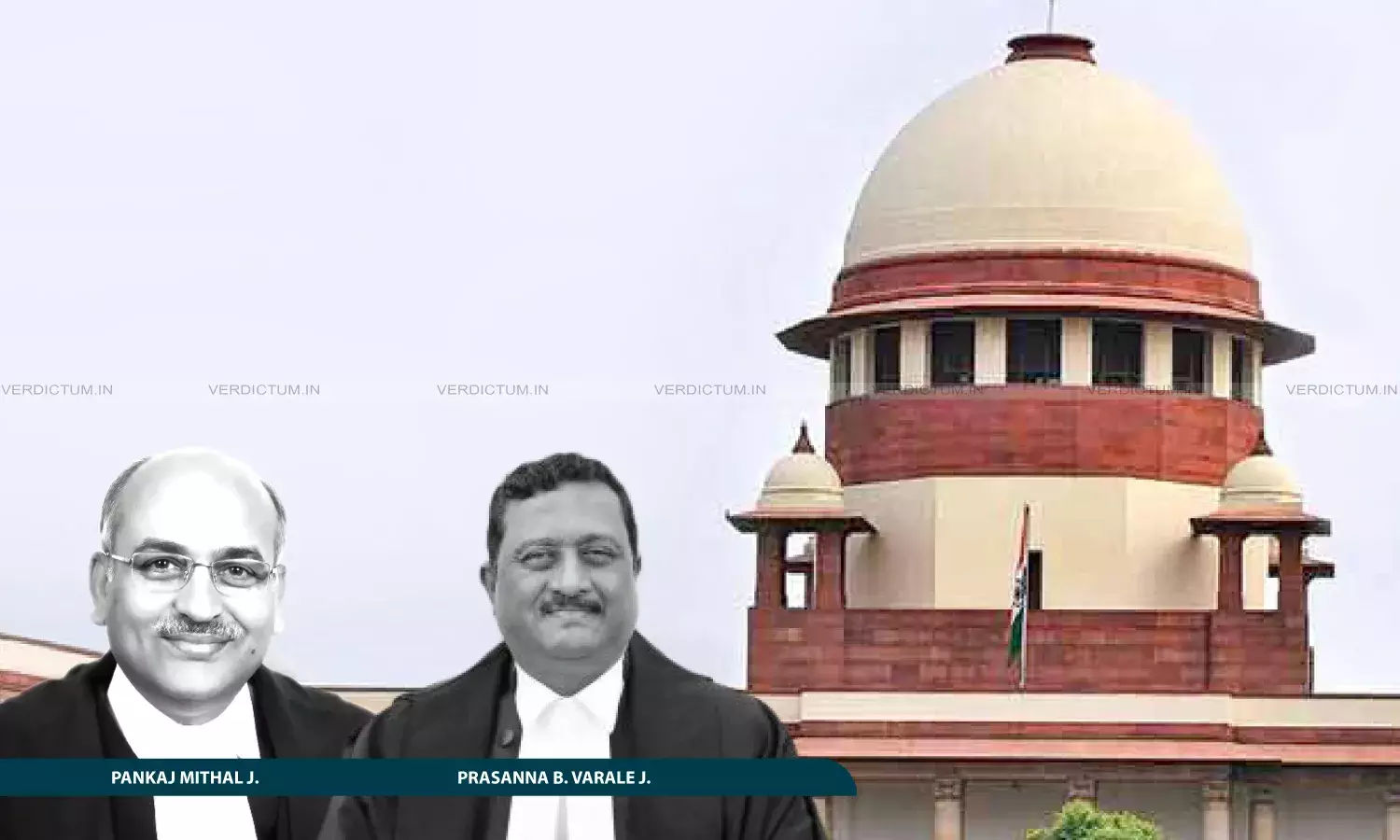
Justice Pankaj Mithal, Justice Prasanna B. Varale, Supreme Court
The Supreme Court has upheld the conviction of a 75-year-old excise constable in a case of corruption while reducing his sentence after taking note of his old age and the period of incarceration already undergone by him. The case revolved around accepting a bribe from the complainant, who was involved in the business of manufacturing contraband liquor and was challenged by the excise party on previous occasions.
The Apex Court was considering a criminal appeal filed against the final judgment passed by the Uttarakhand High Court, sustaining the order of conviction and sentence passed by the Trial Court under Section 7 & 13(2) of the Prevention of Corruption Act, 1988 (P.C. Act).
The Division Bench of Justice Pankaj Mithal and Justice Prasanna B. Varale stated, “As such, the interference of this Court insofar as conviction being recorded by the Trial Court and upheld by the High Court is not warranted, but at the same time considering the circumstances namely, the appellant was of the age of approximately 40 years at the time of offence in question and now, he is approximately 75 years of age; considering the material, particularly, order of this Court dated 21.08.2012 whereby this Court refused the appellant exemption from surrendering, the surrender certificate dated 15.10.2012 whereby the appellant surrendered and subsequently, the order of this Court dated 07.01.2013 whereby the bail was granted to the appellant, the appellant was behind the bars for the period of approximately 2 months and 24 days. Considering these facts, we are of the opinion that the sentence awarded by the Trial Court and upheld by the High Court can be modified to the extent of minimum sentence for the said offences namely, rigorous imprisonment of 6 months for the offence under Section 13 7 of P.C. Act and rigorous imprisonment of 1 year for the offence under Section 13(2) of P.C. Act.”
AOR Manika Tripathy represented the Appellant, while AOR Akshat Kumar represented the Respondent.
Factual Background
The accused appellant was serving as a Constable in the Excise Department in District Udham Singh Nagar, Uttarakhand. The complainant, Kashmir Singh, was allegedly involved in the business of manufacturing contraband liquor and was challenged by the Excise party on three previous occasions. On the fourth occasion, during a raid on the complainant's village, the complicity of the complainant in the said crime was also noticed. It was alleged that the complainant was asked to sign some papers by the appellant and was threatened that if Rs 500 of illegal gratification was not given, then a Challan would be forwarded to the competent Court. The complainant filed a complaint with the Superintendent of Police (Vigilance), and a trap was organised at a restaurant. As a prelude to the trap, the complainant handed over five currency notes of the denomination of Rs. 100 each to the Inspector, who tainted these currency notes with “Phenolphthalein Powder” in the presence of 2 independent witnesses.
A trap party, which included a police team along with 2 independent witnesses, went inside the restaurant and, in the presence of the complainant, recovered five currency notes of the denomination of Rs 100 from the appellant. Appellant’s hands were then soaked in Sodium Carbonate solution, which turned pinkish, confirming the presence of phenolphthalein powder. A memo of action taken on the spot was prepared, and the appellant was taken into judicial custody. The Trial Court convicted the appellant to undergo R.I. for one year and pay a fine of Rs. 1,000, under Section 7, and to undergo R.I. for two years and pay a fine of Rs. 2,000, and in default of payment of fine, to further undergo S.I. for 30 days for the offence under Section 13(2). The High Court dismissed the appeal, sustaining the conviction. Aggrieved thereby, the appellant approached the Apex Court.
Reasoning
Considering the judgment of the Trial Court as well as the High Court, the Bench noted that the same showed that the complainant, along with the raiding party, went to the restaurant. The act of handing over the currency notes to the accused and acceptance of the currency notes, and thereafter, the hands and the currency notes being exposed to water turned pink, showing the trace of phenolphthalein powder, was also recorded in the duly drawn panchnama.
Addressing the claims relating to the shadow witness being an interested witness, the Bench stated, “Perusal of the testimony of this witness shows that PW-2 in his deposition before the Court stated that the complainant, Kashmir Singh is not his relative but person of his knowledge. Now, merely on the statement that PW-2 had an acquaintance with PW-1, one cannot jump to the conclusion that PW-2 was an interested witness. To brand the witness as an interested witness, the defence is required to bring specific material before the Court showing the hostility of the particular witness.”
The Bench also took note of the fact that the complainant had stated before the Court that he was indulged in the liquor trade and action was already initiated against him three times, and he was released on bail.
The Bench thus held, “Thus, considering all abovementioned aspects, we are of the opinion that the learned Trial Court as well as High Court on appreciation of evidence, committed no error in holding the appellant guilty for the offences committed under Section 7 and Section 13(2) of P.C. Act.”
Considering the fact that the appellant was approximately 40 years old at the time of the offence in question and now, he is approximately 75 years of age and has been behind the bars for the period of approximately 2 months and 24 days, the Bench modified the sentence of the appellant to rigorous imprisonment of 6 months for the offence under Section 7 and rigorous imprisonment of 1 year for the offence under Section 13(2) of P.C. Act.
Cause Title: Raj Bahadur Singh v. State of Uttarakhand (Case No.: Crl.A. No.-001105-001105 - 2013)
Appearance
Appellant: AOR Manika Tripathy
Respondent: AOR Akshat Kumar, Advocate Vikas Negi