

Supreme Court Quashes FIR And Criminal Proceedings Against Karnataka Leader Of Opposition R Ashoka In Land Allotment Case
The Apex Court held that the continuation of criminal proceedings, where prior inquiries had found no material against the accused, clubbed with the fact that the prosecution was initiated without a mandatory sanction, would be unsustainable in law.
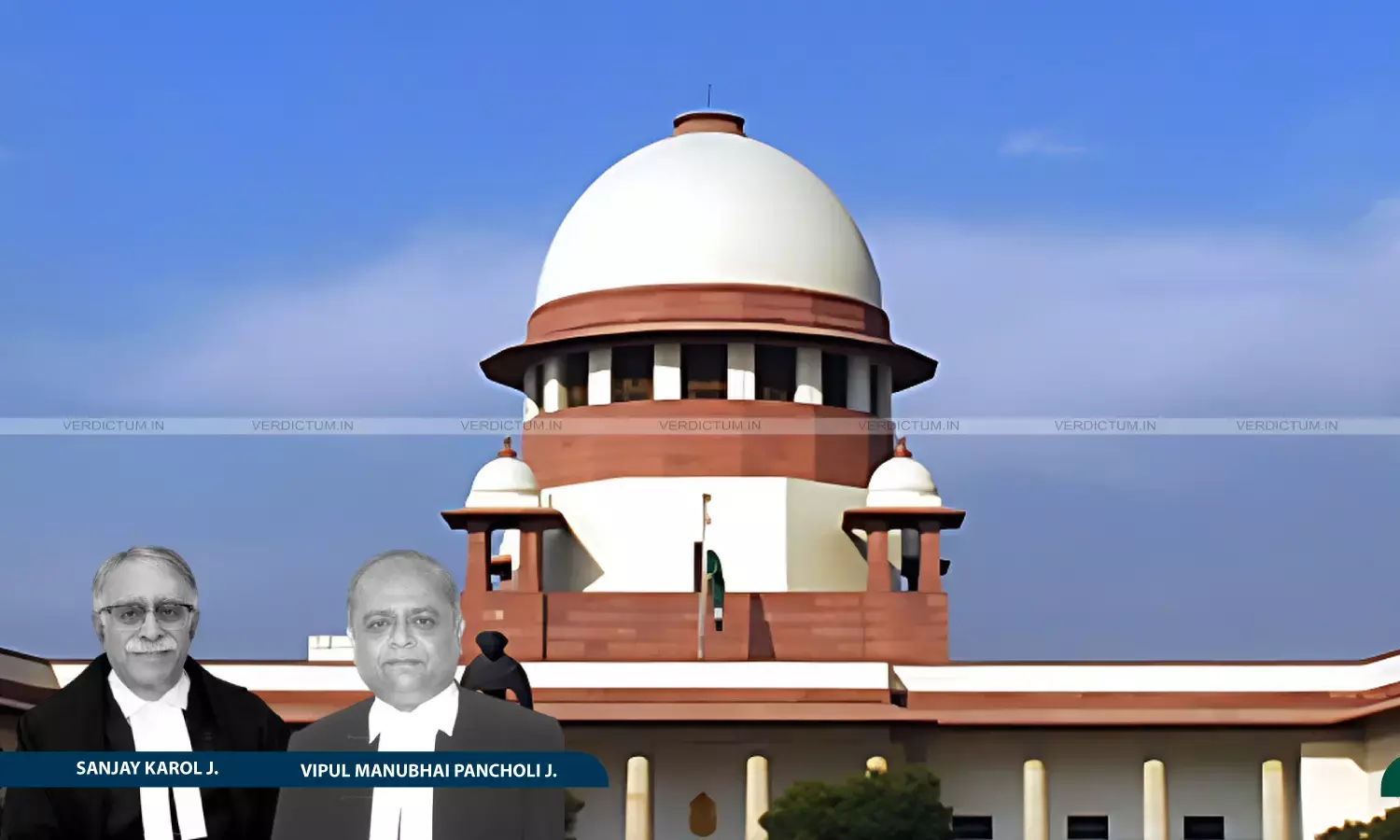
The Supreme Court has quashed the First Information Report and all criminal proceedings initiated against R. Ashoka, Leader of the Opposition in the Karnataka Assembly, in connection with alleged irregularities in the allotment of government land by a committee for the regularisation of unauthorised occupation in the State of Karnataka.
The Apex Court was hearing criminal appeals arising out of writ proceedings in which the appellant had sought quashing of an FIR registered by the Anti-Corruption Bureau following complaints alleging arbitrary and illegal grant of land to ineligible persons.
The appeals challenged the judgment of the Karnataka High Court, which had declined to interfere with the FIR and the investigation initiated thereunder.
A Bench comprising Justice Sanjay Karol and Justice Vipul M. Pancholi, while observing that “three aspects point to the subject complaint and FIR being bad in law – absence of sanction, malice and administrative/judicial recognition, approval of the allotment of land”, accordingly held that “the FIR subject matter of the present case deserves to be quashed and set aside”.
Senior Advocates Mukul Rohatgi and P.B. Suresh represented the appellants and the respondents, respectively.
Background
The appellant had served as Chairman of a Committee for Regularisation of Unauthorised Occupation during a specified period. Allegations were made that land meant for economically disadvantaged persons and members of the Scheduled Castes and Scheduled Tribes had been allotted to ineligible persons.
A complaint was first made before the Karnataka Lokayukta, which, after inquiry, concluded that the allegations against the appellant were unfounded and recommended closure. A revised inquiry was later conducted on the same allegations, which again resulted in closure for want of evidence.
Several years thereafter, fresh complaints were lodged before the Anti-Corruption Bureau alleging similar irregularities. Based on a preliminary inquiry, an FIR was registered against the appellant and others, prompting the appellant to approach the High Court seeking the quashing of the FIR. The High Court declined to interfere, leading to the present appeals before the Supreme Court.
Court’s Observation
The Supreme Court, at the outset, underscored that allotment of land by the State to economically disadvantaged persons is not an act of charity but a discharge of constitutional obligations rooted in the Directive Principles of State Policy. The Court emphasised that land, being a scarce and vital public resource, is held by the State in trust for the people and its distribution must conform to constitutional mandates of fairness, equality, and non-arbitrariness under Articles 14, 38, and 39.
The Court reiterated that discretionary powers relating to the allocation of public land are circumscribed by constitutional limitations. Relying on decisions such as E.P. Royappa v. State of Tamil Nadu, Maneka Gandhi v. Union of India, and Ramana Dayaram Shetty v. International Airport Authority of India, the Court observed that State action must be transparent, rational, and guided by objective criteria, and any departure therefrom would invite judicial scrutiny.
Turning to the scope of quashing jurisdiction, the Court extensively referred to State of Haryana v. Bhajan Lal, State of Karnataka v. M. Devendrappa, and Pradeep Kumar Kesarwani v. State of Uttar Pradesh, reiterating that inherent powers to quash criminal proceedings must be exercised sparingly but are justified where continuation of proceedings would amount to abuse of process or would not serve the ends of justice.
On the merits of the case, the Apex Court examined the role and jurisdiction of the Lokayukta, noting that while its functions are investigative and recommendatory in nature, it had, on two occasions, found no material to proceed against the appellant on substantially identical allegations.
A significant factor considered by the Court was the absence of a mandatory sanction. The Court held that where allegations relate to acts having a reasonable nexus with official duties, prosecution cannot be initiated without sanction. It noted that the applicable Government Order expressly barred even the commencement of investigation by the Anti-Corruption Bureau without prior approval, and the record was silent on any such sanction. Consequently, the preliminary inquiry, FIR, and all subsequent proceedings were held to be vitiated.
The Court also examined allegations of mala fides. After analysing the sequence of repeated complaints filed after long intervals, the identity of complainants, and the political context reflected on record, the Court held that the prosecution appeared to be afflicted by malice. Relying on State of Punjab v. Gurdial Singh, State of Punjab v. V.K. Khanna, W.B. SEB v. Dilip Kumar Ray, and Ratnagiri Gas & Power (P) Ltd. v. RDS Projects Ltd., the Court reiterated that mala fides must be established from surrounding circumstances and that repeated attempts to revive settled issues may indicate abuse of power.
The Court further noted that certain land allotments forming the subject matter of the allegations had already received judicial or administrative approval, reinforcing the conclusion that the prosecution could not be sustained.
Conclusion
The Supreme Court, accordingly, concluded that the FIR and criminal proceedings against the appellant were legally unsustainable due to the absence of a sanction, repeated complaints on the same cause of action despite prior closure, and circumstances pointing to mala fide initiation of proceedings.
Accordingly, the appeals were allowed, and the FIR, along with all consequential proceedings, were quashed. The Court also extended the same relief to the co-appellant whose allotment had been upheld in earlier proceedings.
Cause Title: R. Ashoka v. State of Karnataka & Ors. (Neutral Citation: 2025 INSC 1441)
Appearances
Appellants: Senior Advocates Mukul Rohatgi and Sajan Poovayya, with Advocate Gaurav Agrawal
Respondents: Senior Advocates P.B. Suresh and Harin P. Rawal, with Advocate Aman Pawar
